Review by Rudy Vega ·
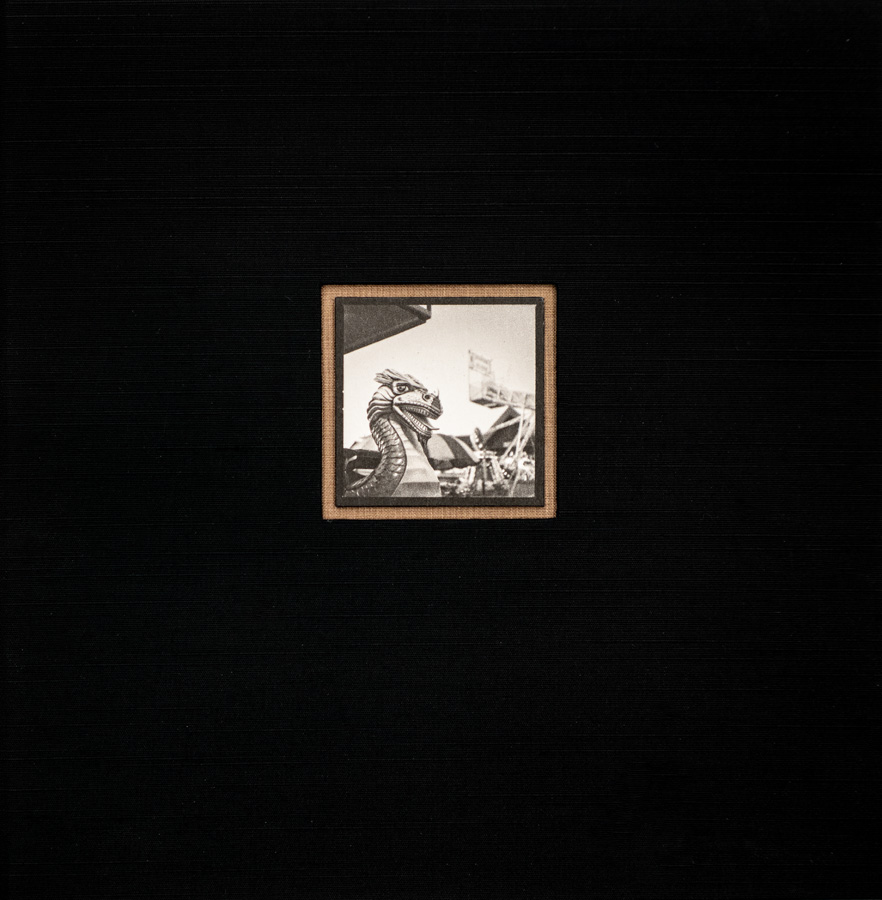
Sean Perry’s Fairgrounds is a modest book in scale but not in feeling. There are no crowds, no bright over the top color, and no appetite for nostalgia as popular entertainment. Instead, the book treats the fairground as a site of afterimage and projection: a place to re-enter through atmosphere.
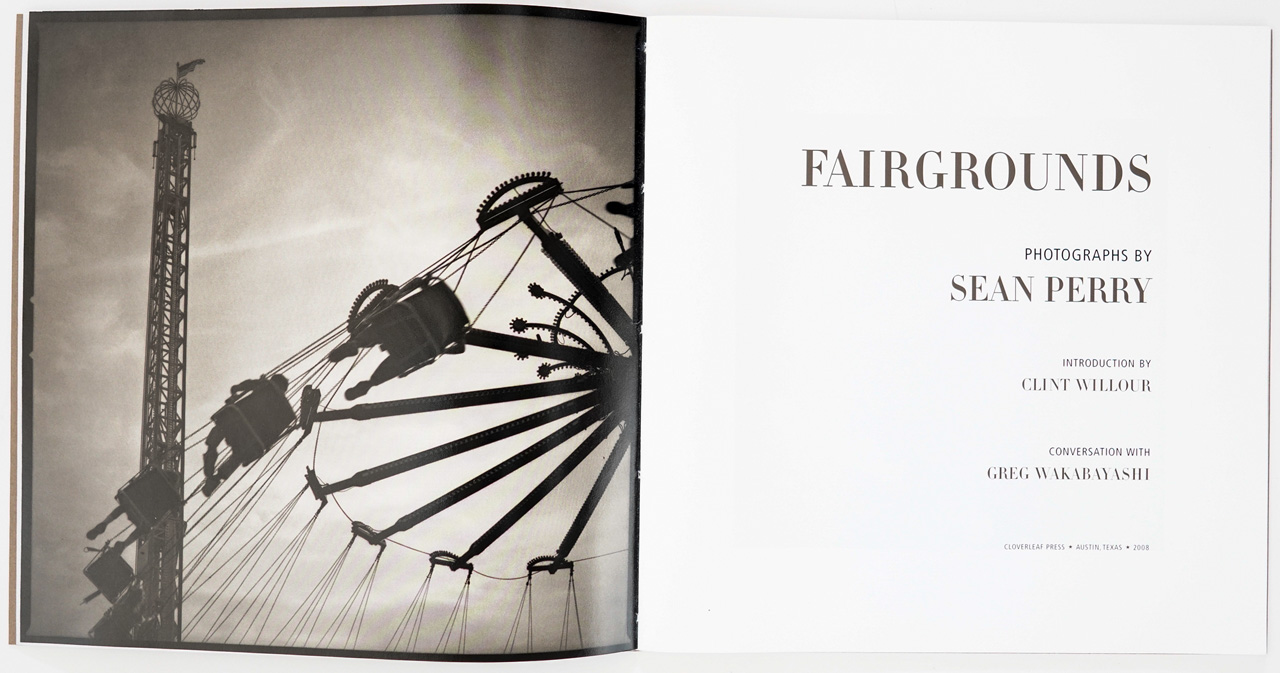
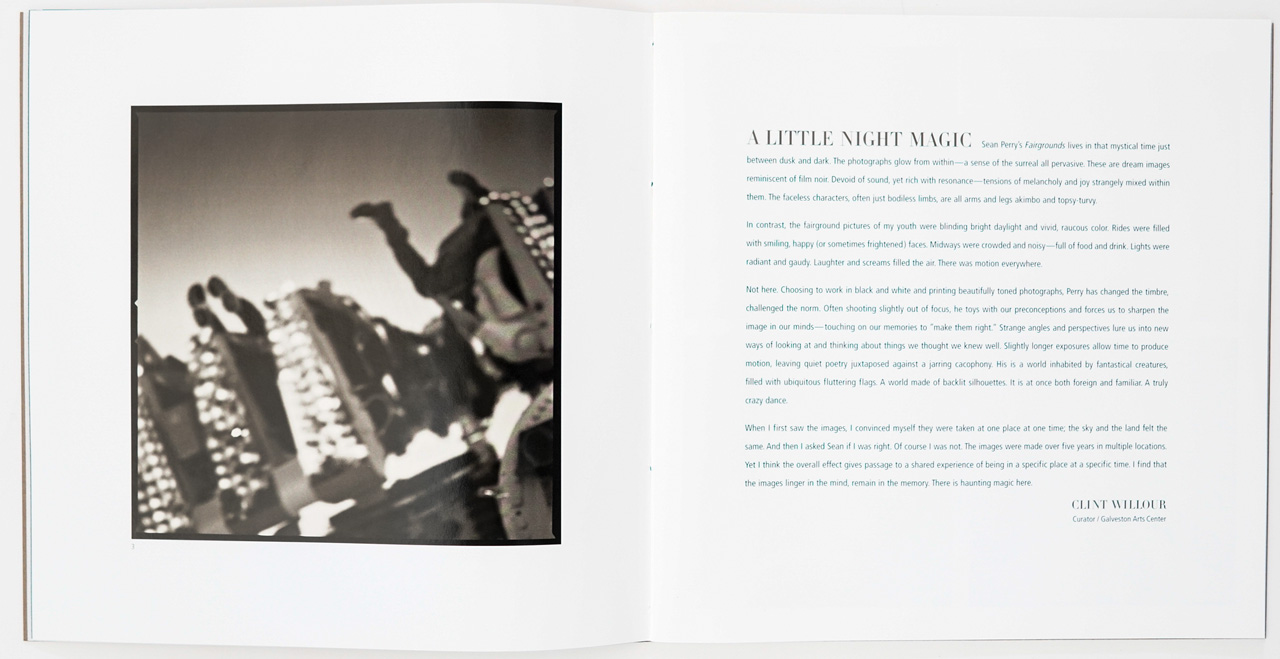
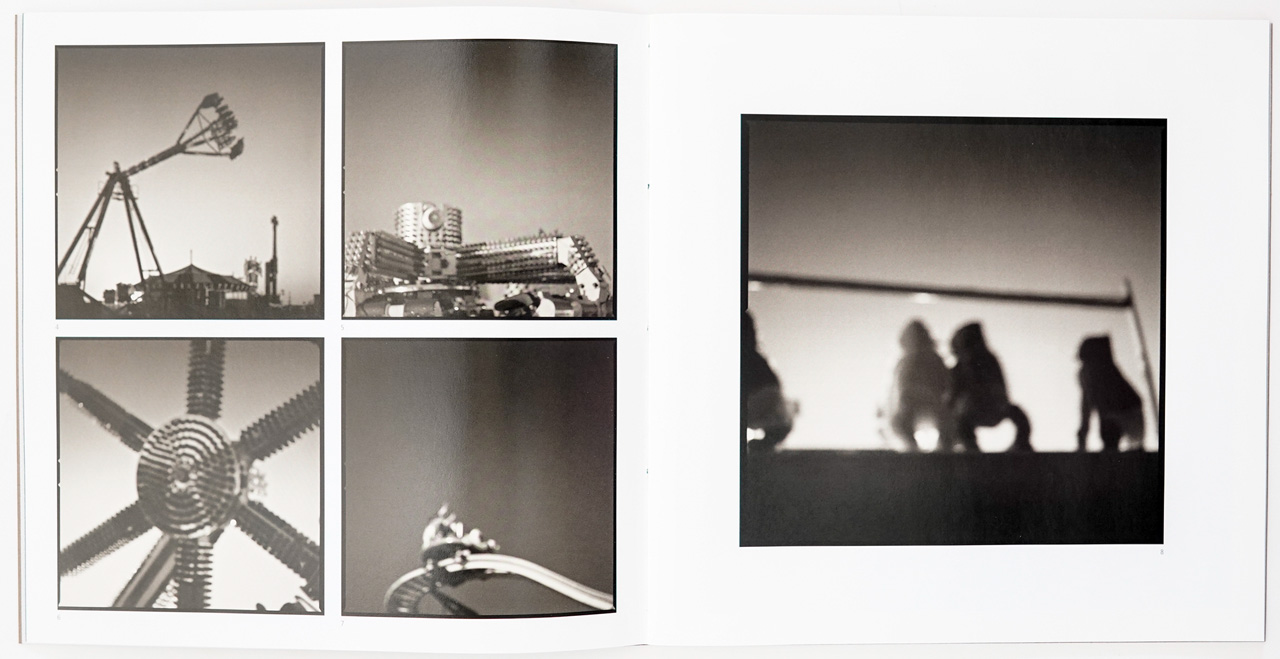
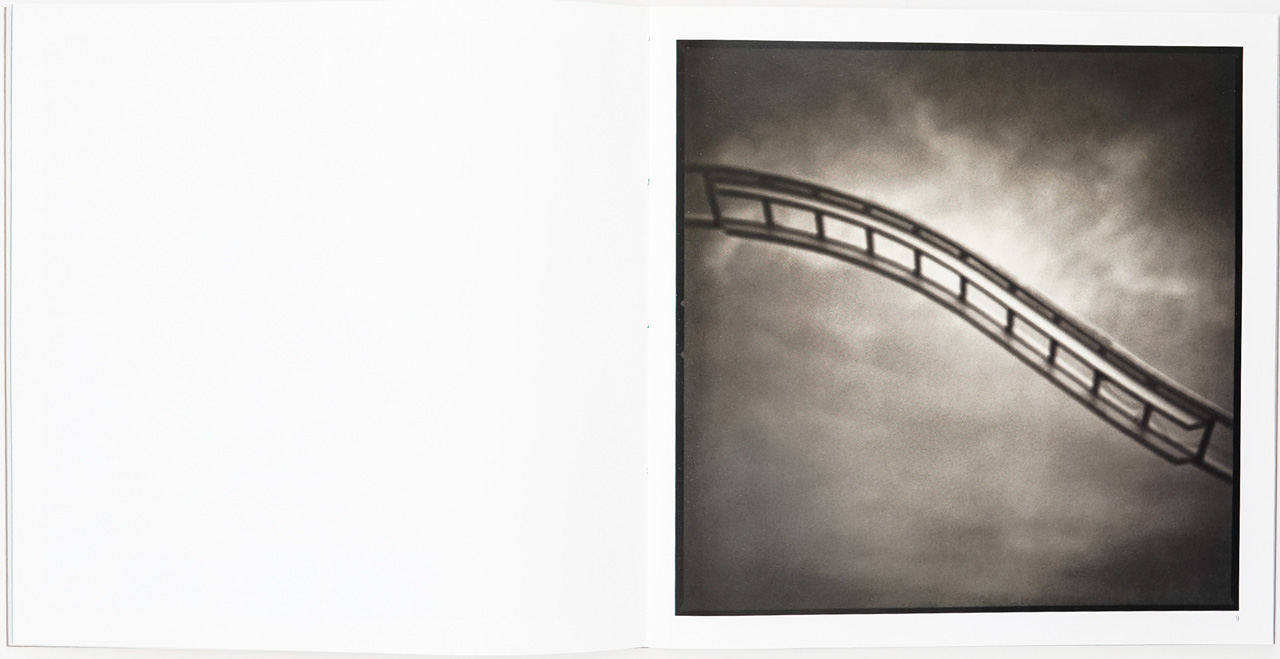
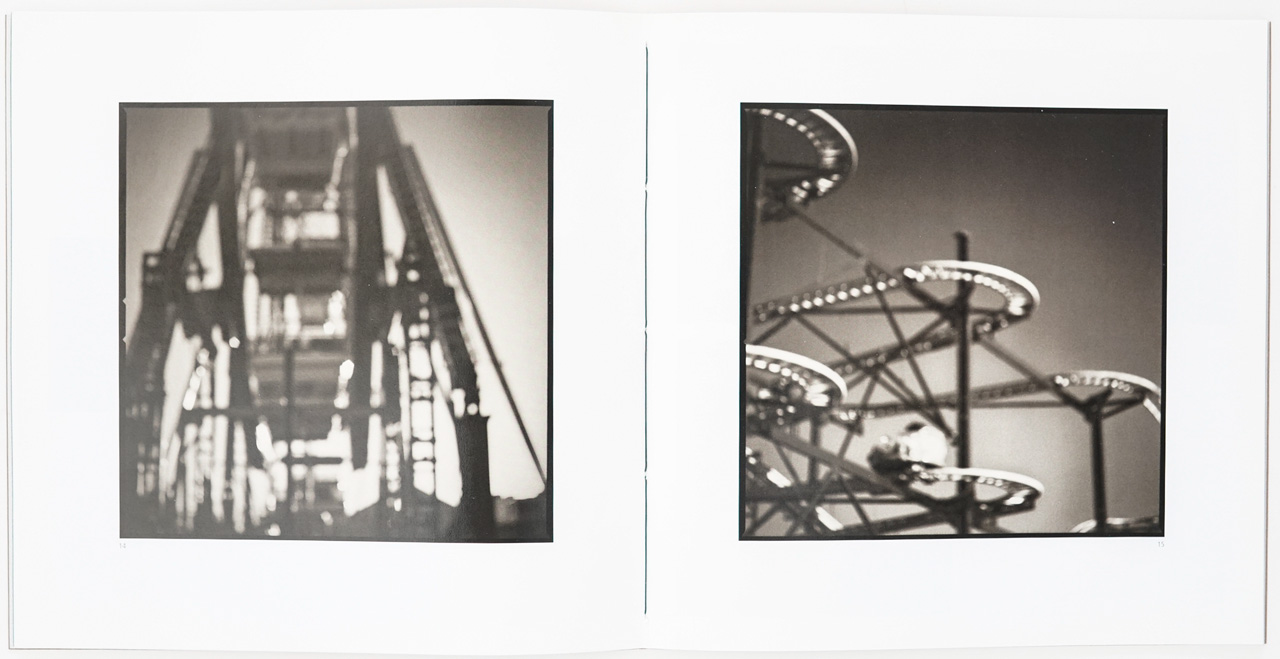
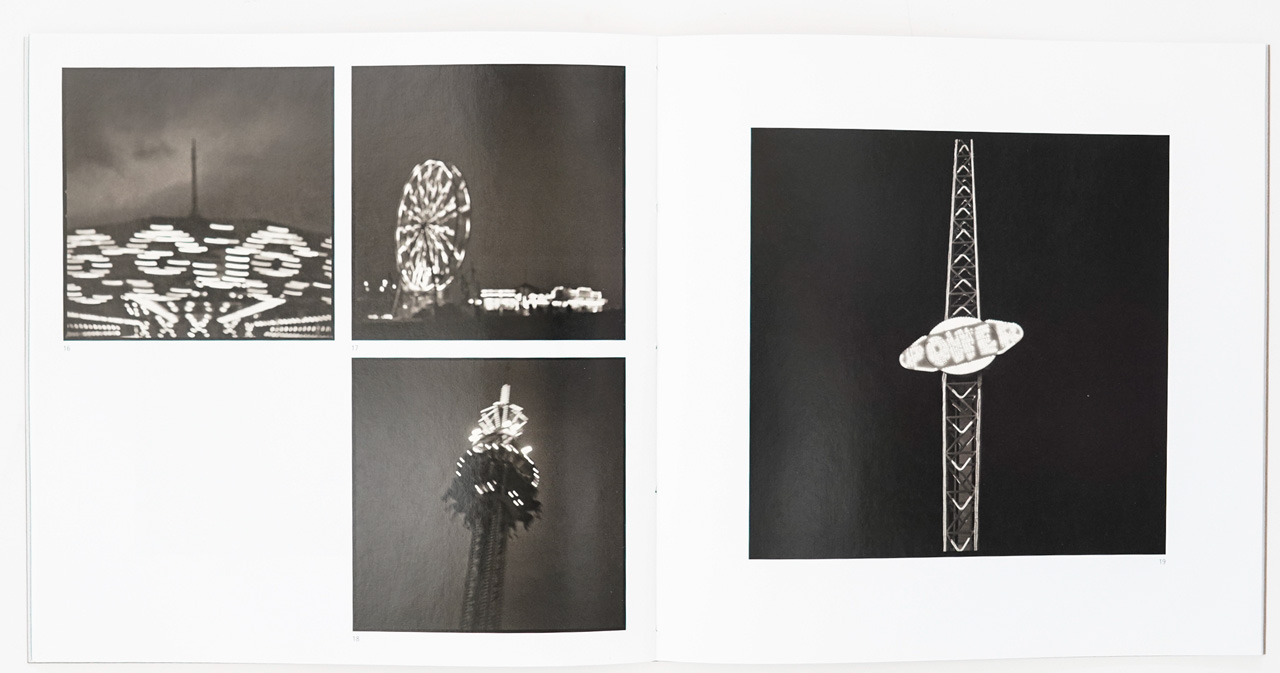
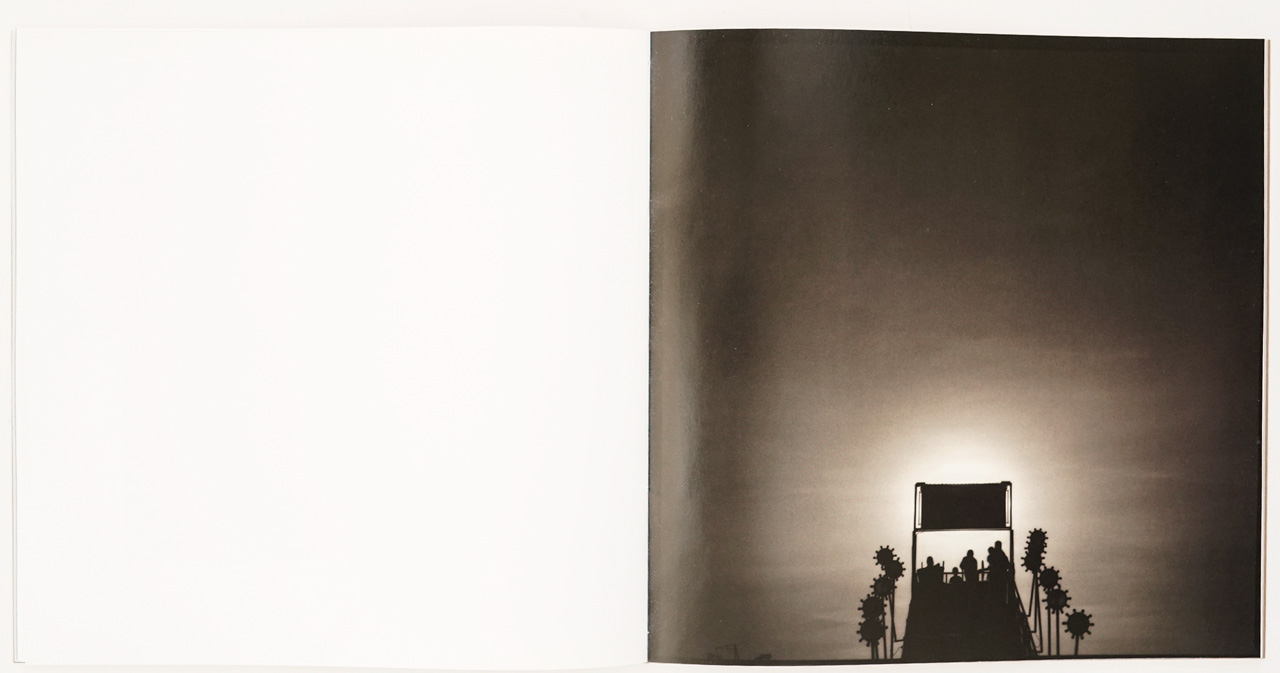
The photographs are black-and-white, often soft, backlit, silhouetted, and tonally restrained. Rides become partial structures, almost apparitions. Arms of machinery, Ferris wheels, roller-coaster tracks, drop towers, and carnival lights are photographed less as objects than as presences. The fairground is recognizable, but only just. Perry’s camera seems less interested in description than in transformation. The photographs do not say, “This is what the fair looked like.” They say, more quietly, “This is what it felt like after it had already become memory.”
That distinction is important. Fairgrounds is not a narrative photobook in the usual sense. It does not move from arrival to event to departure. It is closer to a sequence of mental impressions, returning again and again to a set of related forms: wheels, towers, railings, lights, silhouettes, figures suspended or blurred. The structure feels associative rather than linear, more stream-of-consciousness than story. One image seems to remember another. A curve in a roller-coaster track answers the arc of a ride; the glow of carnival signage echoes the haze of the sky; bodies become shadows, and machines begin to appear oddly animate. The book’s movement is lyrical, not dramatic.
The strongest comparison may not be to fairground photography at all, but to books that use a subject as a passage into interiority. One might think of the tonal quiet of Michael Kenna, though Perry’s work is less pristine and more gestural; or of Keith Carter’s poetic black-and-white imagery, where ordinary things are nudged toward dream and fable. The late Martin Parr offers a useful counterpoint. Fairgrounds, leisure culture, and the visual comedy of public amusement would seem natural Parr territory. But where Parr often pushed such subjects toward satire, color, and social observation, Perry moves in the opposite direction. He drains the fairground of noise and crowd, allowing it to become private, nocturnal, and inward. His photographs do not expose the spectacle; they remember it.
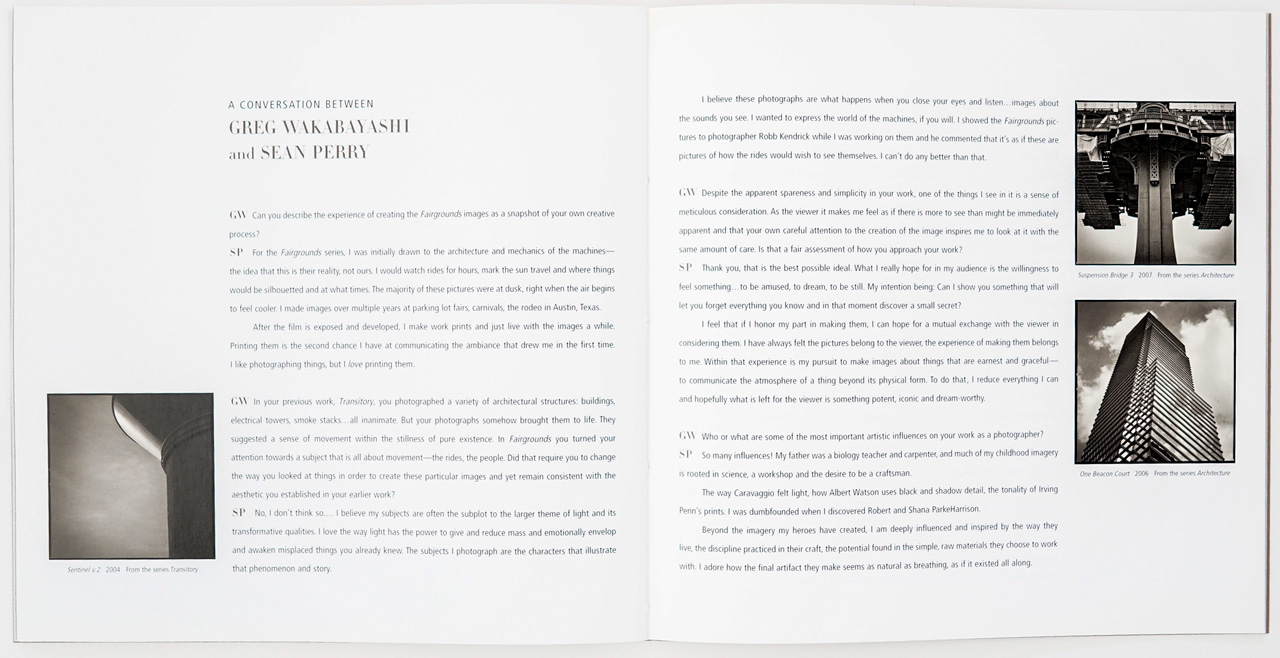
The introductory essay by Clint Willour gives the book a helpful interpretive frame without overdetermining it. His phrase “a little night magic” is apt, but the magic here is subdued. It is not fantasy in a decorative sense. It is the quieter magic of recognition—of seeing something familiar made strange enough that we have to meet it again. The conversation with Greg Wakabayashi is especially useful because Perry speaks about the machinery of the fairground as if it has its own reality, its own secret life. His comment that the pictures may be how the rides would wish to see themselves feels central to the project. It shifts the work away from nostalgia and toward empathy with form, light, and atmosphere.
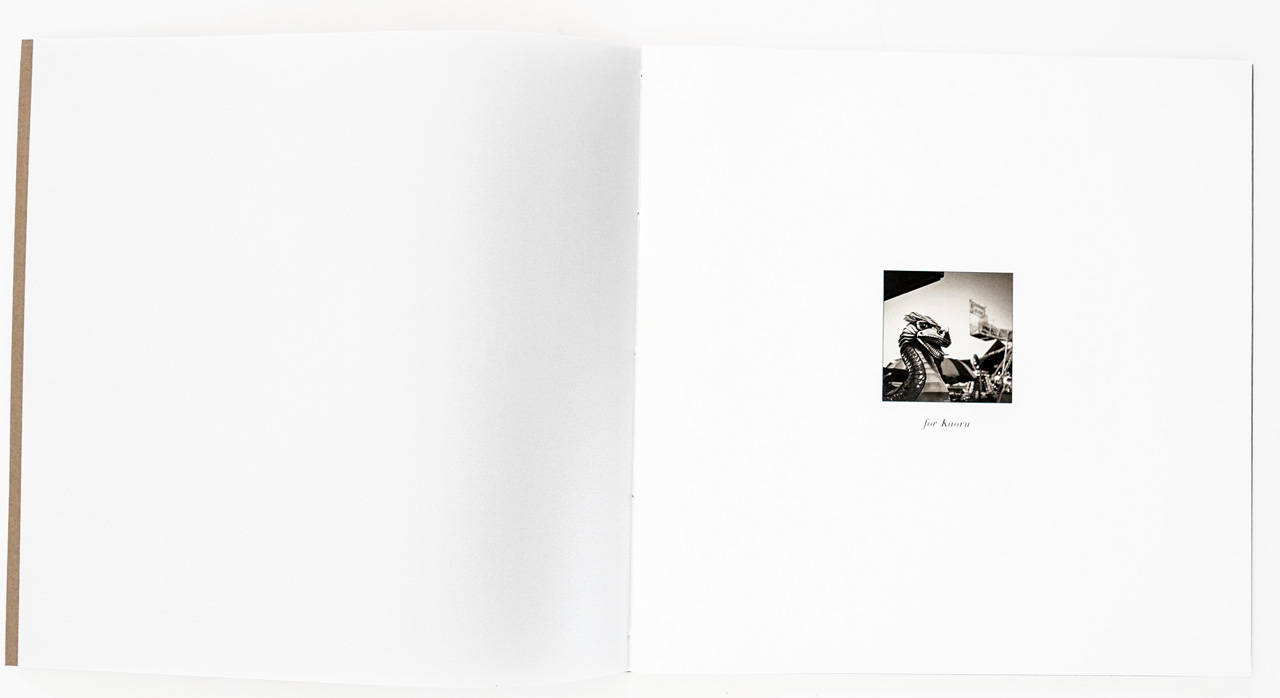
The book’s design supports this reading. The layouts are spacious, unhurried, and elegant. White pages give the images room to breathe, and the use of single images, occasional grids, and quiet sequencing prevents the work from becoming monotonous. The pacing asks the viewer to slow down. This is not a book to flip through quickly for information. It is a book that rewards lingering, partly because the photographs themselves often hover at the edge of legibility. The softness is not a lack of precision so much as a way of making the viewer participate. You have to complete the image internally.
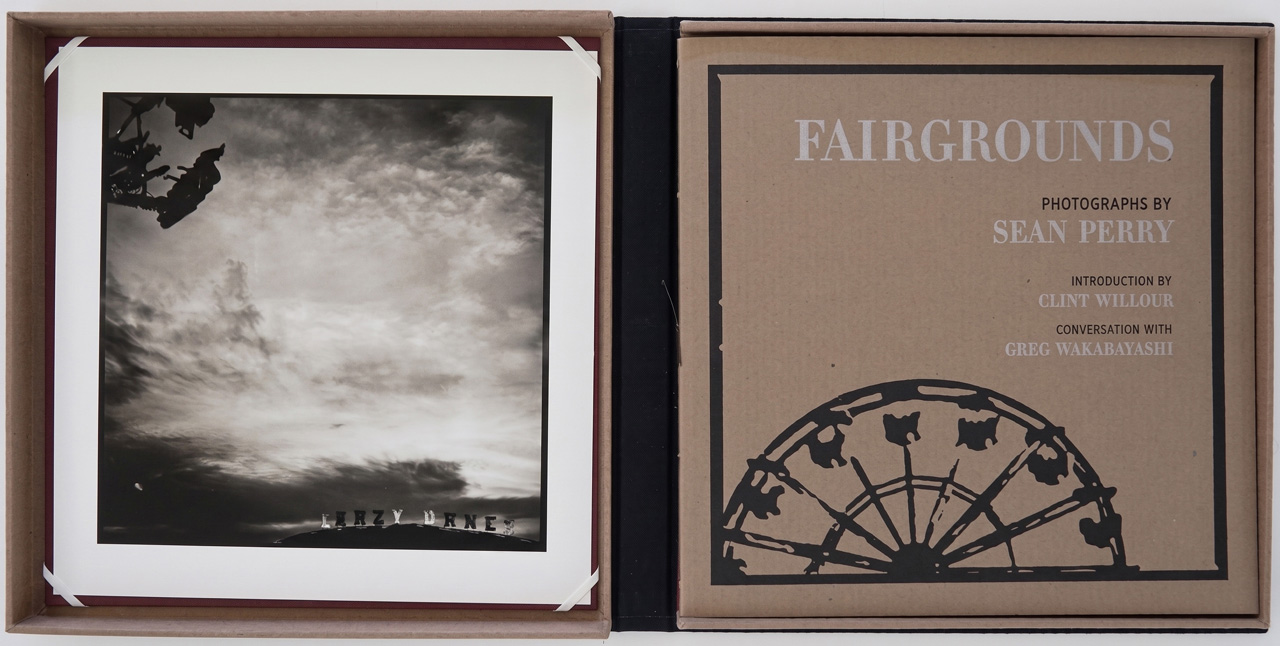
The boxed presentation deepens that experience. The cloth-covered case, tipped-in image, lettered edition structure, signed elements, and inclusion of the additional print create a strong sense of care. The object is handsome without feeling showy. It positions the book as something closer to an intimate portfolio or keepsake than a trade monograph. That matters, because the physical presentation mirrors the emotional register of the work. The box slows down the act of access. One opens it, removes the book, encounters the print, and becomes aware of the book as an object of preservation. Given that the photographs themselves are so much about memory, atmosphere, and the desire not to lose certain sensations, the presentation feels conceptually aligned rather than merely luxurious.
The audience for Fairgrounds is probably a cross-section rather than a mass readership. It would appeal to collectors of fine press and limited-edition photobooks, viewers interested in black-and-white photographic craft, photographers concerned with sequencing and mood, and readers drawn to work about memory, childhood, and place. It may also appeal to people who appreciate fairgrounds or amusement parks, though not because the book documents them in a direct or nostalgic way. Someone looking for the social life of carnivals may find it too inward. Someone looking for atmosphere, ambiguity, and visual poetry will likely find it generous.
Ultimately, Fairgrounds succeeds because it understands that longing is not the same as nostalgia. Nostalgia often wants the past returned intact. Perry’s photographs seem to know that return is impossible. What remains instead are fragments: silhouettes, light, machinery, motion, darkness, and the strange persistence of childhood wonder after the world has become more complicated. The book is not about the fairground as a place one visits. It is about the fairground as something that continues to turn in the mind.
Contributing Editor Rudy Vega resides in Irvine, California. He is a fine art photographer and writer.
____________
Sean Perry – Fairgrounds
Photographer: Sean Perry (American, lives and works in Austin, Texas)
Publisher: Cloverleaf Press, 2025 (Box Set edition)
Text: Clint Willour, Greg Wakabayashi, Sean Perry
Language: English
Book Design: Sean Perry, Jace Graf
Softcover on 100# Book LOE Paper. Hand Sewn; 18 pages, 20 photographs of variable dimensions; book 9.5”x 9.5”
____________
Articles and photographs published in the PhotoBook Journal may not be reproduced without the permission of the PhotoBook Journal staff and the photographer(s). All images, texts, and designs are under copyright by the authors and publishers.


Thank you Rudy for the care and attention in this review, I’m grateful the work was seen this closely. And my gratitude to Hans Hickerson and the PhotoBook Journal team for the heart they bring to photobooks. Love what y’all do.