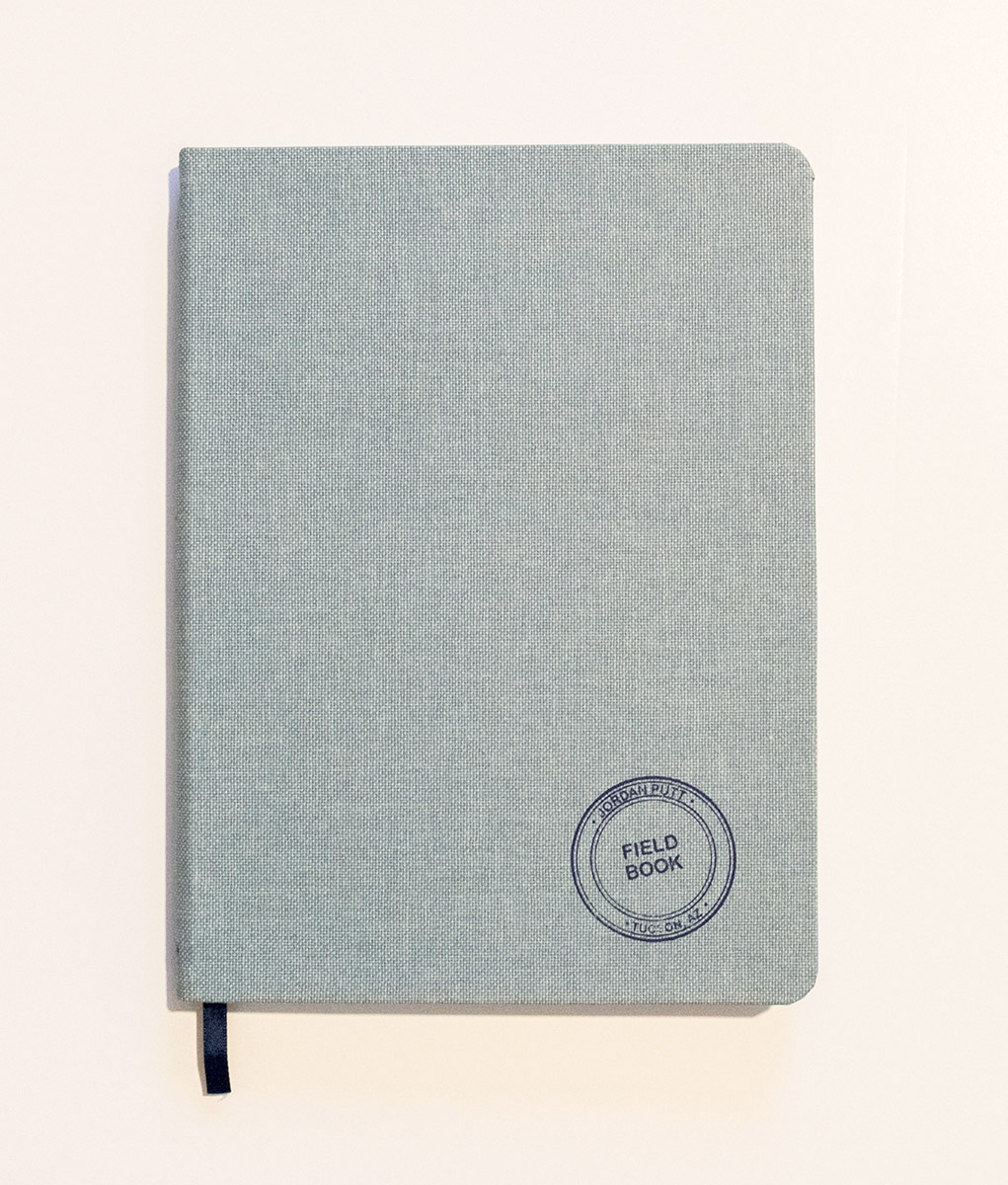
Review by Brian O’Neill ·
In his 2024 book, A Race to the Bottom of Crazy,[1] journalist Richard Grant chronicles beginning a new journey in life with his family after moving to Arizona, the 48th state in the U.S., from Mississippi. As he begins the narrative, he attempts to describe the unease that seems to pervade the state. Writing about his family’s perspective, he says that he and his wife “shared the same misgivings about its rising temperatures and diminishing water supplies, its brutally underfunded and dismally performing public schools, the surly individualism and bared-teeth conservatism that prevails in large swaths of the population, and the seething undercurrents of hatred, paranoia and lunacy that bubble up into the political halls of power” (page 4). Part of Grant’s explanation for this pervasive bad atmosphere that he elaborates has to do with, according to him, mobility and migration connected to economic and political forces: “transience is the main reason why Arizona has such a thin sense of community” (page 5). Yet, as he admits, this also means that people come to Arizona for the sake of personal reinvention, to find other like-minded outsiders, even if, as Grant claims “the culture has almost no sense of common purpose” (page 4).
And yet, Arizona increasingly figures in national and international arenas. Once a “red” state stronghold for the Republican Party, migration, new age cohorts, and ideologies have transformed political realities there (or, here, for me, as I live in Arizona), making them ever more uncertain. Additionally, where else can firms find large swaths of land to build homes and data centers, but in places like Arizona? Some of this has had led to social mobilizations and shed light on questions about the economic future of the state and its inhabitants. While it might be attractive to bill Arizona as a place of stasis and as a kind of unified acultural locale, it is increasingly proving to be a place of change.
Within the photographic record, Arizona often appears in one of three ways. On the one hand, photographers have spent a great deal of time in the state. Think, the Grand Canyon or other aspects of its so-called “rugged beauty.” Mark Klett hasdedicated his career to photographing much of the landscape of Arizona and some of its cultural contours, building on the traditions of landscape photography, especially stemming from practices of re-photography and the New Topographics. On the other hand, there is a documentary, people-oriented tradition. While mostly known as a British fashion and documentary photographer, David Hurn spent years coming to and from Arizona, capturing its cultural dimensions and oddities (in somewhat the same spirit as Grant’s observations that I noted above) in his book Arizona Trips (a mud-wrestling show here, a retired police convention there, and elsewhere in the desert, Hurn found a gigantic wave pool, and so on). However, going further back, as many might already know, Arizona’s history with photography connects tightly to the longer tradition of colonial photographic surveys, government topographic and ethnographic research, and indigenous encounters. Just think of Edward S. Curtis’ 1904 image of the matchstick like horse riders traversing a sepia infused canyon, dwarfed by enormous sandstone cliffs.
Photographer Jordan Putt’s 2025 monograph Field Book sits at the intersections of these different traditions and observations. As a teenager, Putt helped his father with his property surveying job, kicking up dust amidst the cacti as he walked with a GPS unit. He would then work as a land surveyor for the City of Tucson in Pima County, located in Southern Arizona. As Putt has explained, this type of work took on new interpretive possibilities as he began his photographic education: “I became interested in the way that land surveys and photographic expeditions recorded the landscape and, in so doing, shaped historic conceptions of the American West.”[1] Through photography, Putt was able to bring to the fore enduring issues about his home state of Arizona.
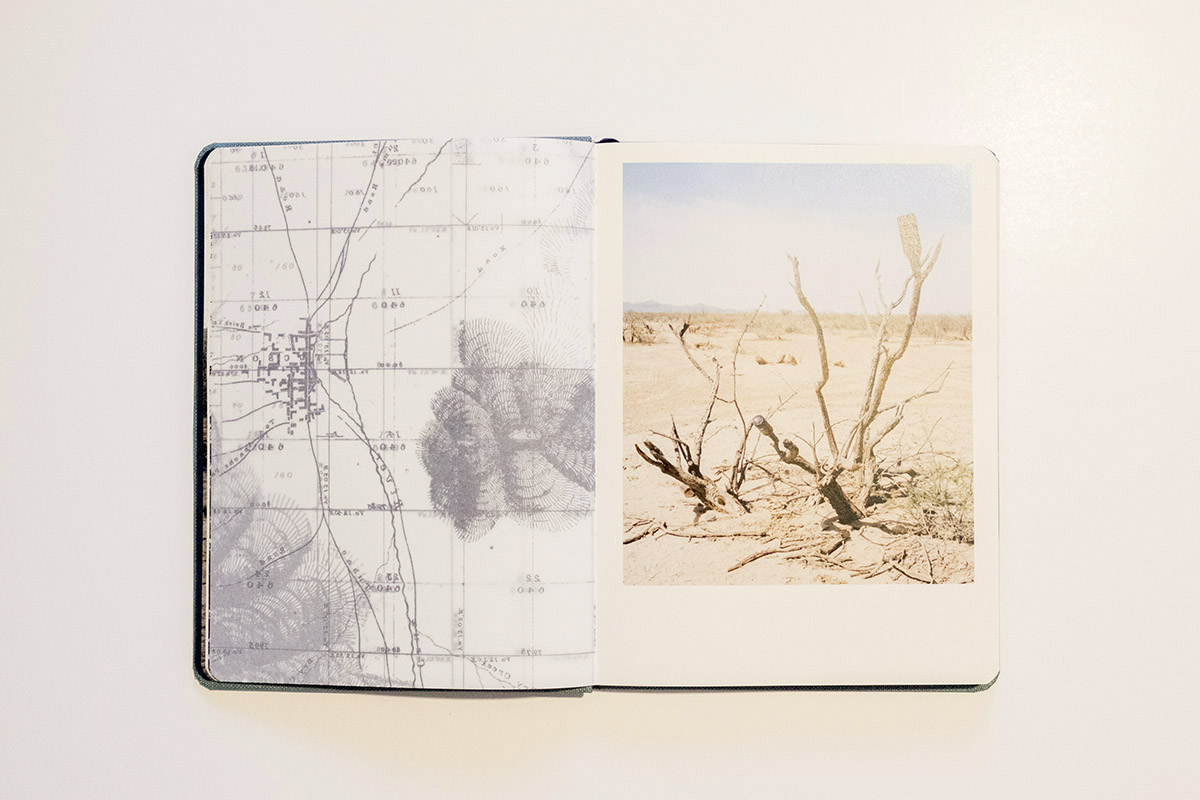
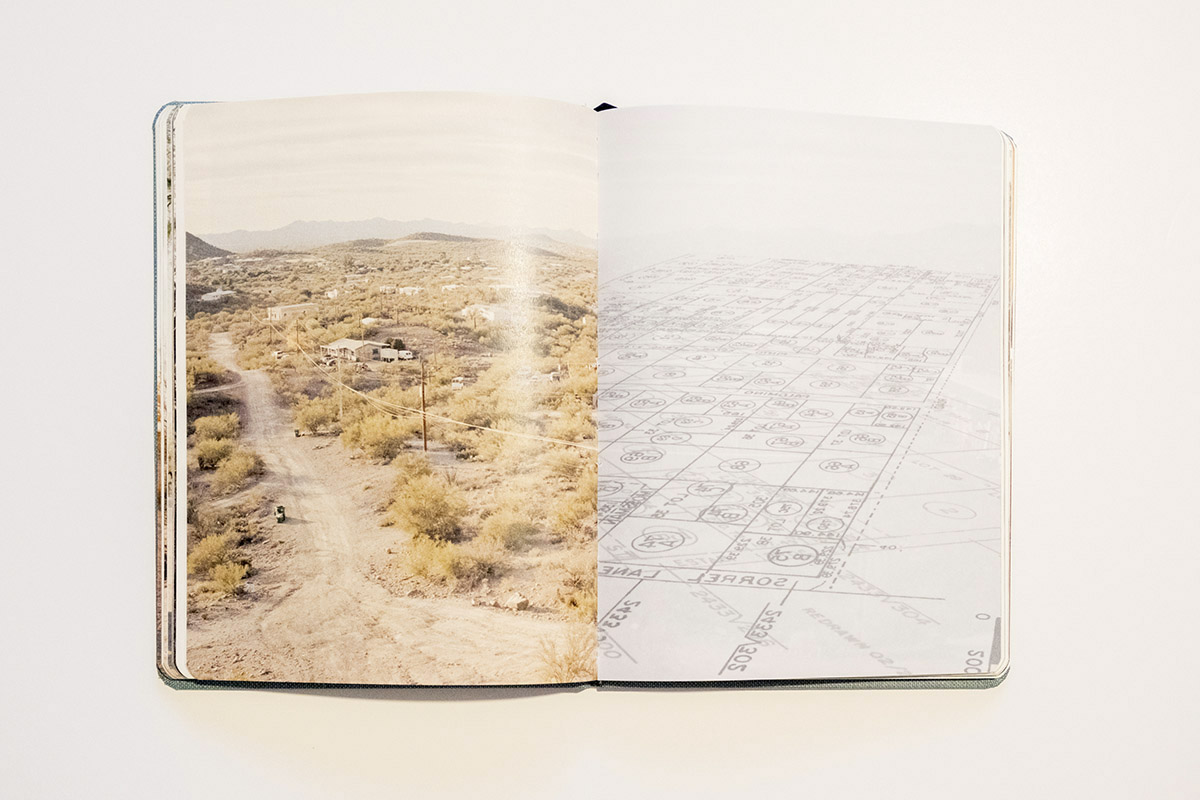
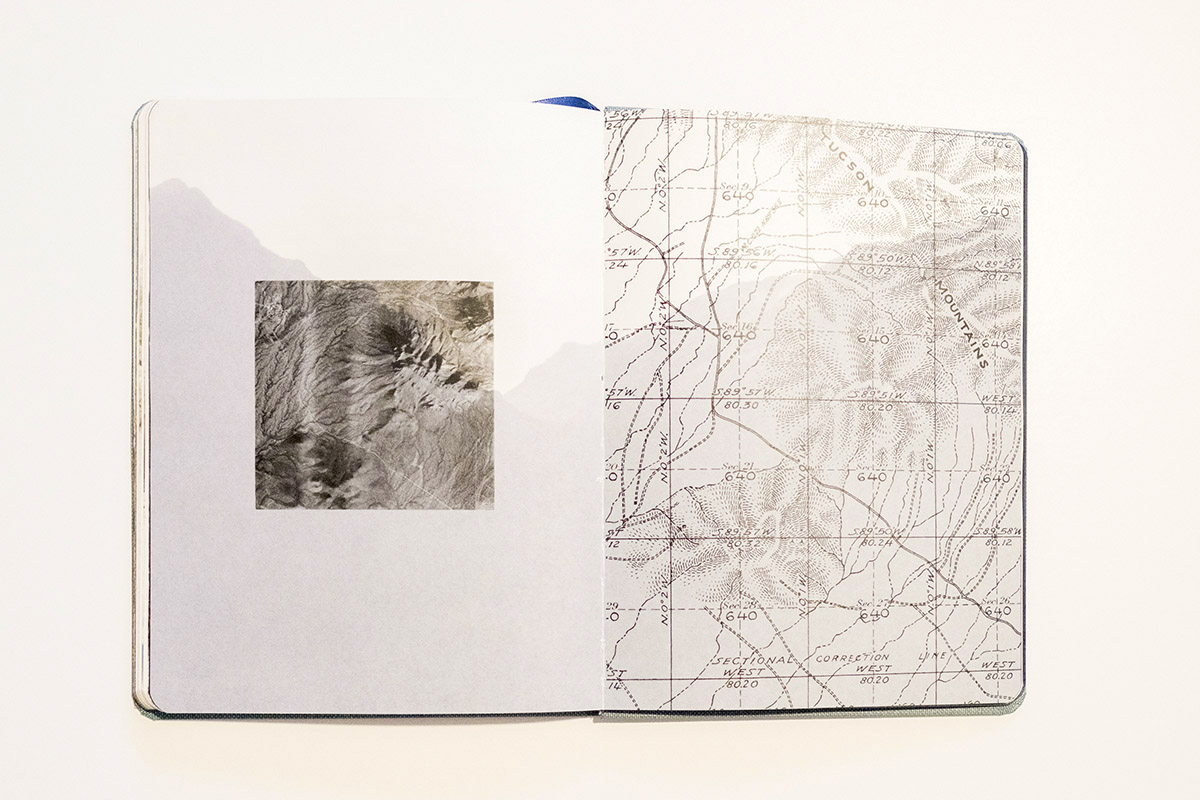
Building on these inspirations, Putt photographed the work we see in his Field Book from 2016-2022, and produced the project with Composit Press. Composit is a collaboration between artists and students at the Oregon State University Art Department in Corvallis, Oregon. Students work with artists to draft designs, often going through multiple iterations and competing amongst themselves to create the ultimate design best suited to the artist and work. For Field Book, the design inspirations emerged out of the classical land survey books that would be carried by professionals in the field (no doubt now replaced by computers and ipads). The result is a highly considered book object offering a diversity of visual materials and clues for the reader to decode, including some vellum inserts of topographic maps of some of the areas featured across the book’s color photographs.
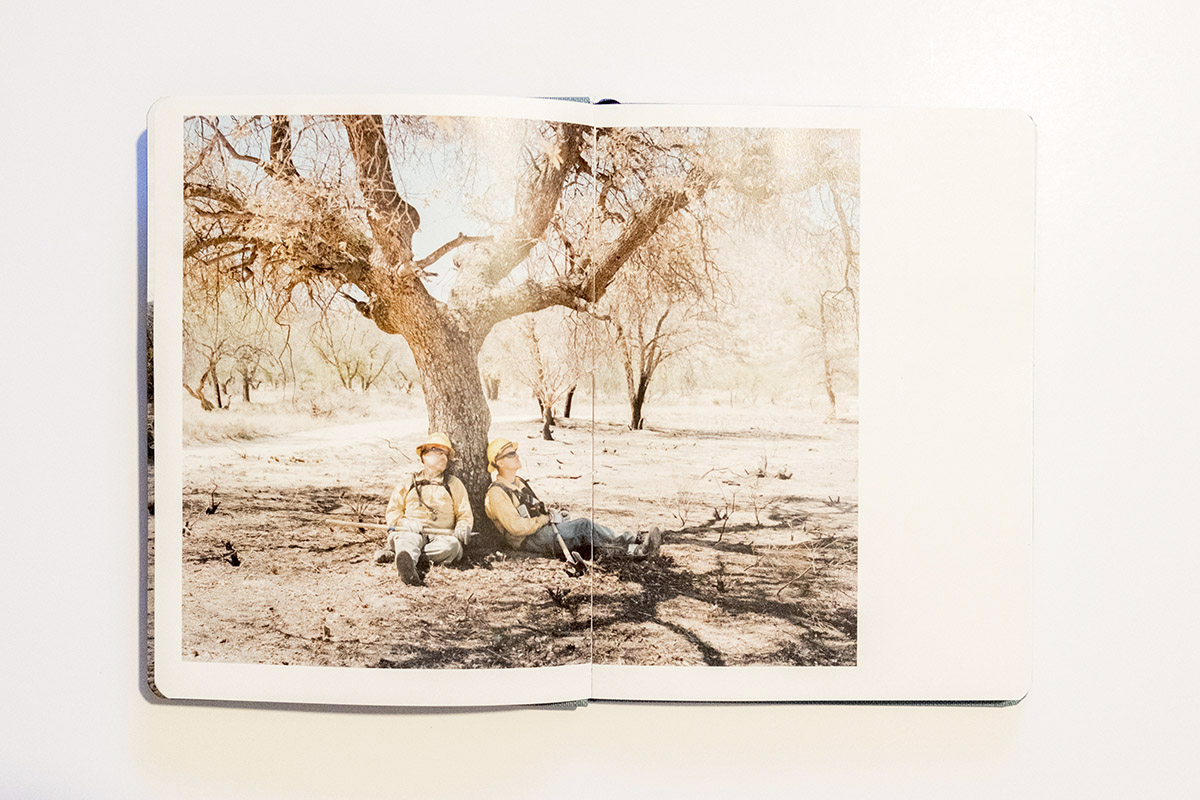
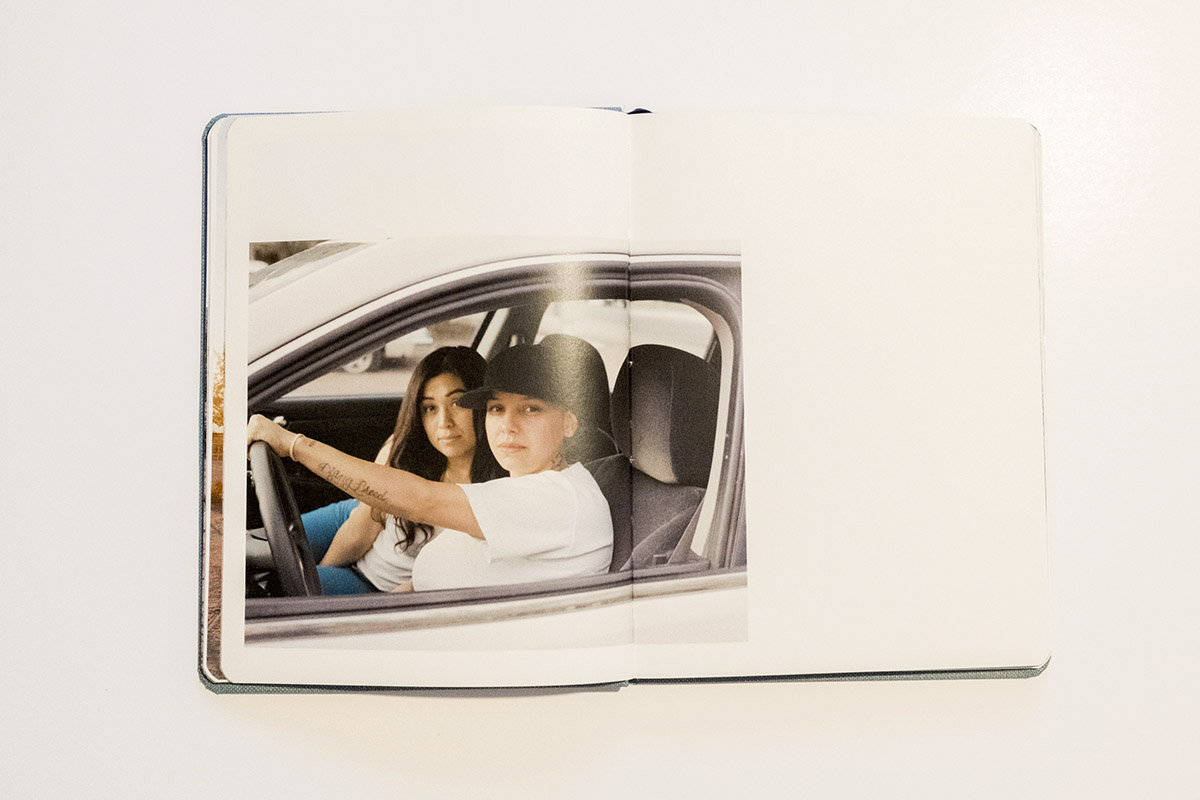
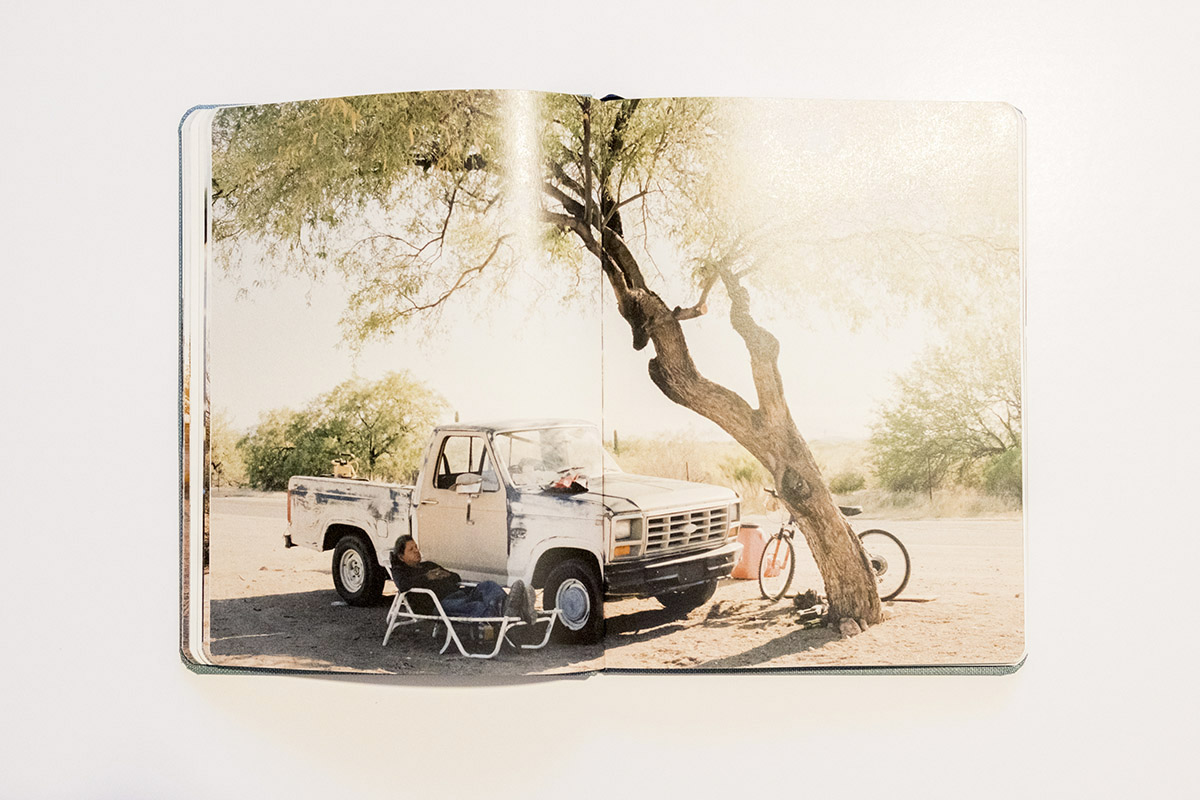
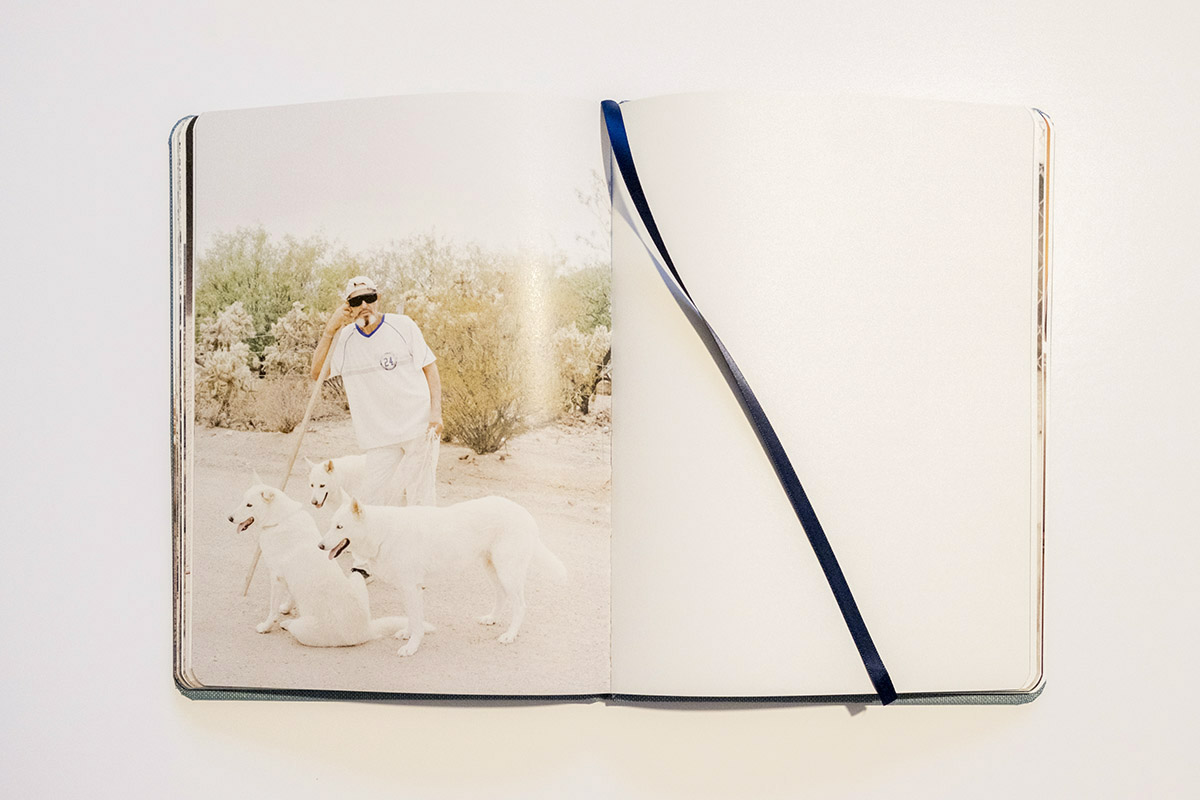
As we open Field Book, we are also engaging the journey of its author: images of workers in hard hats and long sleeves sweat beneath a desert tree on a hot day. Elsewhere people stretch out before a long hike through the rugged mountains. And while there are still some cowboys around, they seem tired. Instead, many of Putt’s images include subjects that are more difficult to classify. In an intriguing portrait, what the reader can outwardly identify as two women, sit in a silver sedan. One has long hair, the other wears a black baseball cap without any logo. With a star on their neck, another tattoo on the left arm reads “dying breed.”
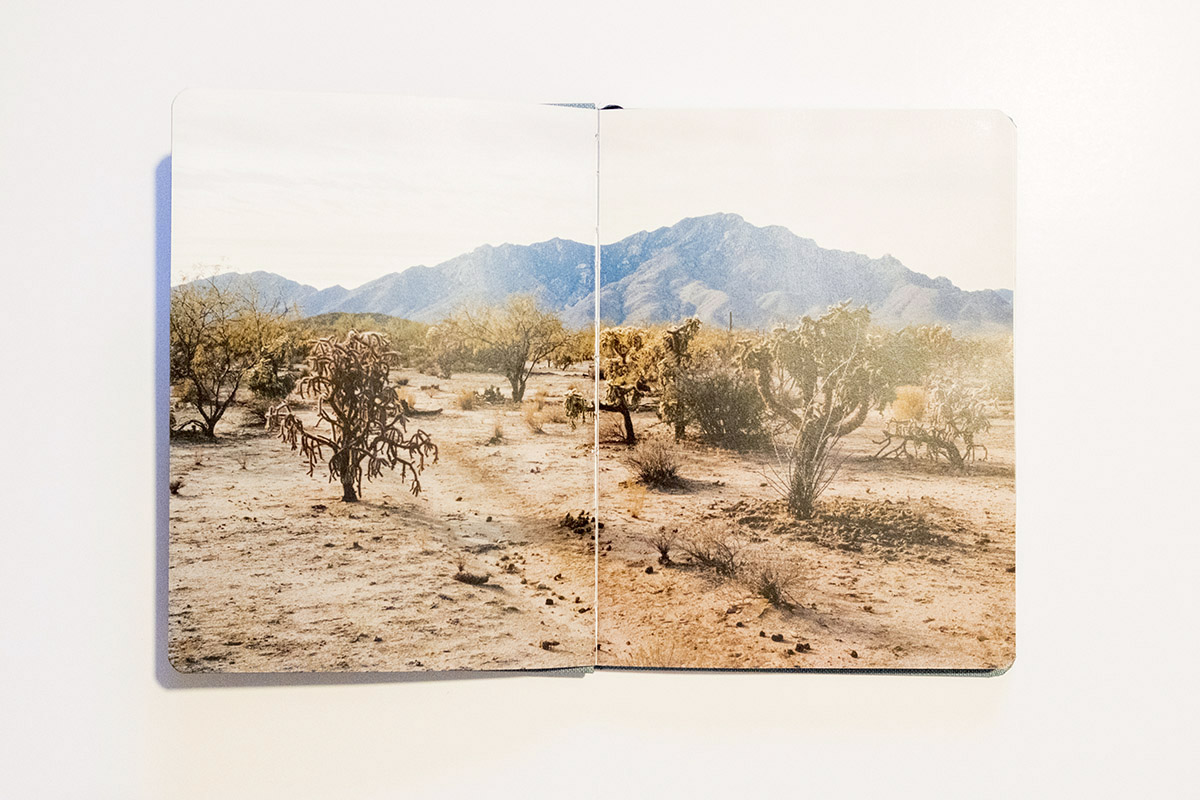
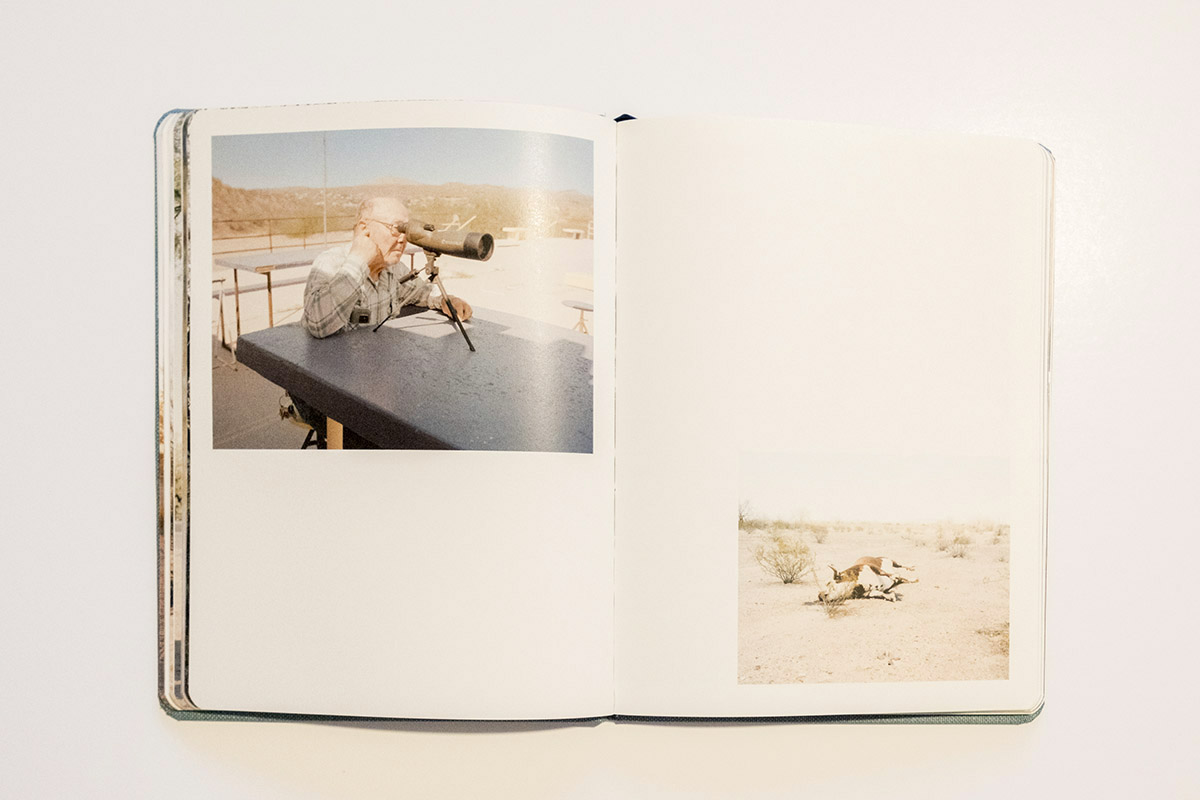
Throughout, the reader encounters Tucson as a flâneur might do, although it is not a place that is ever connected to this idea due to the lack of urban density, among other factors. Working the way through the text, however, I found myself thinking about Putt’s strategy: one gets a similar sense of place in the way that Brassai presented his Paris.[1] At least in part, this can be attributed to the interweaving of particular types of portraits and landscape scenes, emphasizing what might seem, to an outsider, slightly surreal situations: chihuahuas sit perched in a stroller, a tight grouping of saguaros stand by a dirt path, as if ready to march off. Then we see a man sitting on a stool, peering with a seemingly disproportionately sized optic out into the distance. What does he see? And later on, an oasis with bathers (I’ll come back to this soon, below).
Putt’s attention to the landscape and specifically the scale of Arizona (beautifully articulated by the overlaying vellum topographic map/survey map pages), and intermingling his portraits make Field Book an attention grabbing read/viewing. As he describes in the inserted conversation with Kelli Connell, some of these have been staged (although I do not think this diminishes the documentary character of the work). Putt views these as collaborations, and as such one can read the finer details of the portraits for meaning about the characters, almost as a kind of Southwest travelogue. Yet, at the same time, these are not portraits of “notable” people. A man poses with a backwards hat and his collection of watches, counterposed with a figure lighting a backyard firework. Elsewhere, a man holds his black dog by the collar, as if the animal is ready to leap from the car window. Still further, a man, presumably a father, rests in his wheelchair in the afternoon sunlight of his backyard as a boy runs ahead – cinder blocks, paving stones, and stucco complete the scene. Within all these quotidian places, Putt’s images seem to say that the aspirations of its denizens both abound and are contained.
As one approaches the conclusion of Putt’s Field Book, the sense of anomie and whatever possibilities it might lead to (there is a sense of both normlessness and cultural openness that Putt wants to emphasize with the variety in the portraits), seems to yield to a condition of dread (there are early hints of this, such as the image of the dying cow, and also that of a horse straining against some reins) underlying the solastalgia of the work (a term coined by scholar Glenn Albrehct to describe the emotional distress brought on by anthropogenic disasters that result in the transformation of a still inhabited landscape). An old man, surrounded by a forest of saguaro cacti, balances himself against a rock, looking out to the horizon. One of Putt’s nude subjects poses with a book and grapes. If one takes this as a Dionysian reference, it signals a promise of the future, of some kind of bounty, if not fertility in a broad sense. It seems significant that she has a book. But what is she reading? Perhaps she might instead be an Eris, if we stay with the Greek symbolism, indicating conflict and uncertainty. A haze now appears over the once clear desert landscapes and as something seems to smolder from the peaks, so do some ATV drivers kick up clouds of dust, spinning in circles, creating their own particle-filled micro-climate. Indeed, the more one spends time with Field Book, the more one realizes how Putt’s images are thoughtful and suggestive.
Notably, the book’s closing image is a scene shot through a few saguaros in the middle of the night. The landscape is dark and only the cacti’s outlines are discernible in the foreground. In the distance though, white-orange light blazes. Plumes of smoke are visible – a mountain is on fire. The viewer wonders: what homes and species have borne the cost? The question of the violent transformation and its impact to those scenes and faces populating Putt’s Arizona also comes to mind. Property might be damaged, but Putt here is signaling a more deep and perhaps widespread sense of instability. As the soot lifts into the clouds, so does a lack of clarity about the future of Arizona and cities like Tucson. Things are being left to the proverbial gods, and we might well ask how much they care. Returning to the initial image of the workers in hard hats sitting beneath a tree, I initially thought of them in repose. Here, an ouroboric apprehension becomes possible. With the entire work in front of the reader, the message becomes one more of exhaustion.
Poetic and with a historical consciousness, Jordan Putt’s Field Book is a distinctive contribution to photography about Arizona (about which, in my estimation, we have too few photobooks), but also the American West. Putt has rendered well the condition of the desert and its inhabitants, deftly interweaving his own story with that of the people and landscapes that populate the state’s largest desert. Field Book is a refreshingly contemporary work that pays homage to what exists of the past traditions of Arizona photography, while productively addressing the place’s tensions as they now exist.
Contributing Editor Brian F. O’Neill is a photographer and sociologist based in Phoenix, Arizona.
__________
[1]https://www.simonandschuster.com/books/A-Race-to-the-Bottom-of-Crazy/Richard-Grant/9781668011034
2https://www.booooooom.com/2020/04/08/field-book-by-photographer-jordan-putt/
3https://www.google.com/books/edition/Brassai/6Nd30fBYDDcChl=en&gbpv=1&dq=Brassia%27s+Paris+by+night&pg=PA22&printsec=frontcover
__________
Jordan Putt – Field Book
Photographer: Jordan Putt (born in 1992, based in Chicago, IL)
Publisher: Composit Press
Designer: Composit Press and Savanna Aho
Design and Production Supervisor: Evan Baden
Interview Transcript Essay: Kelli Connell
Hardbound cloth cover; foil stamped; sewn binding; 7 x 9″, 124 pages; ISBN 979-8-9987660-3-9
__________
Articles and photographs published in the PhotoBook Journal may not be reproduced without the permission of the PhotoBook Journal staff and the photographer(s). All images, texts, and designs are under copyright by the authors and publishers.


Leave a Reply