Review by Brian F. O’Neill ·
Brave River is the 2026 image-text photobook produced in collaboration between photographer Todd Morten and writer/poet Tim Z. Hernandez, released by Mouthfeel Press. Both authors are based in the American borderlands and have developed other works about the landscape and its inhabitants in recent years. Both are motivated by a sense that the region is too easily essentialized by commonplace media representations. Brave River thus seeks to portray the contemporary quotidian experience of the borderlands with a certain poetic realism that invokes issues of contemporary social marginalization, historical violence(s) and the ethereal, with a sense of hard-won resilience.
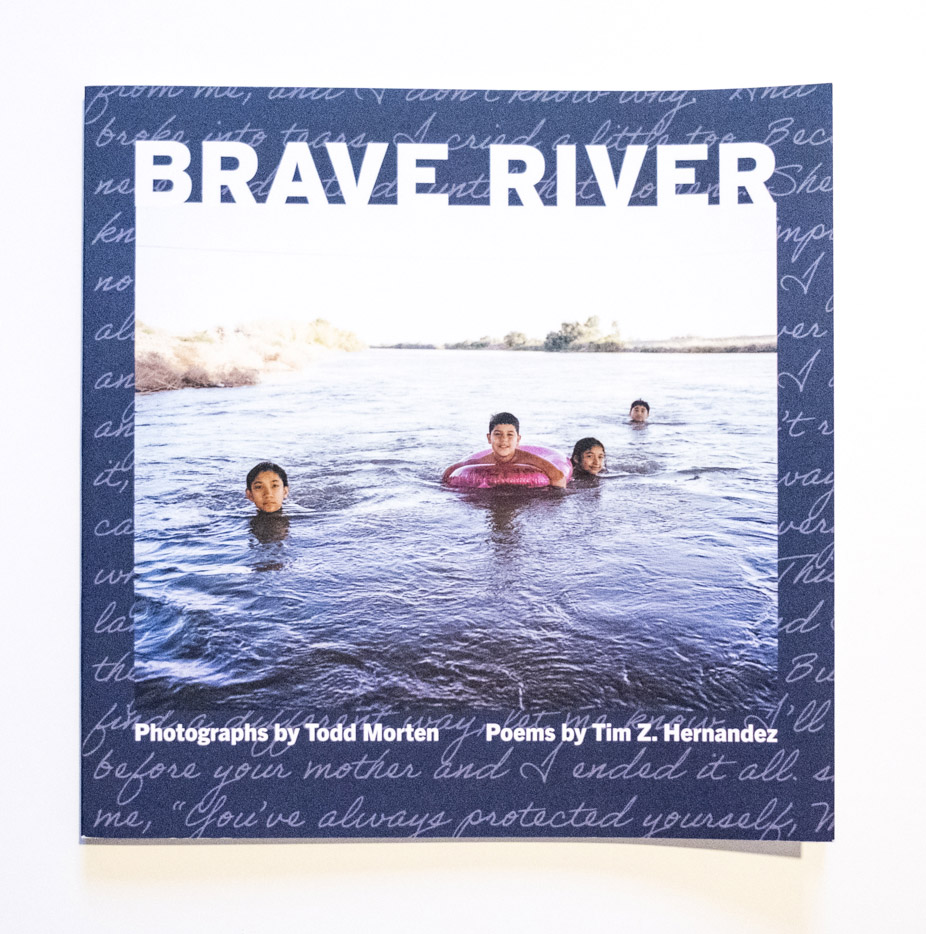
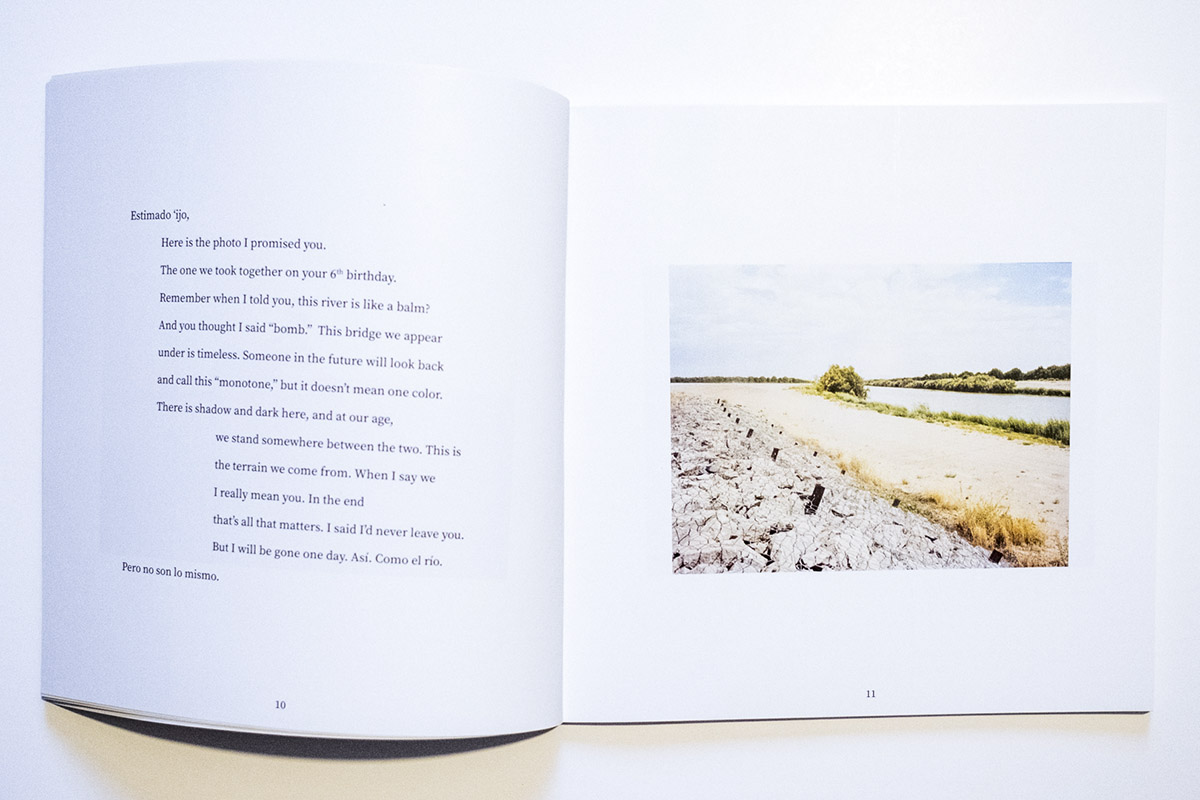
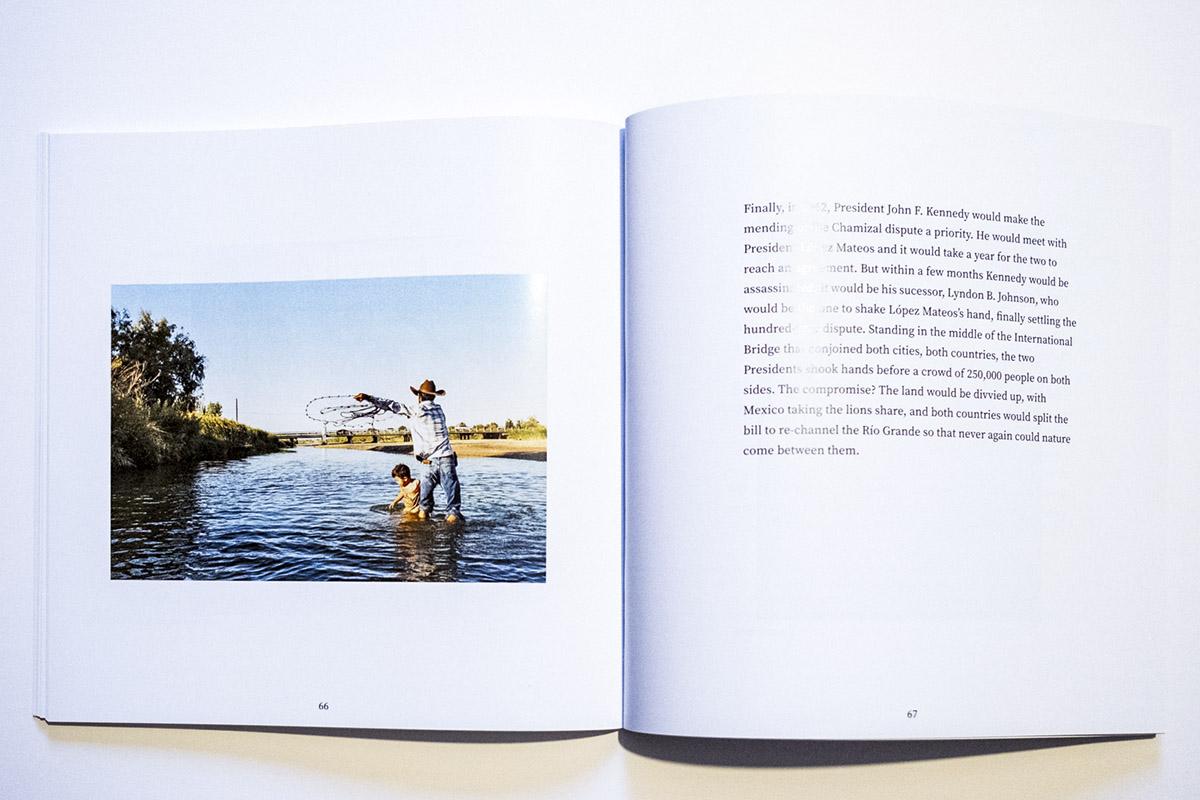
While the title of Brave River indicates a waterway (the Rio Grande), amidst the 39 color images it contains, only six reveal the presence of a water body. There is of course the cover image – a striking picture of four kids, one in a dirty pink floating plastic tube as, I imagine, the sun sets. The blues of the water appear as a gradient, while the river itself extends into the horizon two thirds of the way through the frame. The scene is flanked by the common dusty green and yellow tones of trees and shrubs that populate so much of the semi-arid American (for the purposes of this essay, in referring to “America,” I use that term in the way I think the authors intend it, that Mexico and the United States are both American territories, a point which is emphasized by the text on page 58 mentioning colonial processes and land disputes around Texas and the facing page (59) in which the image of three girls playing with an oversized tennis ball is taken from a short distance, and on one girl’s short is blazoned the United States’ flag) Southwest. The other images with bodies of water in them include one of a rocky embankment used for flood control. Elsewhere we see a muddy, or more specifically, silty, canal with horses grazing in the distance. So, what is the deal with this River?
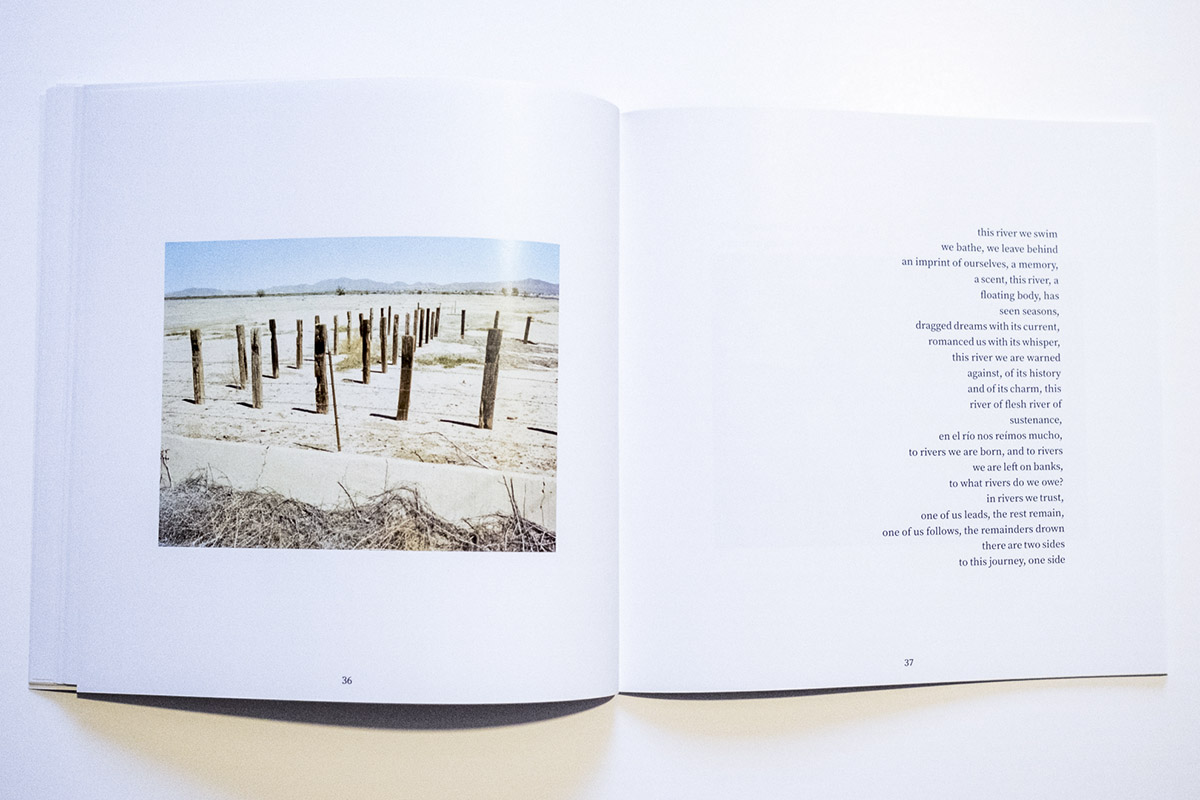
Having lived in the American Southwest much of my professional life, I know about the extent to which water flows through the cultural landscape of the region. I suspect that in some of these images, water is there too: here and there in the background, just over a small dirt mound, there is probably a thin canal cut through the dirt to irrigate a field over there, or what about just behind a chain link fence where a man uses wire clothes hangers to display a hodge-podge of blouses for sale. Indeed, Jack Kerouac’s observation in On the Road was spot on, although of a different socio-hydrological system: “I wanted to sit on the muddy bank and dig the Mississippi River; instead of that I had to look at it with my nose against a wire fence.” Barriers abound in America, and yet there remains a fluidity – people and resources flow and live together, seemingly in spite of the realities of the natural, historical, and political conditions that abound around them. These facets make up the cultural landscape of the region, the interwovenness of human beings and the communities they make with how they respond, react, intervene, and ultimately transform territory. As Hernandez writes:
“this river we swim/ We bathe, we leave behind/ An imprint of ourselves, a memory…to rivers we are born, and to rivers/ we are left on banks…in rivers we trust…we set adrift we never/ tell we never burn/ we never know who among us/ will return” (pages 37-38).
Smartly then, Morten and Hernandez begin the narrative with a map, an archival document dated from 1946 from the then War Department’s U.S. Army Corps of Engineers of the New Mexico Texas Canutillo Quadrangle. Indeed, this is essential to understanding the cultural geography and its seemingly ever-lasting potential for renewed interest in this region – the eye of the state is often looking down. But the map also shows something else. While of geopolitical interest, it can also be read as something of a hydrological cartography. It is a watershed after all. And so, as the reader then encounters Morten’s images and Hernandez’s texts, an important methodological maneuver is made: from the abstract vision of the state, or otherwise of an outsider, etic standpoint, we then get closer to a vision that is more grounded in the very socio-cultural flows of life leading to a multi-modal emic portrait.
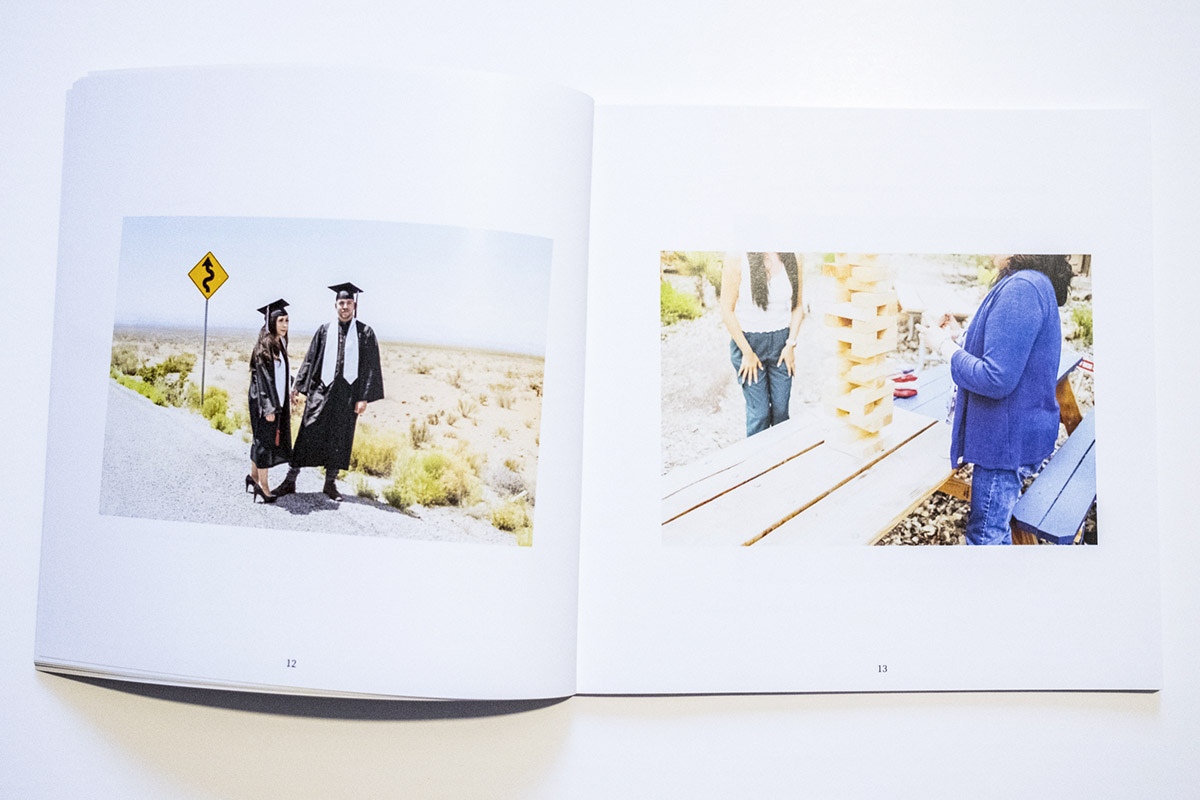
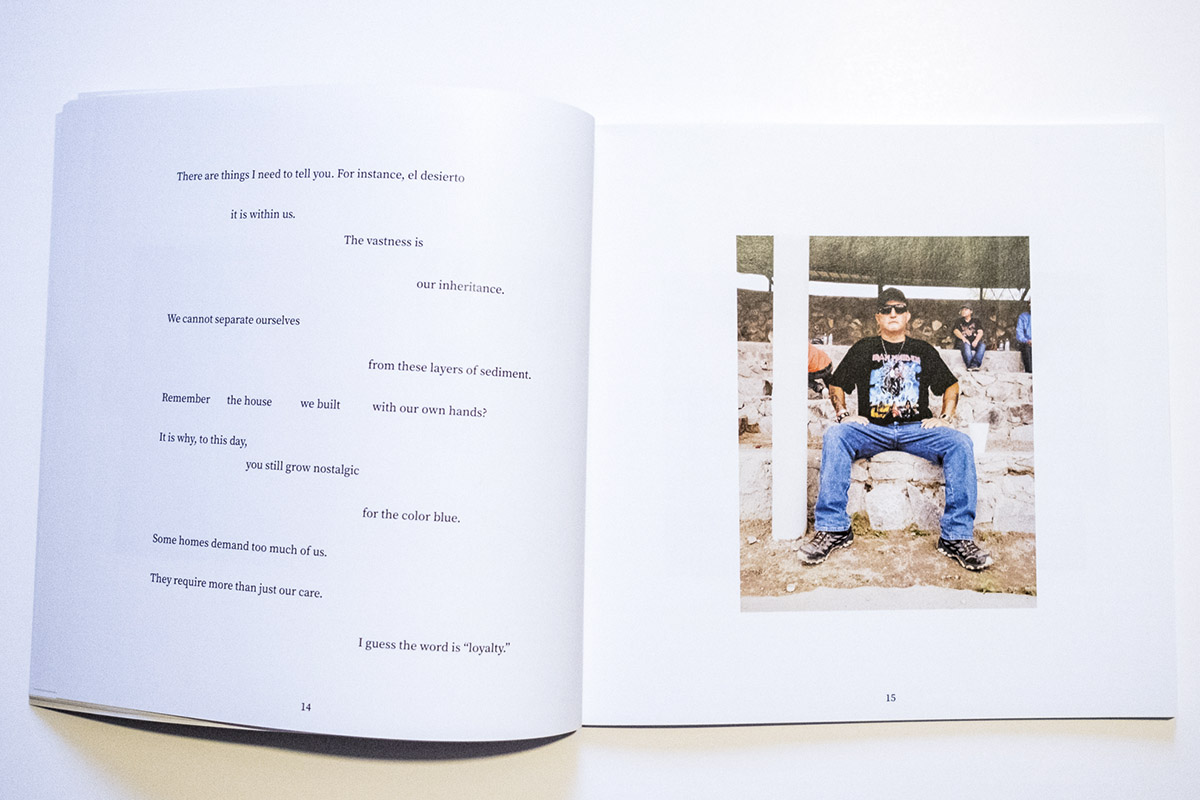
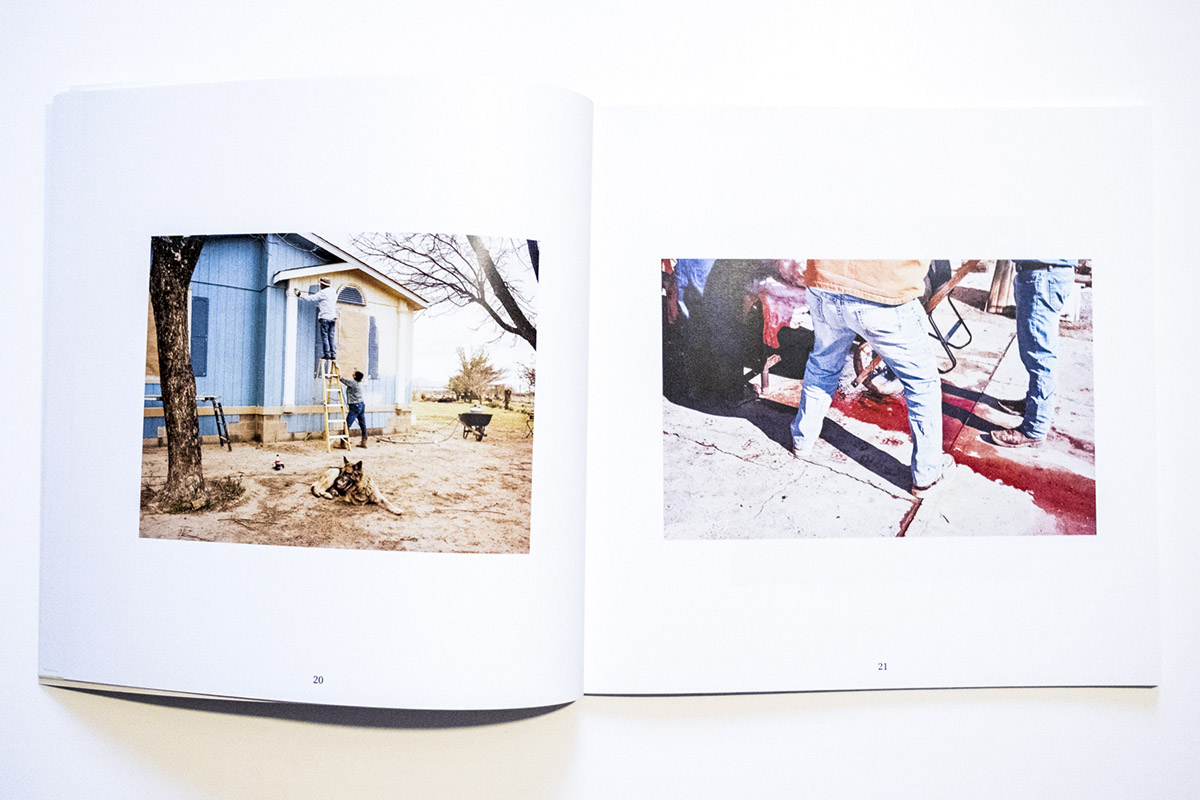
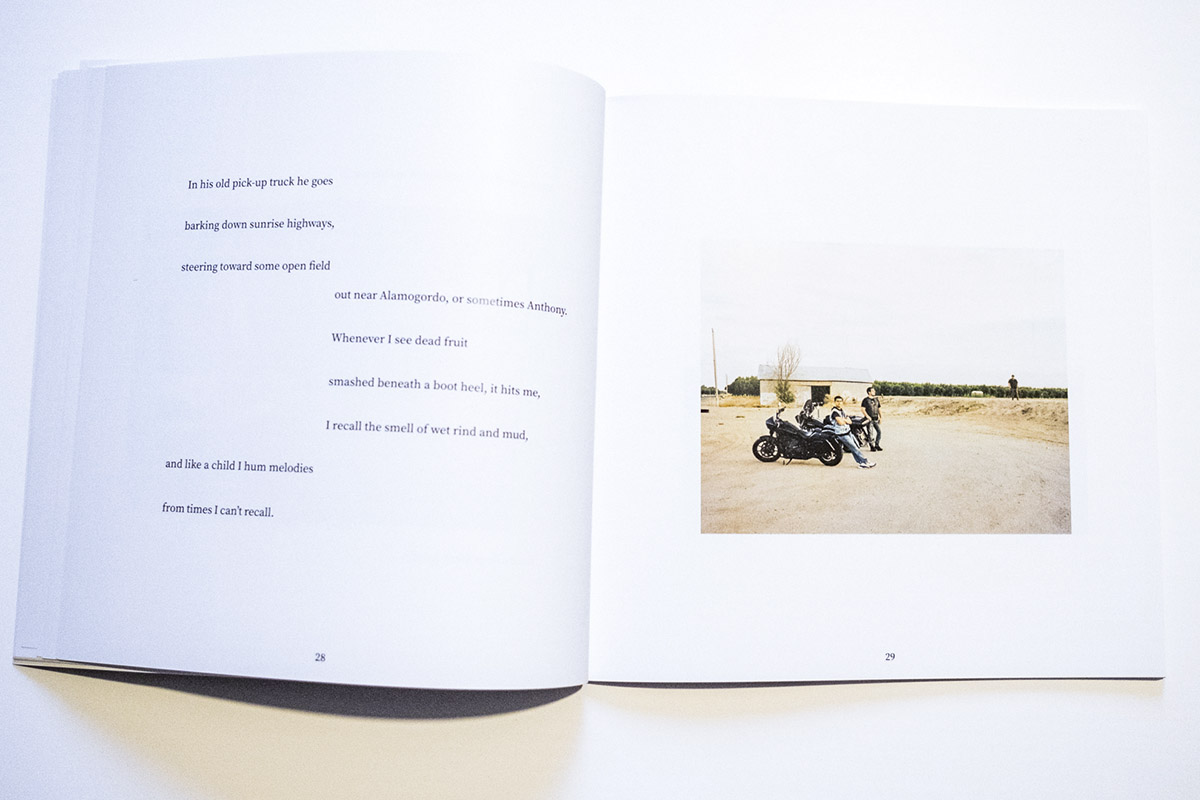
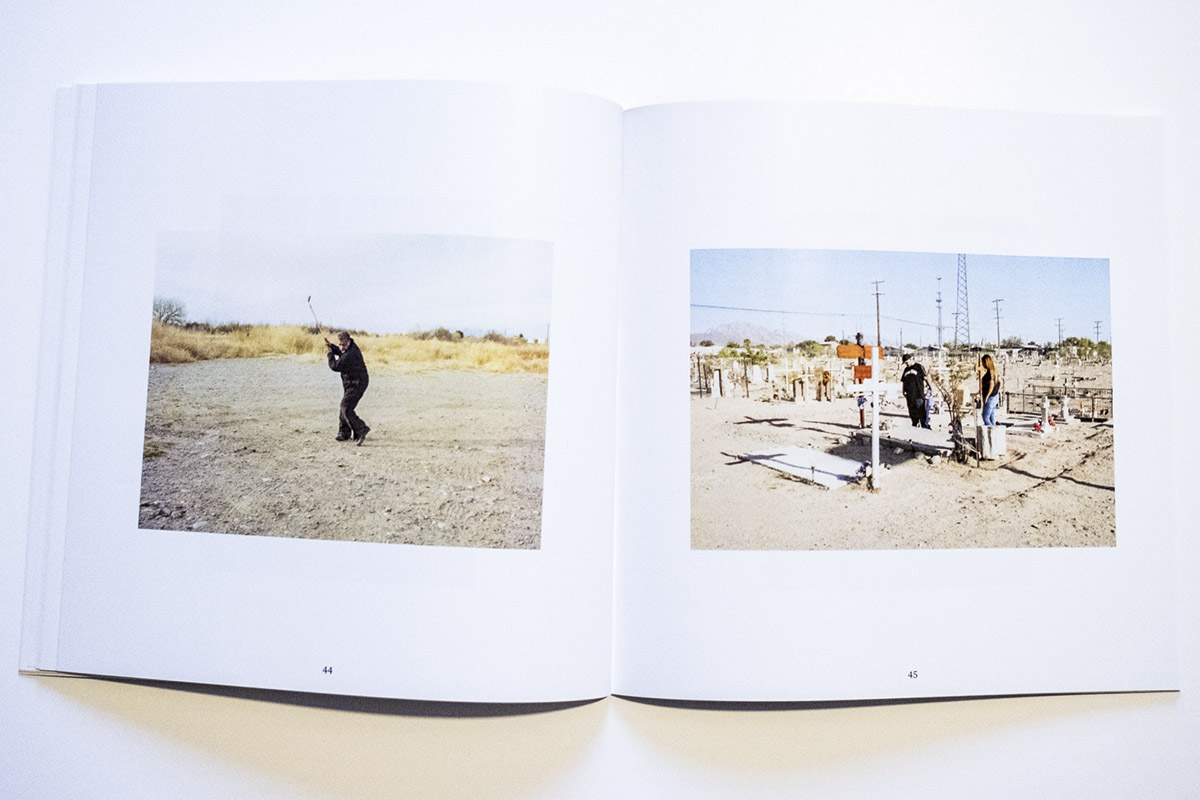
Proceeding through the work, the connection between people and place is brought to the fore by Morten’s documentary style images and Hernandez’s poems and writing. In, roughly, the first half of the book a story is narrated that describes the trials of a family. Some of these involve a father figure speaking to a son, relating stories and wisdom, and reflecting on a life lived in connection with the land. For example, at one point the narrator asks, somewhat rhetorically yet also with a hint of real interest, if there is any other way to make a living than tending to chickens. “What can I do?” he asks. It is a moment that at once recognizes the fluidity of the world, perhaps that changes in larger economic forces, yet proclaims that the connection to the environment and tradition is also somehow necessary. Moments like these abound in Hernandez’s words. In another moment, he relates the story of a mother losing a child, and elsewhere of a grandfather passing on an heirloom, and also half-forgotten memories that are spurred by unpredicted encounters with nature. In each instance, Morten’s images are well chosen, never didactic, but often offering a clear connection to the story/text. This strategy offers verisimilitude to the text as a whole and to Hernandez’s writing in particular. Even if fictional, throughout we find truths.
It is interesting that the cover of the book describes the writing as poetry. The writing is freeform, and it is easy to read as fragments of notes that could have been collected from life histories. The idea of poetry gains force though through the presentation in the latter half of the book, where the writing takes to describing some of the politics, debates, and concerns of The Chamizal Dispute surrounding questions of the boundaries of Juarez and El Paso and the shifting of the Rio Grande. That story involves more than a century of history, conflict, and stand offs between presidents in the United States and Mexico, eventually resolved in the 1960s. However, as the final text describes, a Peace Park was established in the “grey zone” that was under dispute, and even today people can gather there from both sides of the border, people who may not necessarily even be much aware of the foundation of the dispute can, in some sense, come together. A political grey zone has become a communal place along the course of the river. It is in this moment, that I think of the poetic dimension of this work. As a totality, it is a kind of epic poem, yet one that does not wish itself to be particularly grand. The stories of a river, of geopolitics, of nations, and everyday people are all imbricated, and this is what life is on the border is, an often strange, yet beautiful mixing of elements, people, and forces.
A well sequenced image-text photobook, Brave River offers the reader much to think about. The relationships between the different modes of working are thoughtful and the presentation of the narrative arouses questions in the reader that do not lend themselves to easy conclusions. This is a book to sit and think with, and to revisit again over time. Of course, the timing of the work is on point, yet the stories that it relates are evergreen. This is especially fitting for a book about the cultural landscape of the American Southwest, a place that has long been a hotbed of dispute, yet remains today a site of active change and adaptation. And while there are many high profile, newsworthy events and situations that continue to capture the public’s attention about this area, the authors have produced something that speaks to some of the enduring qualities and everyday realities of the region’s people. It is a place of human stories. And Brave River is an important installment in the long tradition of borderlands writing, yet it is a unique document that skillfully marries multiple approaches to representation that offer an unsentimental, yet strikingly true image of place.
Contributing Editor Brian F. O’Neill is a sociologist and photographer based in Phoenix, Arizona.
____________
Todd Morten – Brave River
Photographer: Todd Morten
Publisher: Mouthfeel Press, 2026
Poems: Tim Z. Hernandez
Language: English, Spanish
Design: Kimberly James
Perfect Bound; 74 pages; 39 color photographs; ISBN: 978-1-957840-45-1
____________
Articles and photographs published in the PhotoBook Journal may not be reproduced without the permission of the PhotoBook Journal staff and the photographer(s). All images, texts, and designs are under copyright by the authors and publishers.


Leave a comment