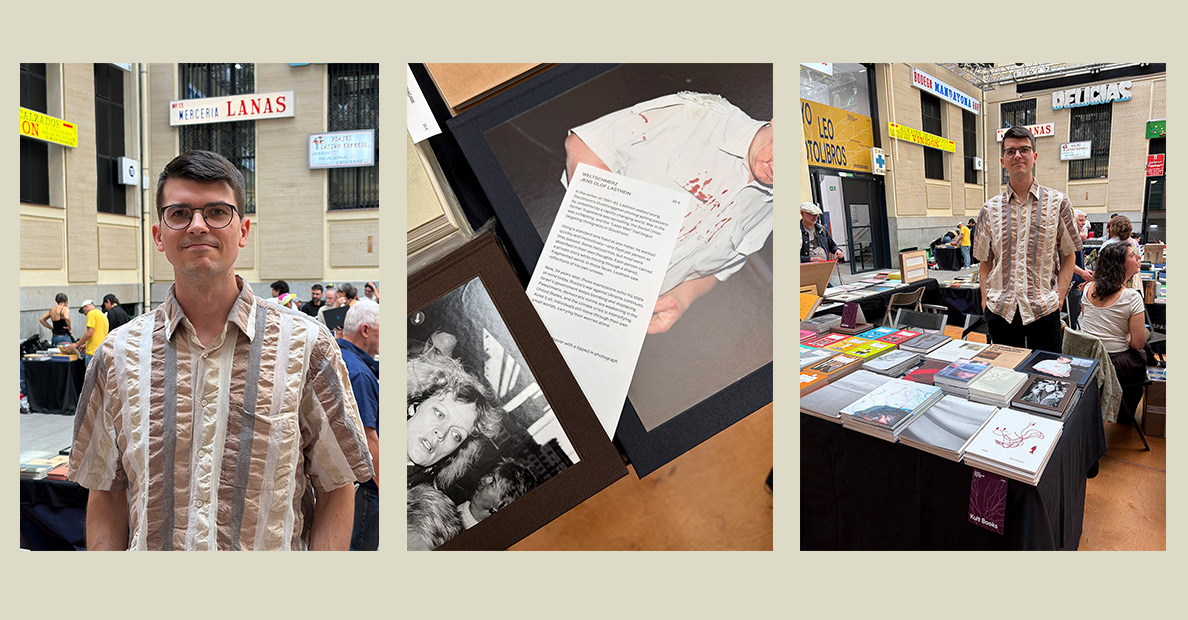
Interview by Hans Hickerson ·
HH: When did you start Kult and why?
JR: It was 2016. I was finishing my master’s. I had moved from Finland to Sweden to do my master of art in photojournalism. At the time, when starting the master’s, I was really passionate about daily photojournalism and the daily press, how to share events and news fast with photography.
But during my master’s the focus shifted to photobooks. I had a professor who was a huge photobook enthusiast, and it had a big effect on me as well. During my master’s I was working already on my own project, which I wanted to publish as a photobook. But I didn’t believe that any publisher would believe in my idea, my vision of the book, how I wanted it to become. I did do one submission to a publisher, but I never heard back from them of course, so I said, OK, I’m just going to publish it myself.
Prior to finishing the project, I made my first book ever, which was 2017, and I made it with a former classmate. I knew the book very well. She had a dummy already and it was very convenient to publish the very first book. It was titled Roots, by Latvian photographer Eva Saukāne.
HH: What is Kult’s publishing model? How do you choose books, and what kind of books?
JR: How do I work?
HH: Yes, do you pay them, do they pay you, do you split the cost? They submit or you don’t take submissions…
JR: I do take submissions, but I get them a lot nowadays, so quite frankly the chances of getting published through submissions are quite low. I still want to see work all the time, I think it’s a duty of mine as a publisher to see every submission that is being sent. I review all of them with care, but for me since I work alone the most important thing is that the communication and the personal connection work well.
And it helps to have met the artist, so many of the books I have found through fairs. People come to show their work, or I have known their work since before, and we have talked about collaboration for a while. I have made many books based on submissions as well, and it does happen to this day.
And I also have launched this book award. It was supposed to be 1 to 2 books, but now I’ve published 3 books in the end under this award, fully based on submissions without knowing the artist before. Within this it varies. In the beginning I didn’t charge anything for my work, but now I’m a family man and have to change my operation a bit. Until then I used to work a warehouse job, in the evenings and weekends, to support myself. At the time as well I used to pay most or a lot of the production costs for the books. And it’s not feasible any more. It’s not a hobby any more, it’s a profession, and I have to treat it as such. Having to take pay for my design work, for example, for my time and for my retouching which I always do for the books.
How do I choose books? First and foremost, I see how they fit the publishing line. What I’ve done before, where the line is going. I want to keep it surprising though. It can be boring if you can see what sort of books one would make. I want to keep it open for everything. As a rule of thumb, it’s projects based on some sort of documentary practice. Most of them are documentary or post-documentary photography and also works that discuss photography as a medium. Surveillance, for example. It’s not photos per se, but it’s related to photo technology.
HH: How many books have you published and have any been particularly successful or notable or maybe you have learned from some that weren’t so notable?
JR: Yes, absolutely. I have published 34 books so far, and 2 more are coming out this fall. So by the end of 2026 it will be 36 books. It’s about 6 or 7 books a year. That’s a good tempo for me. More than that would be difficult, since I also design the books. The most notable ones, I think, I have had a fair share of books that have been a success in their own ways. First and foremost every book that sells out is some sort of a success. In 2023 I had 2 books in the Aperture Paris book awards, nominated in the first photobook awards. So those 2 were maybe those that have gotten the biggest recognition. But I think many of my books would be on a par with them as well. It’s always a difficult competition. It’s based on a jury. Books that haven’t been nominated or awarded are not necessarily any worse in the end. But of course there are books that are not failures per se, but that are books that somehow fail in the production. Like mistakes, or even in the editing. Of course I get better in what I do during the years. And every book brings its own lessons for sure.
HH: How has the photobook scene changed over the years?
JR: Wow. I feel like it changes so often. I can’t keep up. Whenever I think I’ve learned something and I know something about the market, I go to the next fair and it’s fully switched around and there’s some new war and people are not spending money – they’re very careful about spending.
How has it changed? I’ve been part of this bubble for about 10 years now. There are trends that come and go. You can quite clearly see a book from 2020 or 2016. There were certain fashions. But also it stays the same. There are always new people who want to enter this bubble whereas others who want to exit after losing a bunch of money and time. I think the number of people in the scene is the same all the time. What I would like to have more is youth engaging in the photobook. Partly maybe for financial reasons that it feels that it’s not for them. It’s not doable to partake.
HH: Maybe they’re making zines.
JR: I think so and I hope so too. That’s the way to start. It is more democratic. You can go to your local library and make your first book with 10 euros. Just print it out and staple it and that’s it. It depends on one’s ambition – what you want to make of it. If you want to aim for publishing with Mack, go for it, I support you. But you can also just do it yourself.
HH: Where do you see photobooks going in the future?
JR: I think it’s going to stay more or less the same. It’s going to be a good bunch of passionate, enthusiastic people making their books, devoting all their time and money to making books for a bunch of very enthusiastic collectors and makers and photographers. I don’t see a huge change in this. I don’t think it’s becoming more mainstream based on these 10 years I’ve been following the scene.
HH: What photobooks have inspired you the most or that you use as models? I have to just name a few so I would say Lars Tunbjörk’s Office, the 2001 edition, that’s been a huge inspiration for me. What I like about it is the design in the sense that – of course Lars’ photography – I’m a huge fan of everything he does – but the design of the book leaves room for the pictures. They take over and the quality of the reproduction is great. I just love that book and the sequencing. It’s one of my all-time favorites. And what I like about it also is the timelessness. I evaluate a lot of things based on the timelessness factor.
Let’s say another big inspiration for me is Raised by Wolves, by Jim Goldberg. I feel like it’s a book that doesn’t get old. It’s been very inspiration in how it’s been made, the narration. Eugene Richards’ Dorchester Days as well. These books come from my documentary background. These were always like masterpieces for me. Like modern classics, like Mike Brody’s A Period of Juvenile Prosperity. I like the work. The book I love it as well. It’s hard not to like. It’s a milestone. It’s a classic.
HH: Are you still doing your own personal work?
JR: I’m trying to. I’m trying to do my personal work. I started as a photographer as I mentioned. I’ve published 2 of my own books as well. I have photographed the third one. The photography for the third one is done. But I don’t have the time to design it. It needs conceptualization and the thinking part. So I would like to say yes, but the proper answer is I try to.
Hans Hickerson, Editor of the PhotoBook Journal, is a photographer and photobook artist from Portland, Oregon.
Articles and photographs published in the PhotoBook Journal may not be reproduced without the permission of the PhotoBook Journal staff and the photographer(s). All images, texts, and designs are under copyright by the authors and publishers.


Leave a Reply