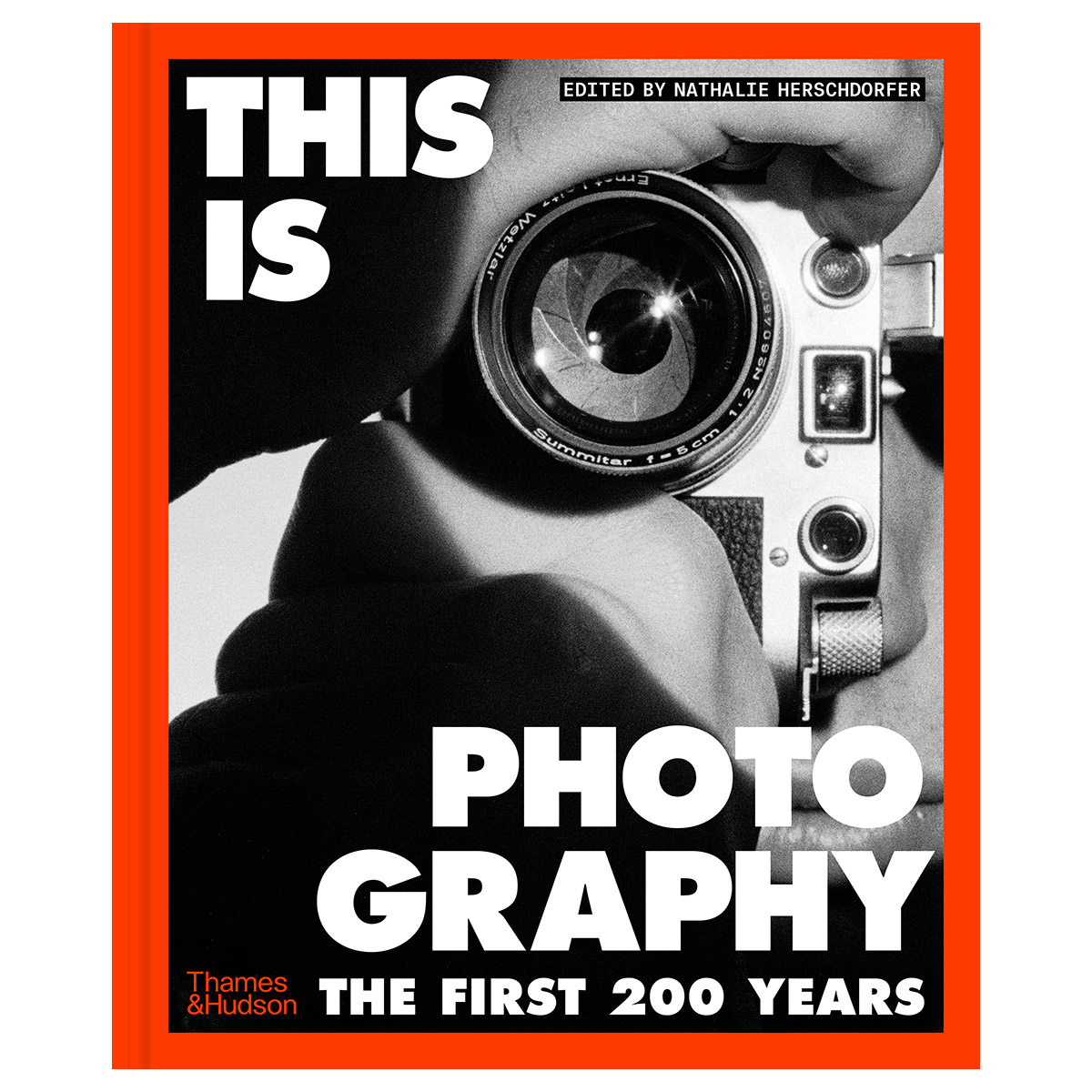
Review by Gerhard Clausing •
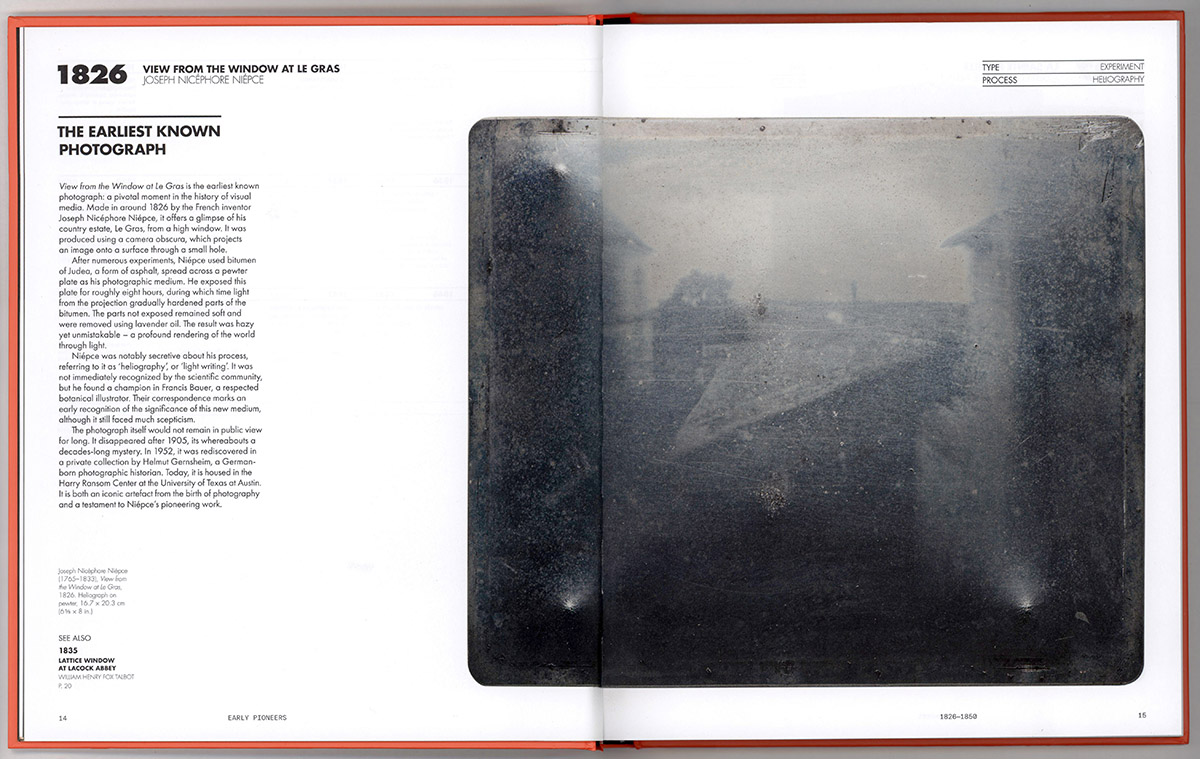
How do you deal with 200 years of photographic achievements in a single volume? It may take a little patience to see what Joseph Nicéphore Niépce saw from his upstairs window. A roof slopes away from us, a wall emerges from the gray, and gradually the marks on a pewter plate resolve themselves into a place in France where somebody once stood and looked. I like the fact that this photograph, made around 1826, still asks something of its viewer. Two hundred years later, with an ample supply of perfectly legible photographs passing across our screens every day, how often do we devote that much time to a single image?
Nathalie Herschdorfer, Director of Photo Elysée in Lausanne, has organized this anniversary volume around individual years. The publisher’s statement draws attention to the breadth of the undertaking, from Eadweard Muybridge’s studies of motion to Rosalind Franklin’s X-ray imaging of DNA. For me, much of the pleasure lies in the smaller connections one can make along the way. The year is printed prominently, the photographic process is identified, and a discreet “See also” in the margin offers an invitation to disregard chronology altogether. Longer essays by Herschdorfer, Himes, Nadar, Campany, Lucia Moholy, and others, as well as timelines, a glossary and a bibliography complement the succession of short entries. One can browse quite happily here and still come away having learned something about how a photograph works.
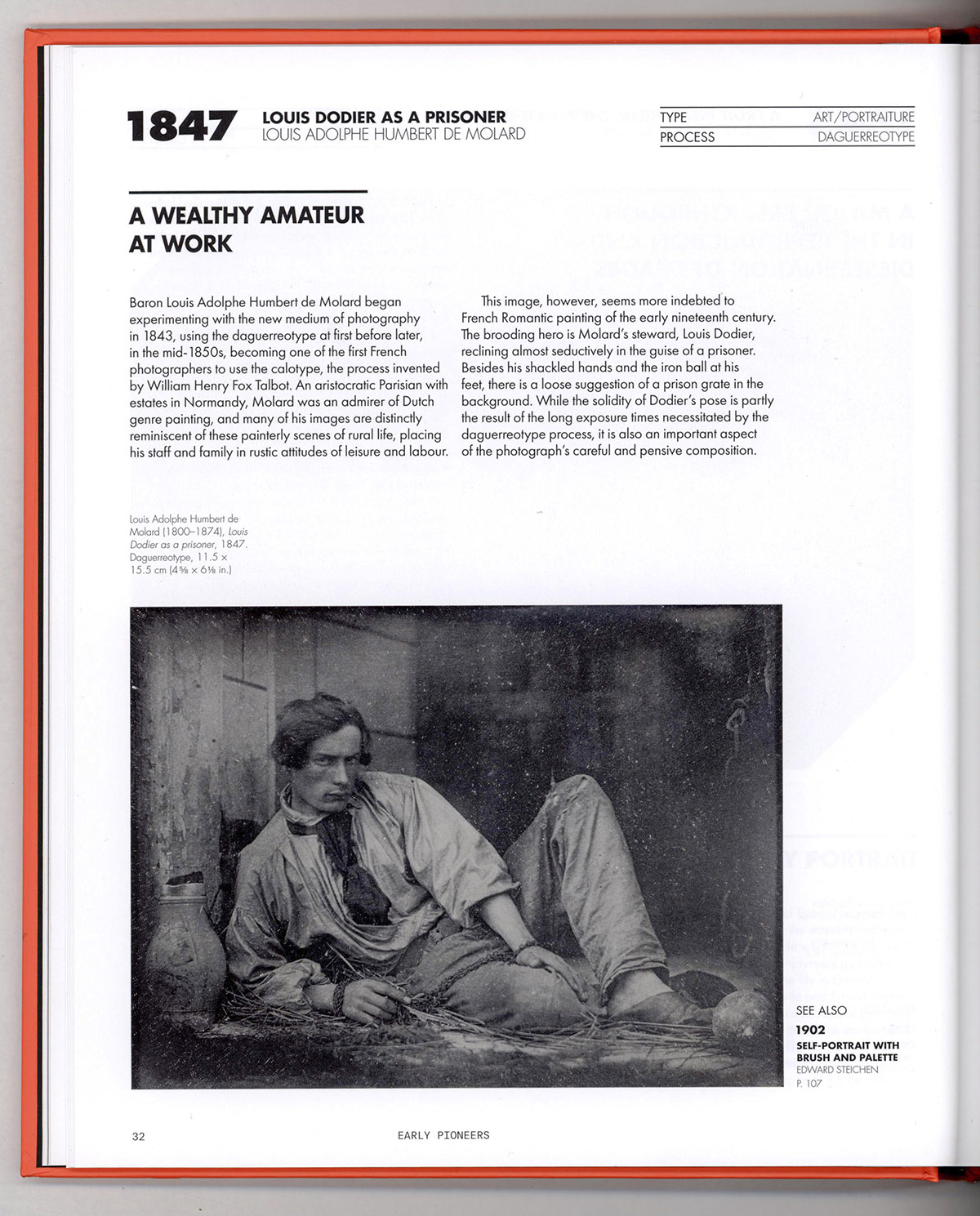
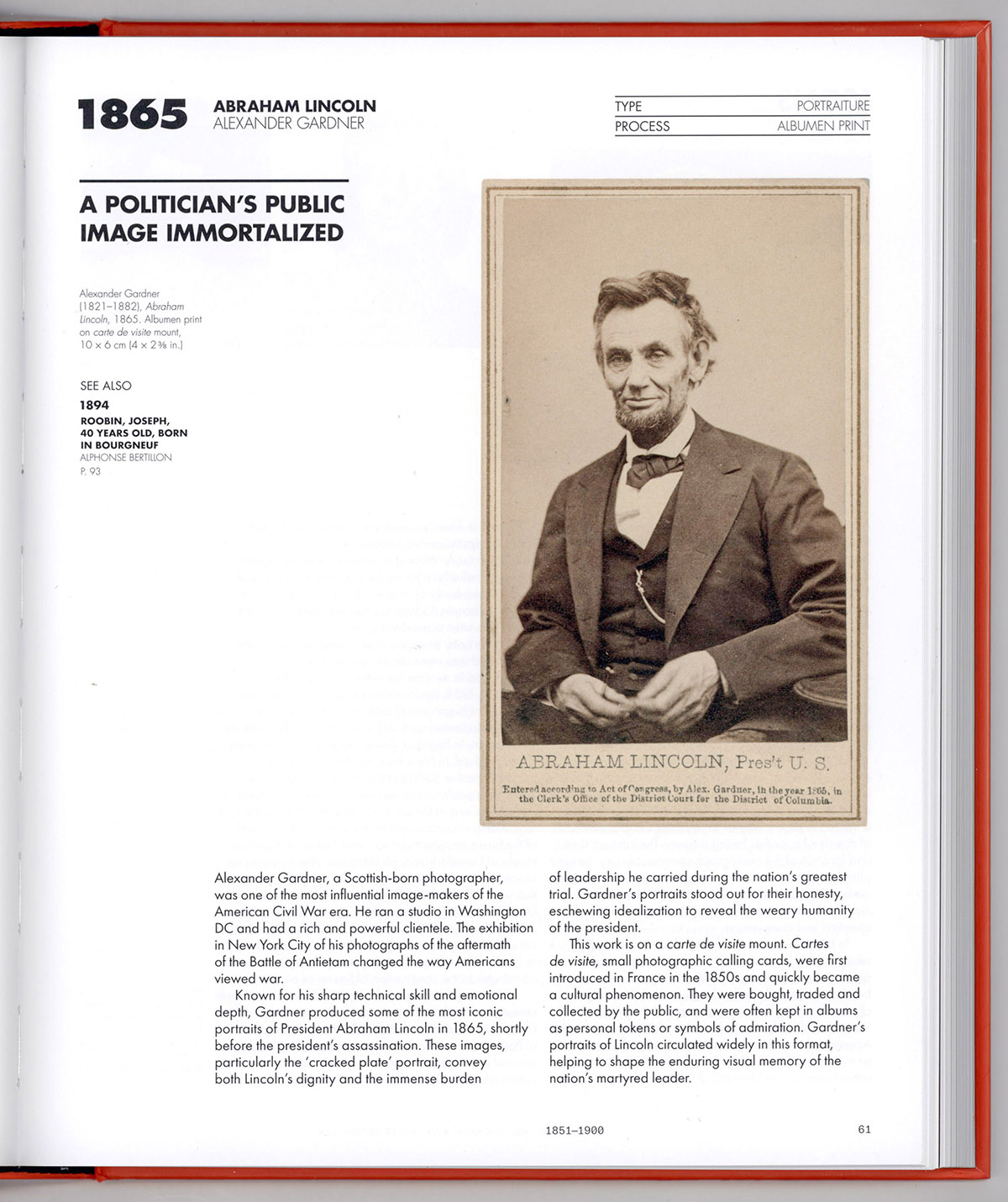
Let’s look at some more examples. I am highlighting approximately every 10th year below to show you the range of what is featured in this impressive and comprehensive photobook. Consider the handsome prisoner reclining on page 32. His hands are shackled, an iron ball rests at his feet, and he looks remarkably comfortable. In 1847, Baron Louis Adolphe Humbert de Molard enlisted his steward, Louis Dodier, to play the part. The long exposure required for a daguerreotype helps explain the settled pose. It also gave the photographer an opportunity to indulge his taste for French Romantic painting. Eighteen years later, Alexander Gardner’s Abraham Lincoln sits with his hands loosely gathered in his lap. Here the innovation is partly a matter of distribution. This little albumen portrait, mounted on a carte de visite, could be bought, exchanged, and slipped into a family album. Imagine turning a page from a relative to the President of the United States.
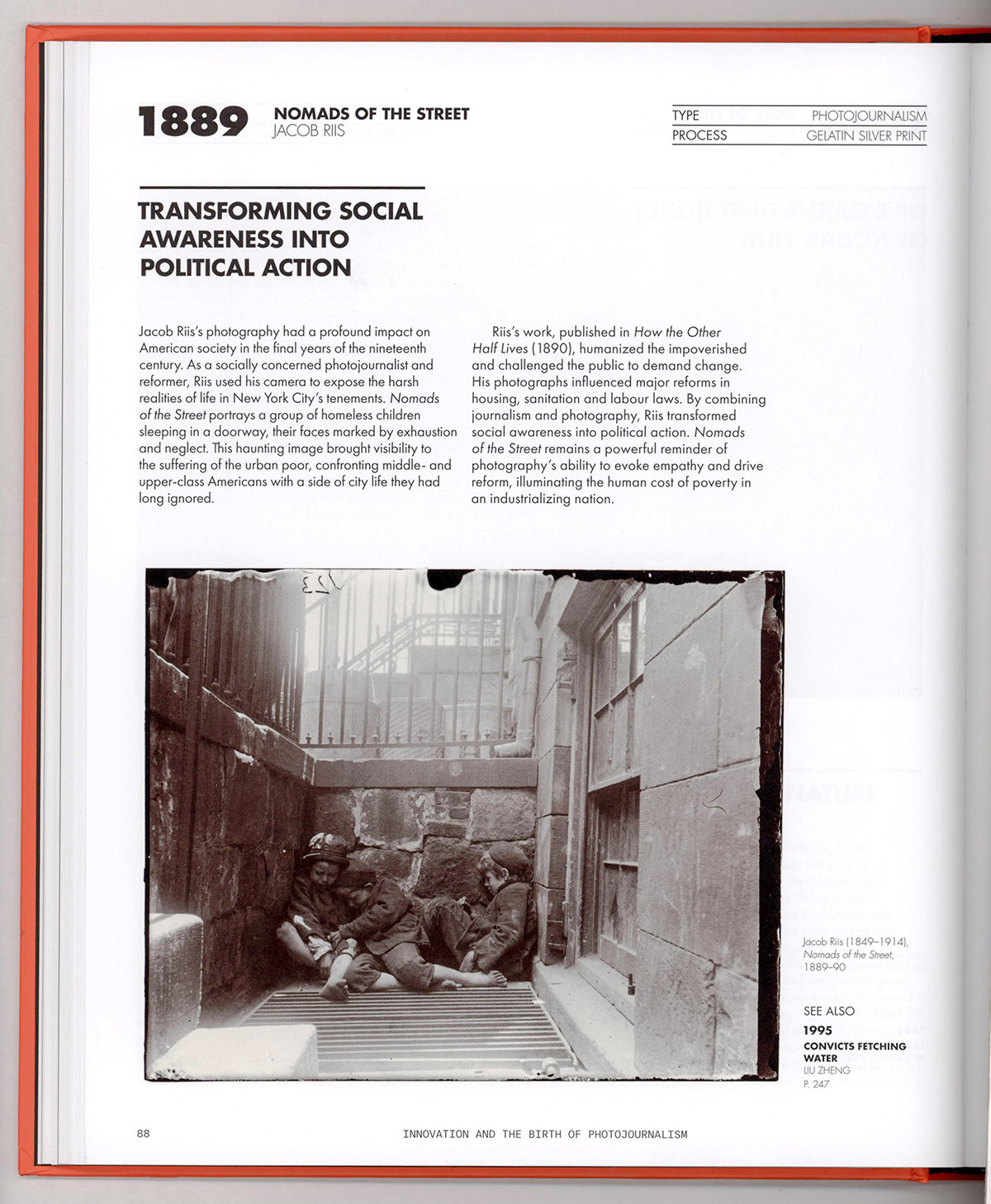
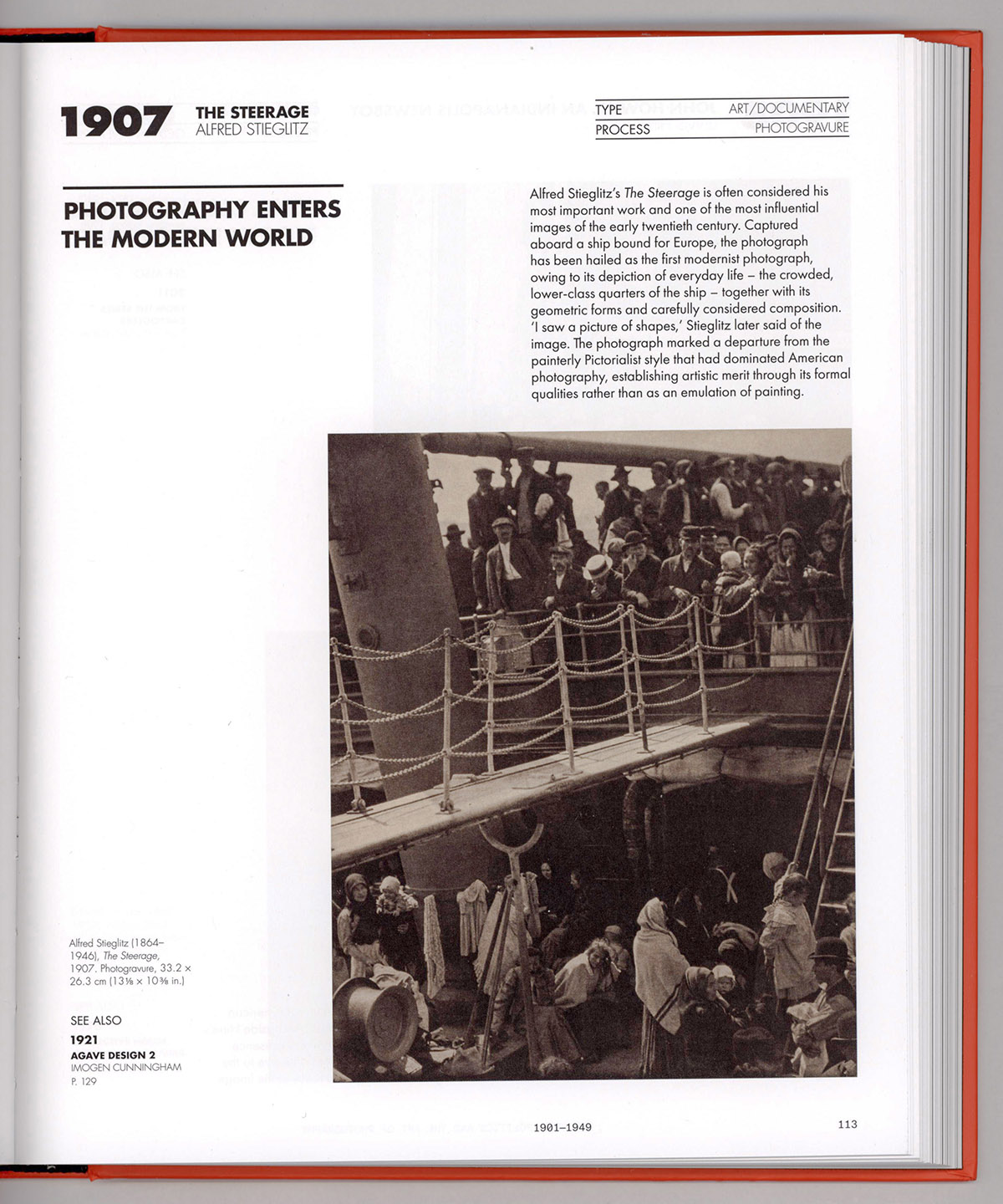
Who gets to appear in a photograph, and who gets to own a copy? Jacob Riis’s Nomads of the Street (1889) brings us down to the level of children huddled in a New York doorway. Through publication in How the Other Half Lives, such pictures reached readers who had the means to do something about the conditions Riis described. Alfred Stieglitz’s The Steerage (1907) gives us another arrangement of people in close quarters. My eye follows the bright gangway across the photograph before returning to the passengers above and below it. A single piece of shipboard equipment makes a handsome geometric composition and shows us how thoroughly people can be divided in a shared space.
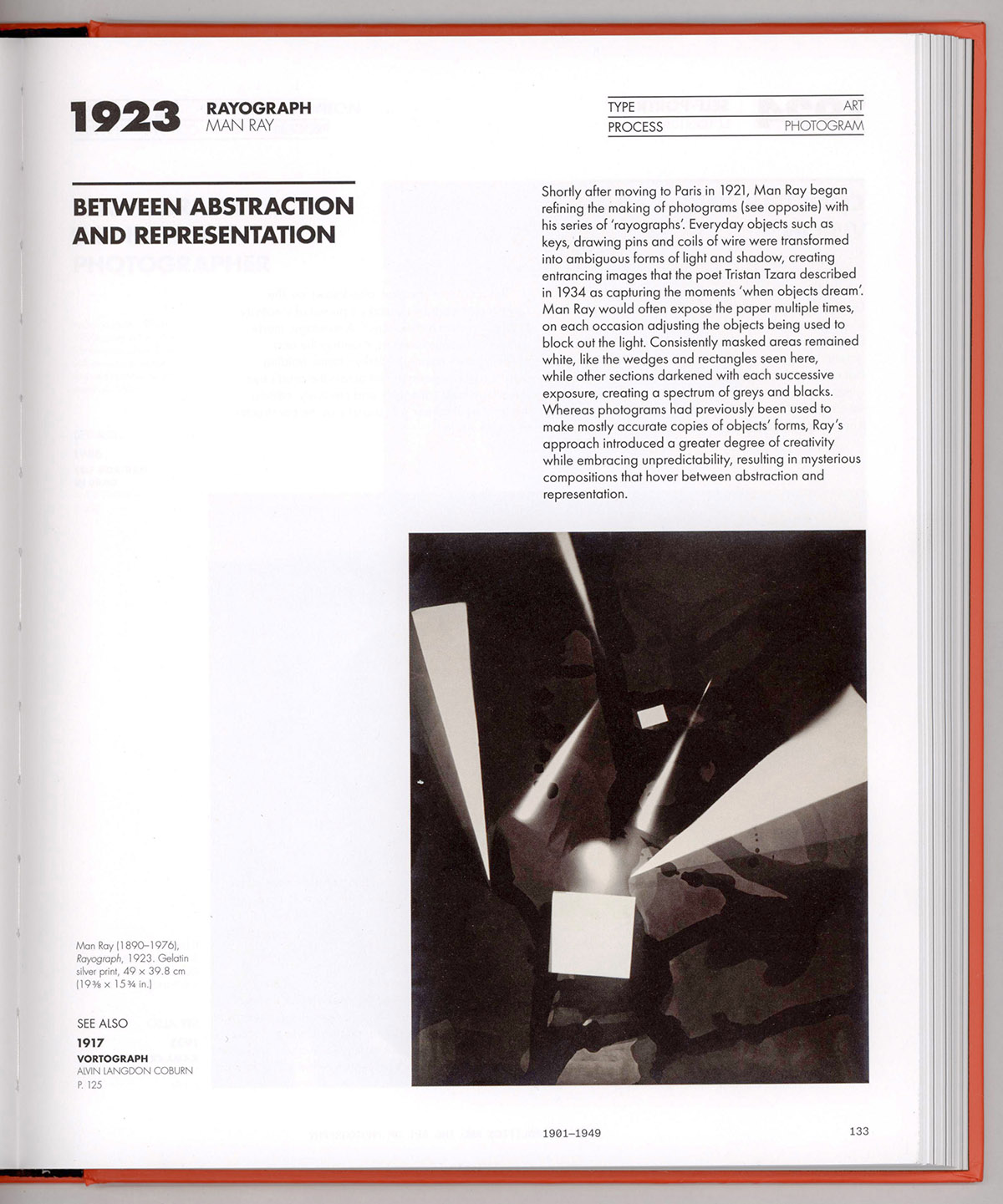
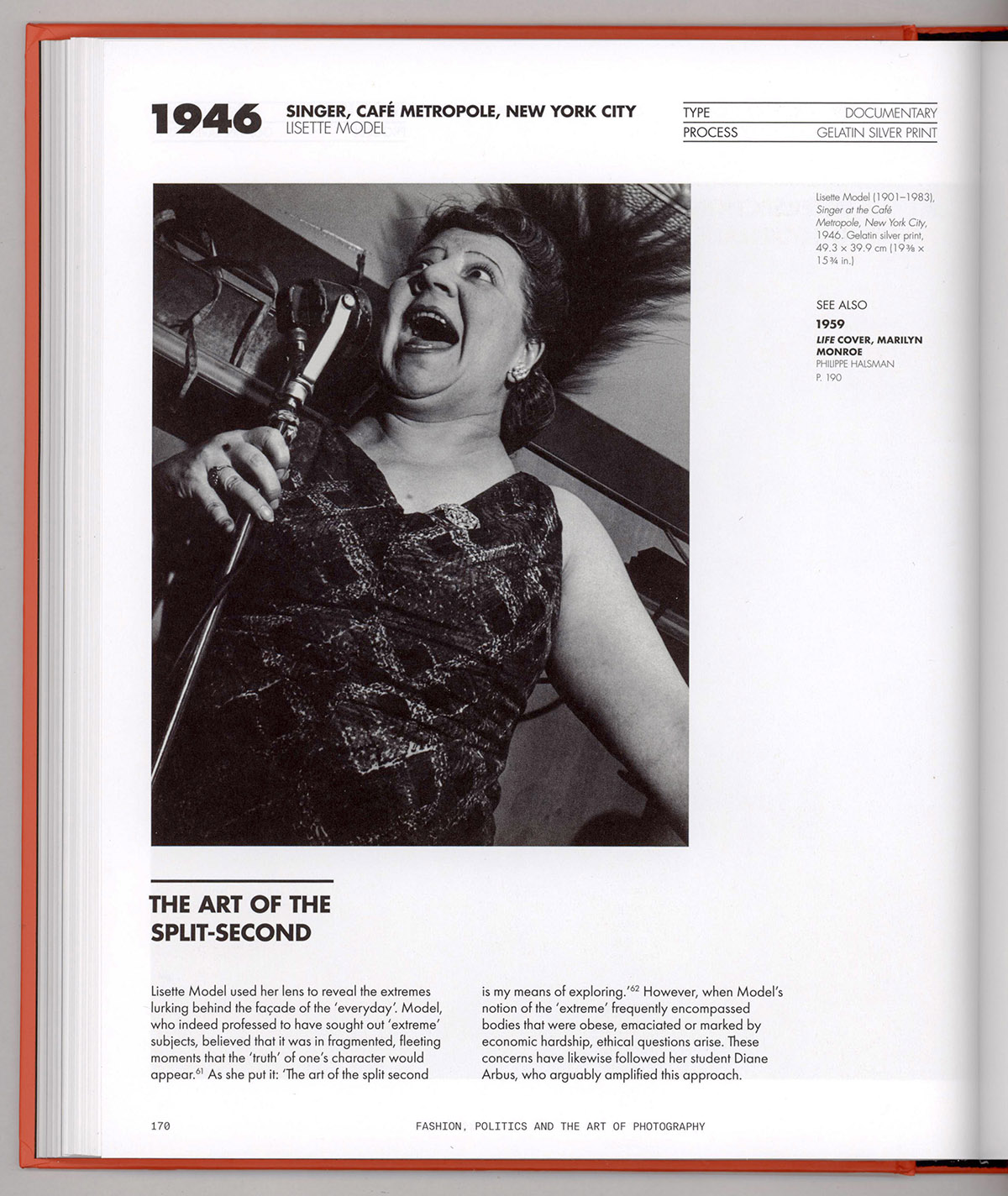
Then along comes Man Ray, who at times completely dispenses with the camera. In his 1923 Rayograph, moving objects between exposures leaves white wedges, a pale rectangle, and passages of deep black on light-sensitive paper. I found myself trying to identify the objects, then wondering why I needed to. Lisette Model offers a different sort of photographic surprise on page 170. Seen from below, her Café Metropole singer grips the microphone stand, mouth wide open, hair flying. We can practically hear the note. Would the singer herself have chosen this fraction of a second to stand for her performance? Model’s picture leaves that question open.
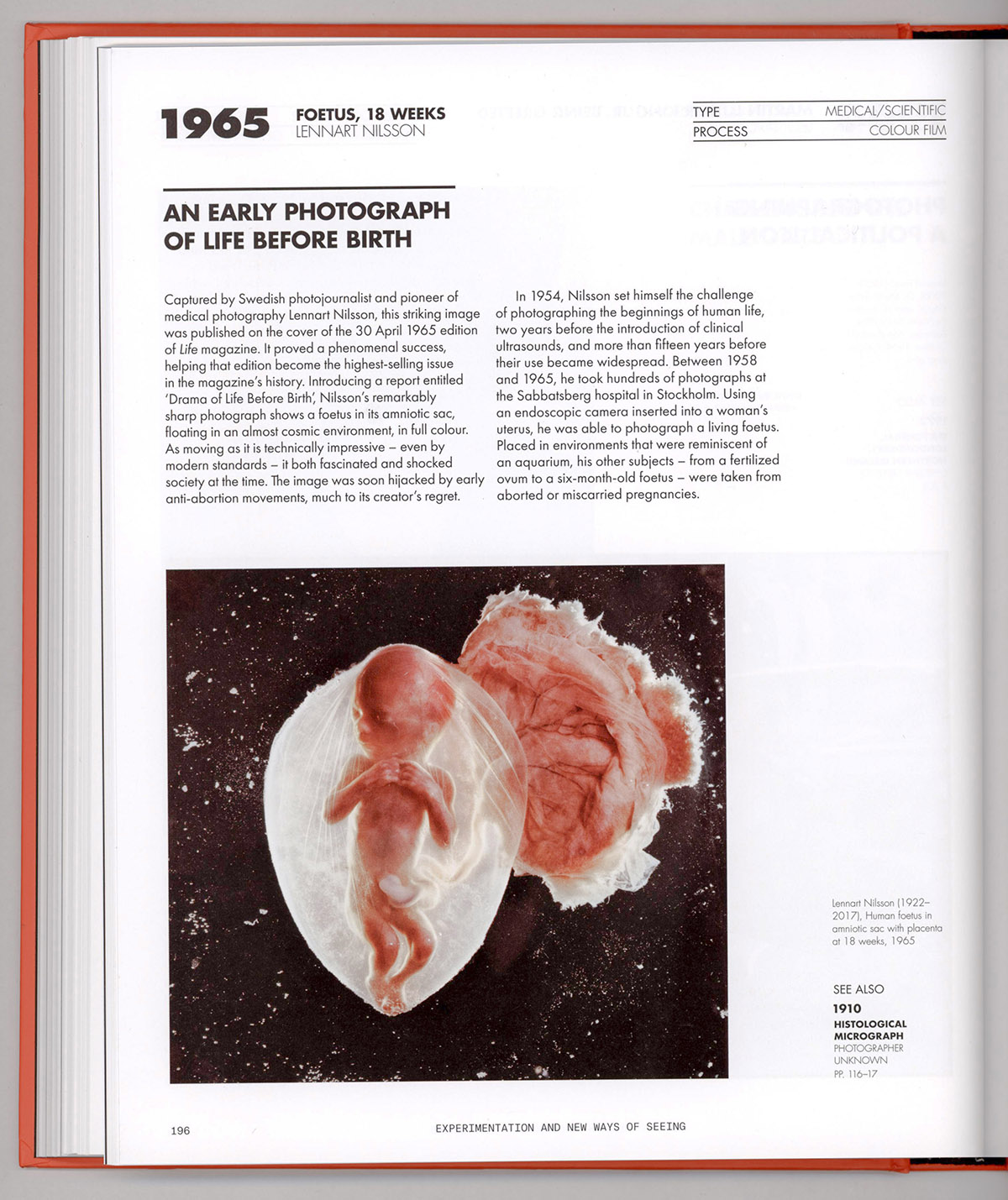
The brief entries occasionally leave me wanting another paragraph, but then there is always room for further research as one gets inspired by this compendium. Lennart Nilsson’s Foetus, 18 Weeks, reproduced on the cover of Life in 1965, is especially striking in this respect. The translucent sac glows against a dark field flecked like a night sky. The text distinguishes Nilsson’s experiments with an endoscopic camera from his photographs of specimens outside the womb. Given how readily a viewer might take this particular image for a glimpse inside a living woman, I would have welcomed a more explicit account of how the cover photograph was made.
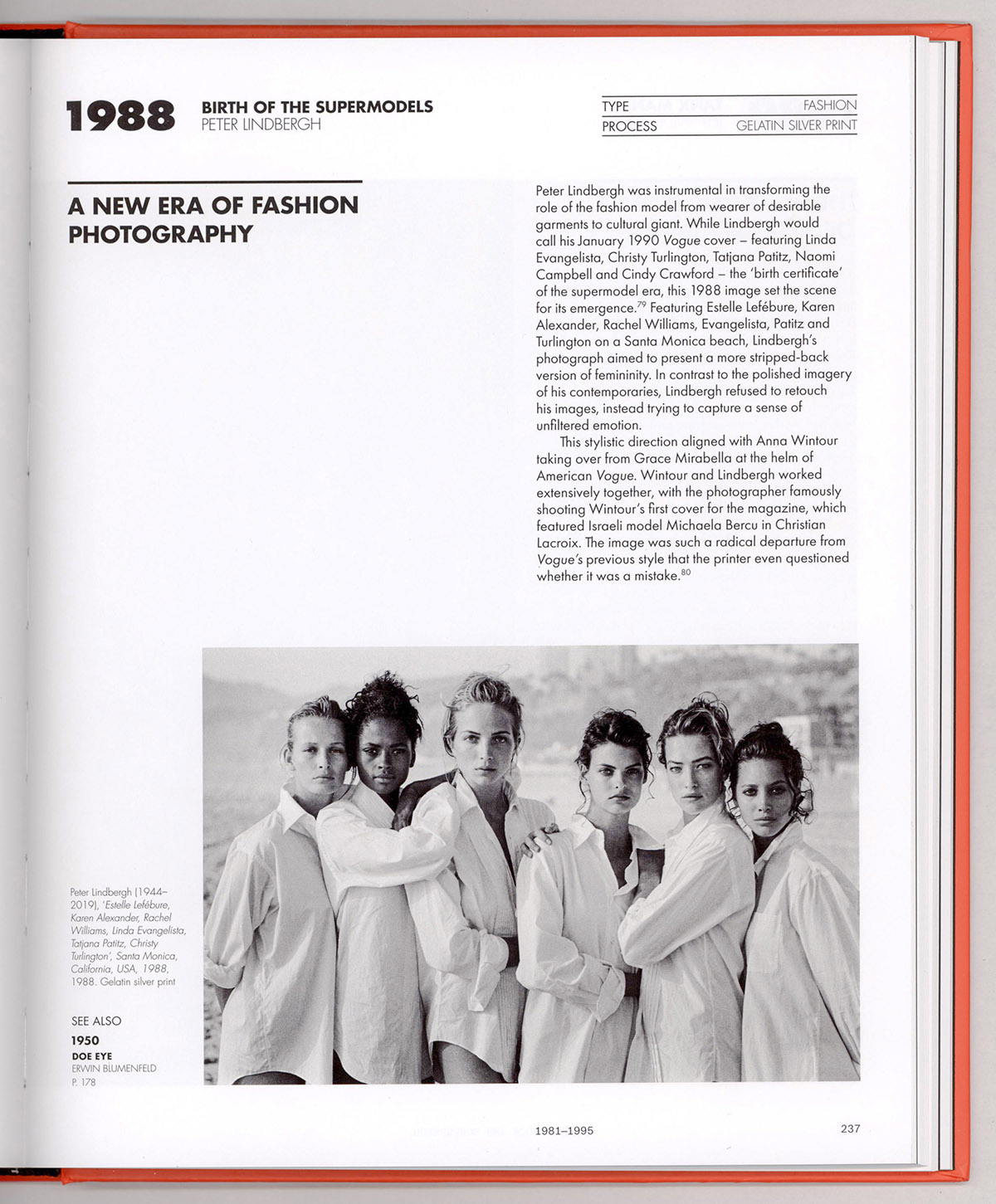
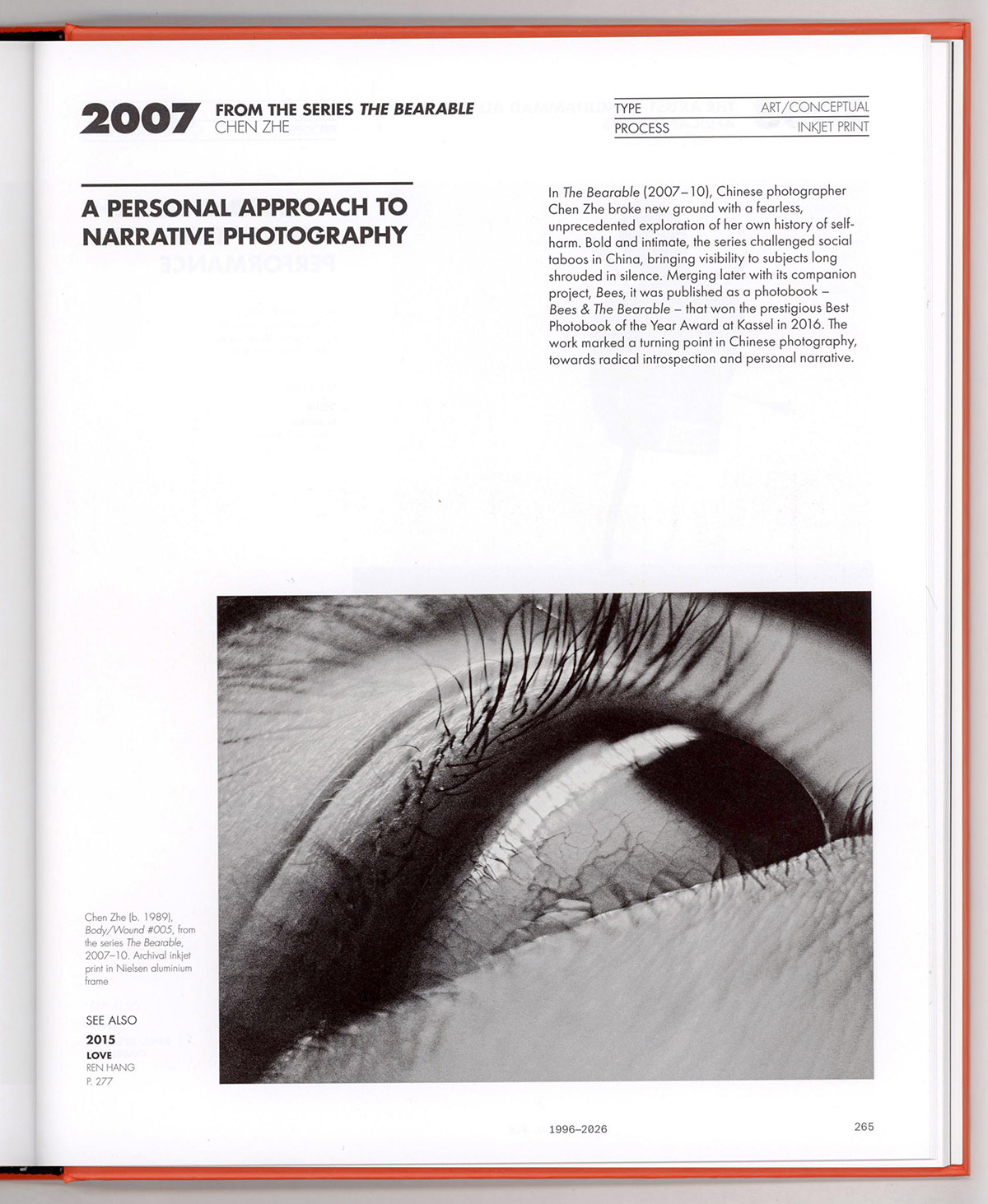
Two later selections reward a second look for quite different reasons. On a Santa Monica beach in 1988, Peter Lindbergh gathered six models in loose white shirts. An arm reaches across a shoulder, heads lean together, yet each woman holds our gaze individually. One can see how readily fashion customers might remember the faces and forget the shirts. In Chen Zhe’s Body/Wound #005, from her autobiographical series The Bearable (2007–10), a single eye fills the frame. We are close enough to trace the tiny vessels across its surface. How little that physical proximity tells us about another person’s pain! The series eventually found a home alongside its companion project in the photobook Bees & The Bearable.
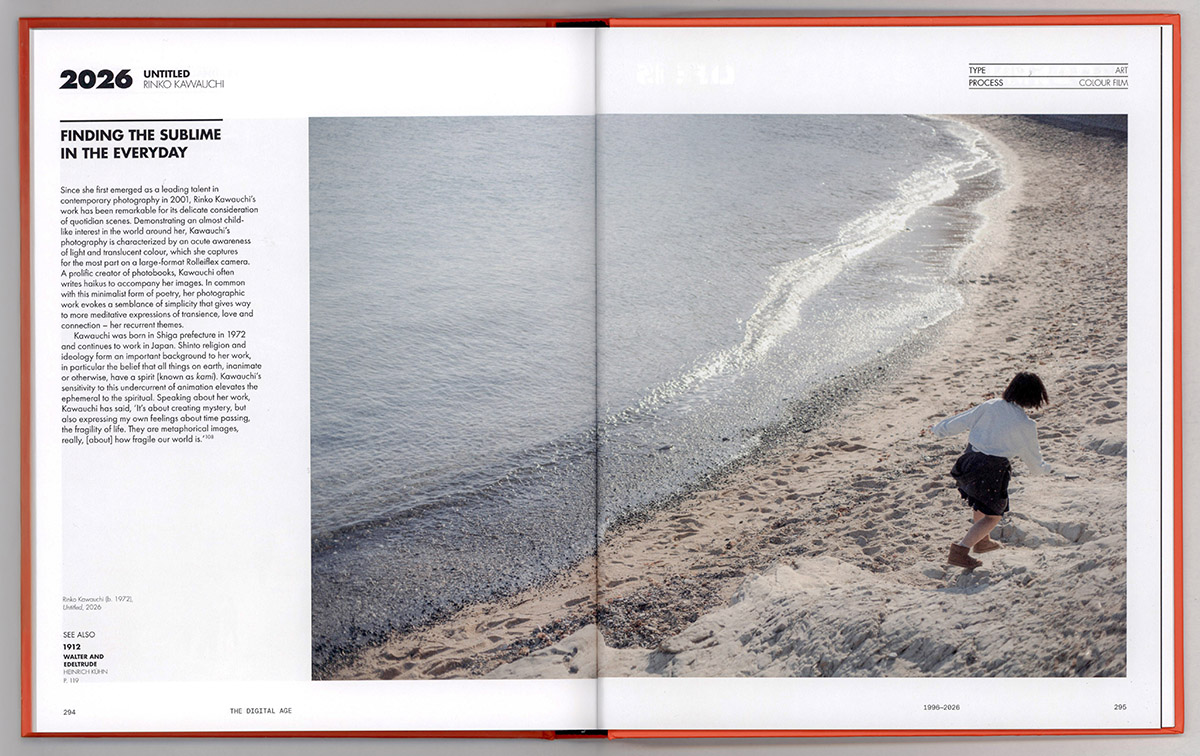
Herschdorfer gives the 2026 spread to Rinko Kawauchi. A child negotiates a sandy slope at the far right while a little wave breaks across two pages. I especially enjoyed discovering the process listed in the upper corner of this section devoted to the digital age. Kawauchi used color film. Turn back to Niépce’s window and there is an unexpected kinship between these two photographs. Someone noticed what the light was doing in a familiar place and gave us a chance to stand there, too.
So, to summarize: This Is Photography: The First 200 Years takes us from Nicéphore Niépce’s faint view through an upstairs window to Rinko Kawauchi’s photograph of a child at the water’s edge. What changes most across those two centuries is the relationship between the person who makes a photograph, what is pictured, and those of us who eventually see it.
Consider what happens when a photograph can travel. Alexander Gardner’s portrait of Abraham Lincoln, printed on a small carte de visite, allowed a family to place the president in an album alongside their own relatives. Jacob Riis’s photograph of children sheltering in a New York doorway made a different claim on its viewers; it asked people to recognize as their neighbors’ children they might otherwise have passed in the street. In both cases, where the photograph ended up mattered as much as where the photographer stood.
Herschdorfer’s year-by-year arrangement also rewards a reader willing to skip a century. In 1847, Louis Dodier could sustain his pose as a shackled prisoner through the long exposure a daguerreotype required. In 1946, Lisette Model caught a café singer from below in the middle of a performance. One man had time to settle into a role. One woman became known to us through a fraction of a second, a moment which she would pobably not have chosen. Seen together, the pictures turn a technical advance in exposure time into a question about who gets to shape a portrait.
Such trips through two centuries of images are the pleasure of this volume, and an excellent reason to return to it. Once we have looked up the date and identified the process, we can turn back to the photograph and ask a more interesting question. How did a particular way of making and sharing a picture affect what we think we know or don’t know about what is shown?
____________
Gerhard (Gerry) Clausing, Editorial Consultant and previous Editor of the PhotoBook Journal, is an author and artist who investigates the role of culture and memory in visual art.
____________
Nathalie Herschdorfer, Editor – This Is Photography: The First 200 Years
Photographers: Various
Texts: Nathalie Herschdorfer and others
Language: English
Publisher: Thames & Hudson, London and New York; © 2026
Hardbound, with illustrated cover; 320 paginated pages, 9.4 x 11.25 inches (24 x 28.6 cm). Printed in Spain by Estellaprint. ISBN 978-0-500-03036-3
___________
Articles and photographs published in the PhotoBook Journal may not be reproduced without the permission of the PhotoBook Journal staff and the photographer(s). All images, texts, and designs are under copyright by the authors and publishers.


Leave a Reply