Review by Brian F. O’Neill ·
It is December 9, 2025 and it is my first time in Japan. As a photobook collector, I head to Jimbocho, the well-known neighborhood for books (I actually revisited on December 18 too). Most of what I find on the shelves as I peruse the stores are Japanese novels. I stop at the places that my Lonely Planet guidebook and some YouTube videos have mentioned. Bohemian’s Guild is interesting as promised, and it is densely packed floor to ceiling. The upstairs has an art gallery. But, I’m not really finding what I am looking for. As I take a turn and pass people waiting in another one of the ubiquitous orderly lines for ramen noodles, I pass the distinctive, multisided architecture of the Jimbocho Yoshimoto Manzai Theater. Ahead of me in the distance, I see some people in a bookstore on the first level of a multi-level brick building. It is getting late and the warm light of the interior is starting to spill through the floor to ceiling glass panel and door that is surrounding the entrance. In all caps, text located at the bottom left of the pane reads STACKS BOOK STORE.
Inside, I quickly find what I have been looking for: zines and books with images in them. Not all are photobooks. Some are novels. Some have various types of illustrations. Some of the photobooks don’t interest me. But, as with many things in Japan, within a small space you can find much to explore. Time to take off my down jacket, and to breathe.
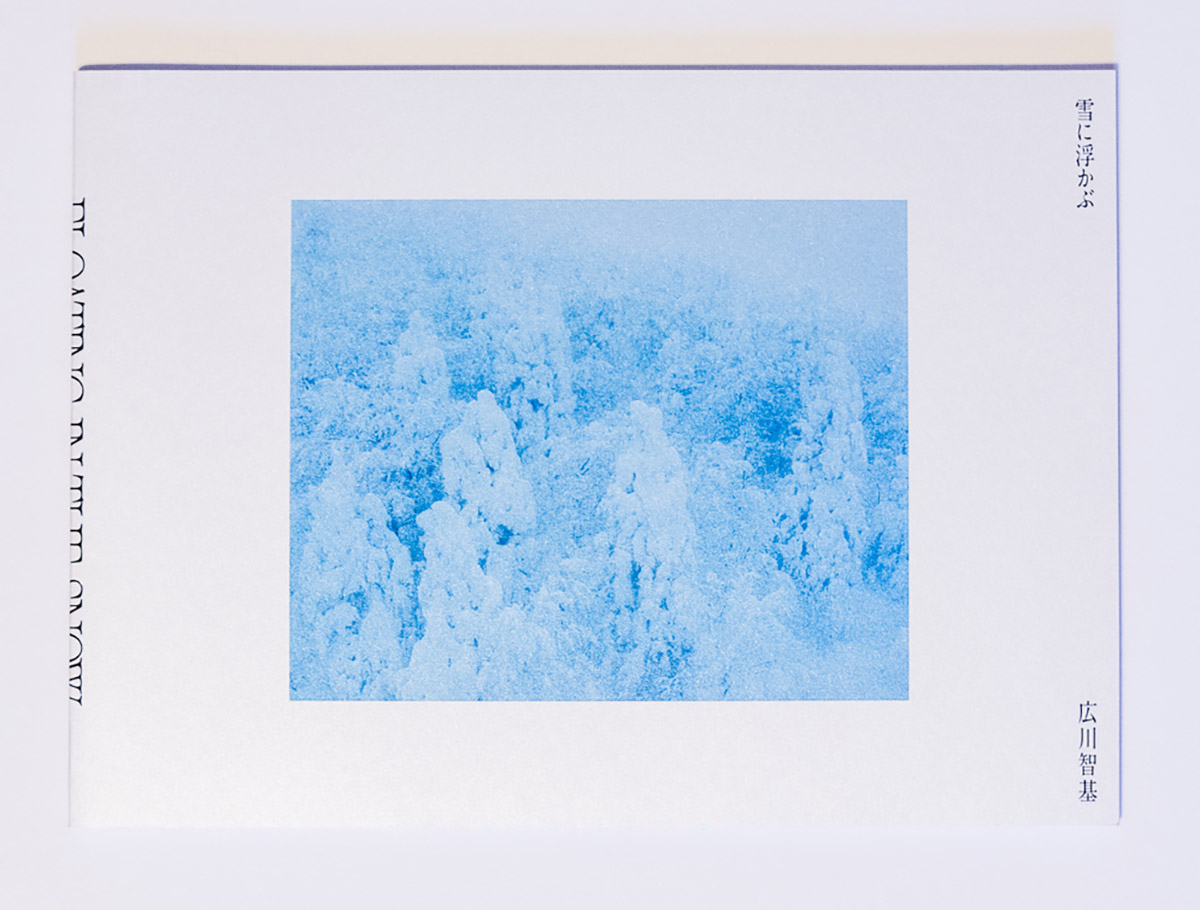
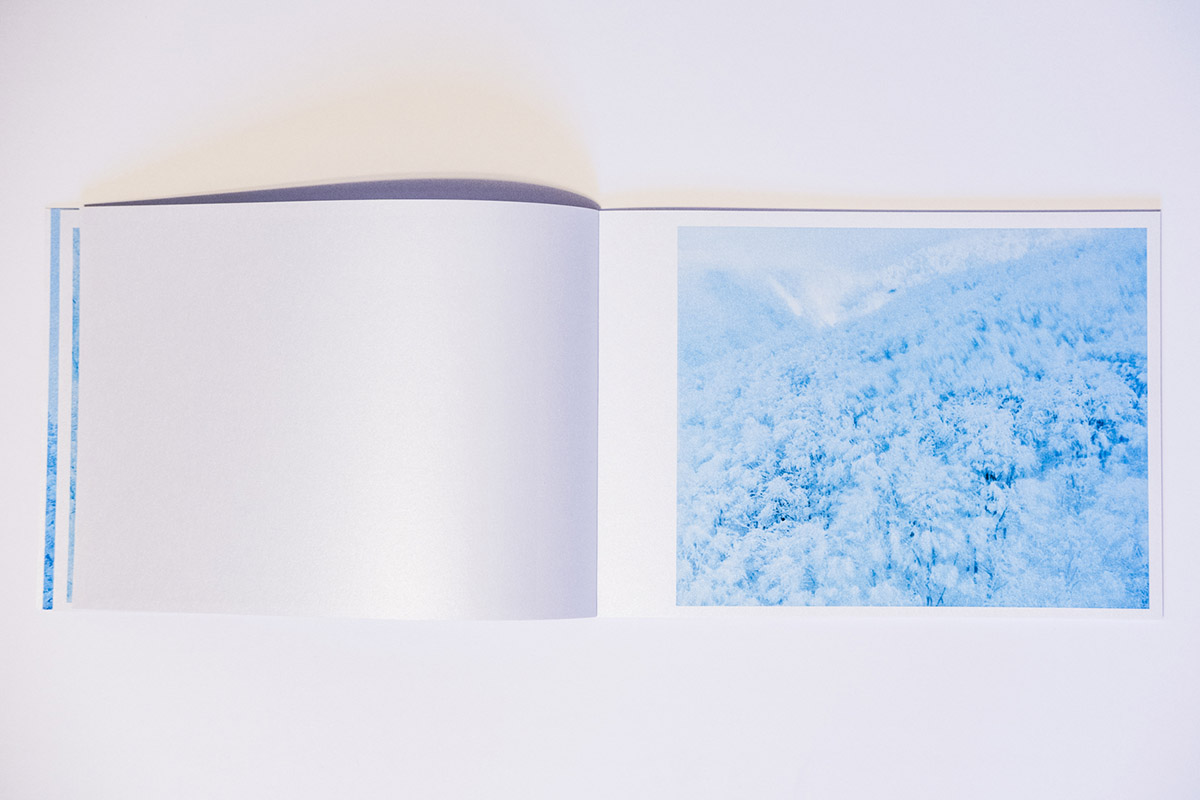
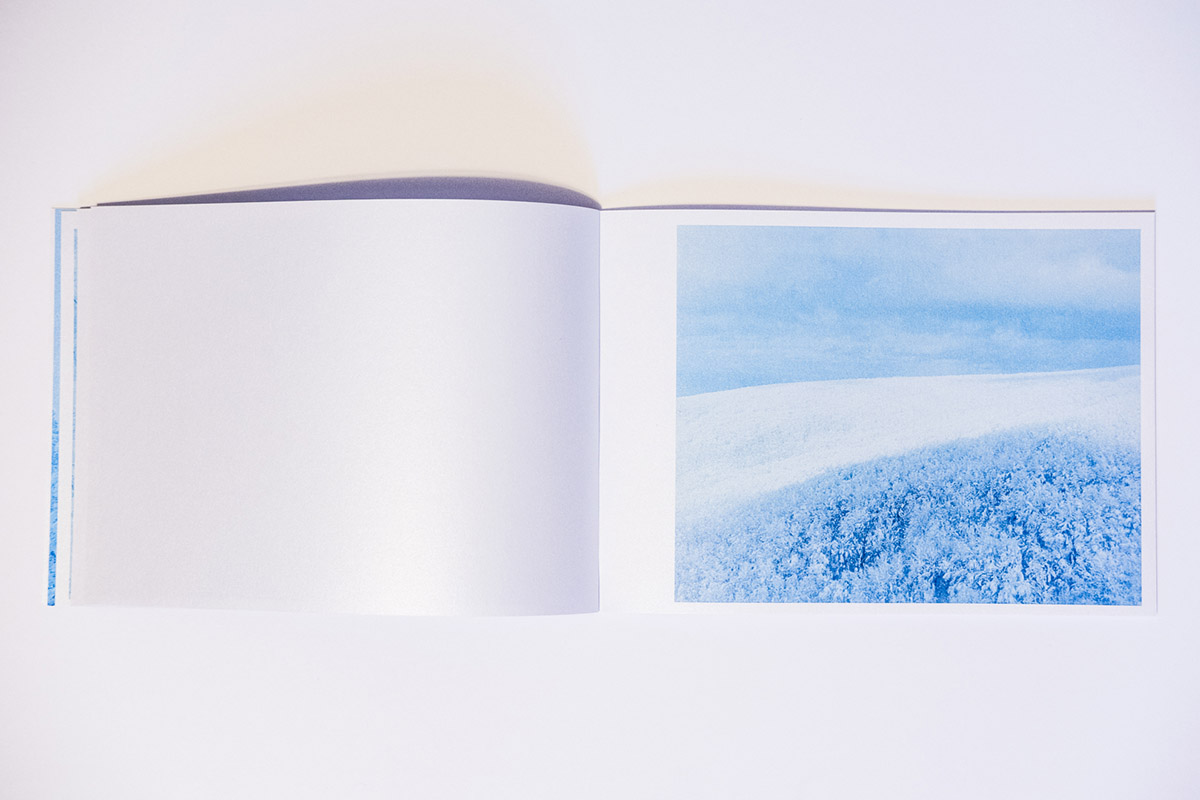
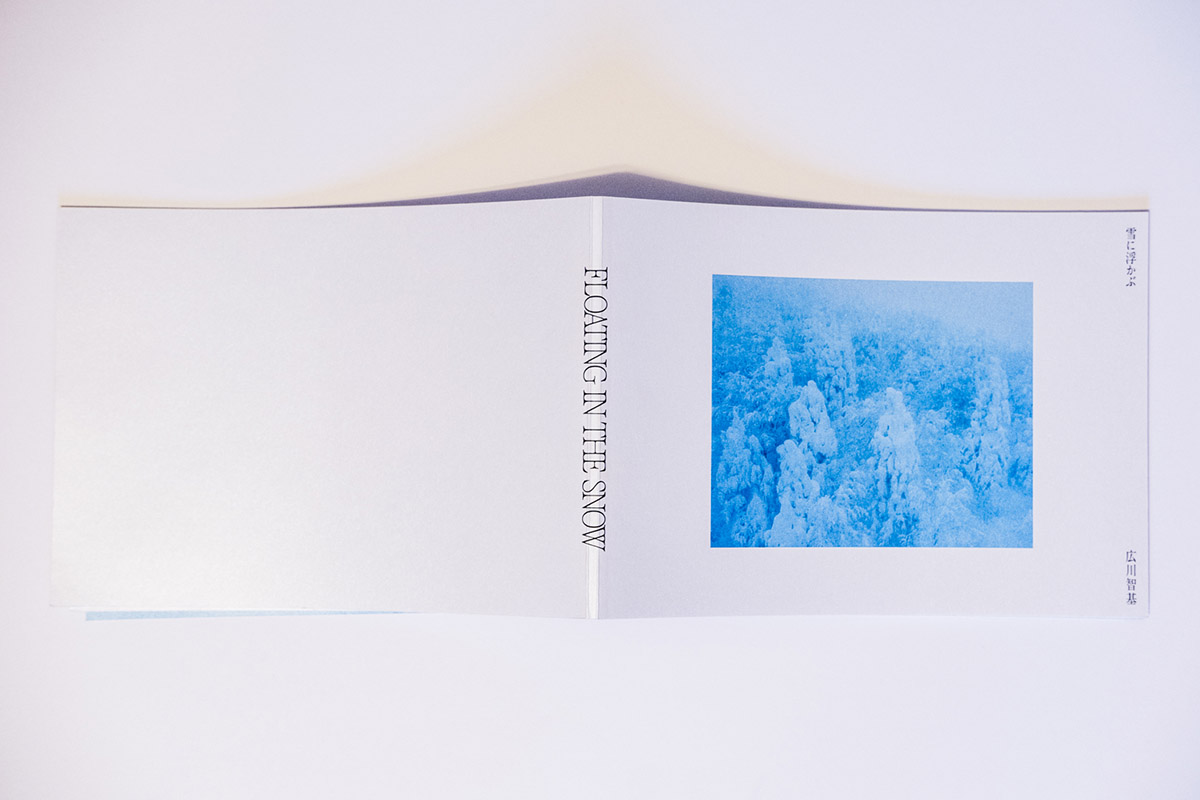
Within a plywood shelf near the floor, a sparkle catches my eye. Looking closer, I cannot read the words on the spine. This is how I encountered Floating in the Snow (you must open the entire book, exposing the full spine to see the words) by Japanese photographer Tomoki Hirokawa. Released in 2025 under his own imprint, the photobook is about the locations of Mount Moriyoshi, Tohoku, Mount Zao, and Hakkoda, all roughly in North-central Japan. While some of the locations, like Mount Moriyoshi, are known for the “snow monsters,” or “Juhyo” in Japanese, that develop as the trees become caked in snow amidst the depths of winter, in my correspondence with the author, he described it in the following way: it is a “natural phenomenon that forms when various conditions—such as temperature differences, humidity, and wind—come together, causing snow and ice to accumulate on trees. Mt. Moriyoshi in Akita, Mt. Zao in Yamagata, and Mt. Hakkoda in Aomori are known as the three major locations in Japan where this phenomenon can be seen.” While these sites are exceptional in their own right, Hirokawa has managed to transform them further through a combination of his distinctive images (made over several years, 2013-2019), color palette, and the printing techniques used in this project.
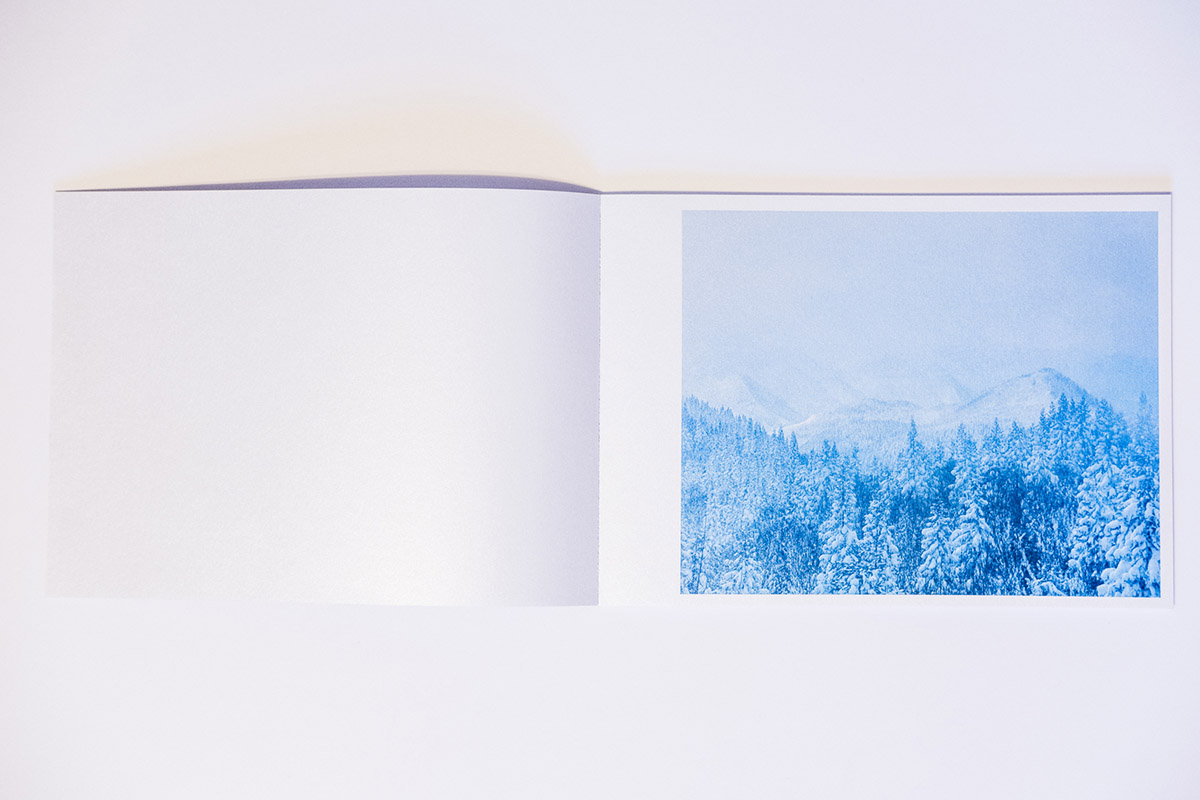
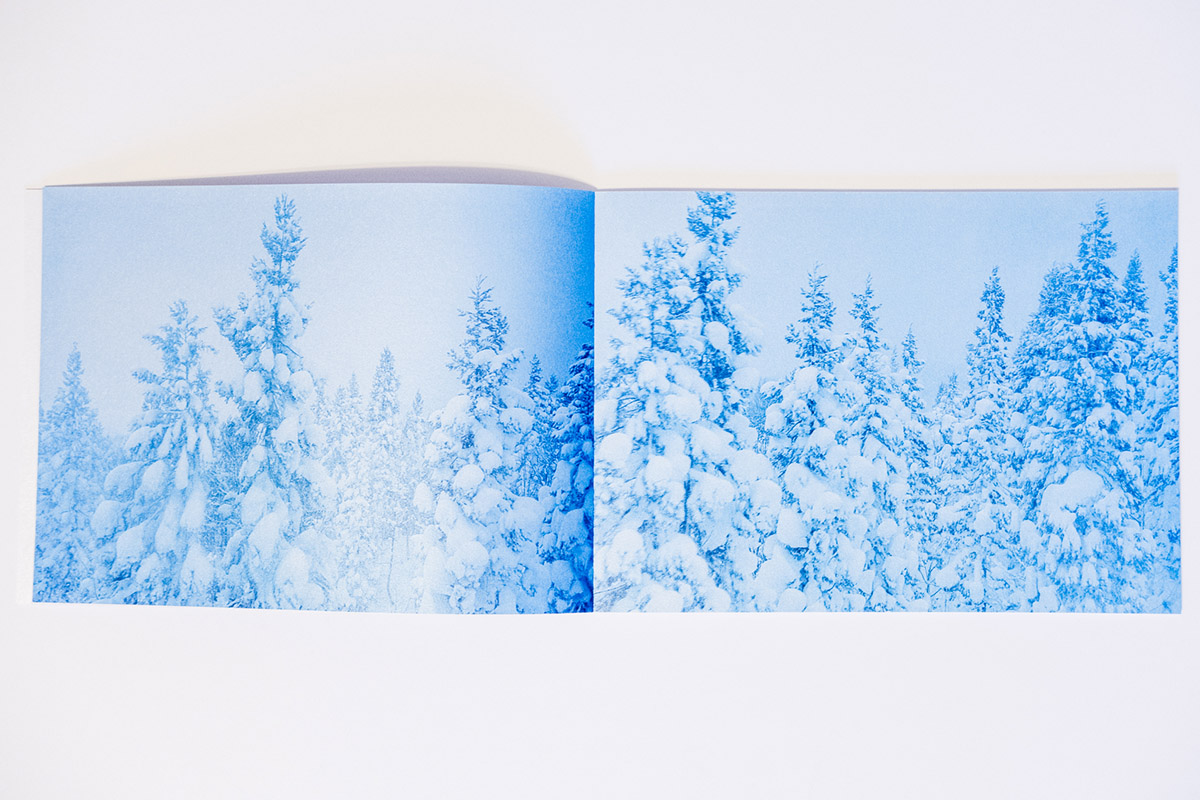
The first aspect one notices about Floating in the Snow is the paper and its tactile qualities. At about 10 by 7 inches in size, this horizontal object is comfortable and lightweight in the hands. This is due to the judicious selection of images, at a total of 28 (29 if you count the cover image), but also the unique paper choice. The paper has the feel of a light cardstock that has been coated or impregnated with sparkling grains. One of the effects of this is the added luminescence that the paper provides the cool, hazy-blue images spanning the 48 pages that of course adds to both the sense of awe, but also mysterious characteristics of the snowy tree figures in a clever use of printing that is able to capture and convey the embodied sense of being on a Japanese mountainside that the images themselves might not have achieved.
Additionally, the paper has both a density but also a rather weightless quality that is surprising when first picking up the book. Corresponding with Tomoki, I was able to learn even more about the paper and his printing process: “I usually make all my prints myself in the darkroom, but I struggled to reproduce the blue tones effectively with on-demand printing. When I was discussing this with the printer for this book, they introduced me to an interesting paper. It has a pearl-like surface, and although my darkroom prints are typically on glossy photographic paper, I felt this paper allowed for a different kind of expression, which I found very compelling. The paper is called “Twin Snow,” and I felt it was a perfect match for this work” (personal correspondence, March 22, 2026). While these design decisions could easily have weighed down the project, the consistent approach used with the production of the images here does not have a deleterious effect at all. Instead, everything works to amplify a certain poetic verisimilitude.
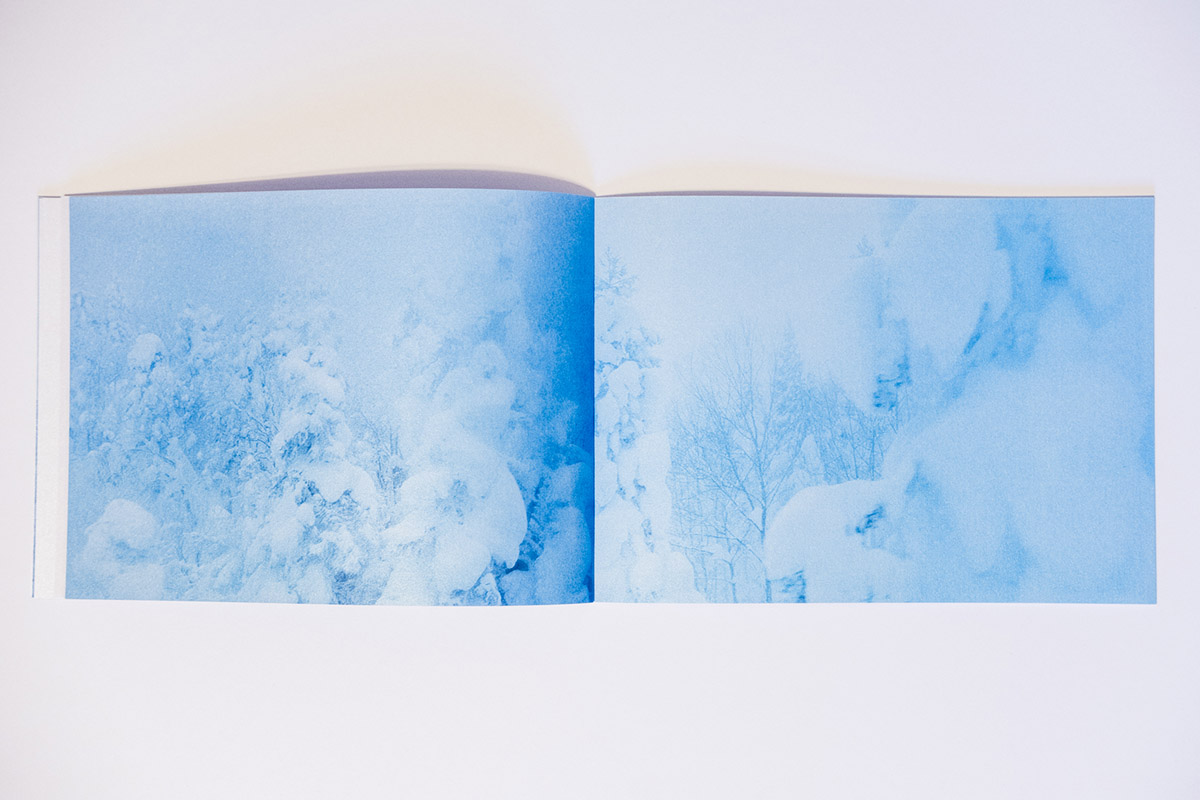
The reader enters the mountains much in the same way that Hirokawa may have: a blue, hazy, mist-engulfed landscape of mountains and trees seems to be ever-present. The snow looks moist as it sticks to the conifers that undulate through the mountains. Drawn to these textures of both the snow and the trees, we see a few different viewpoints and a full spread showing the extent of the forest and its details in the book’s opening images.
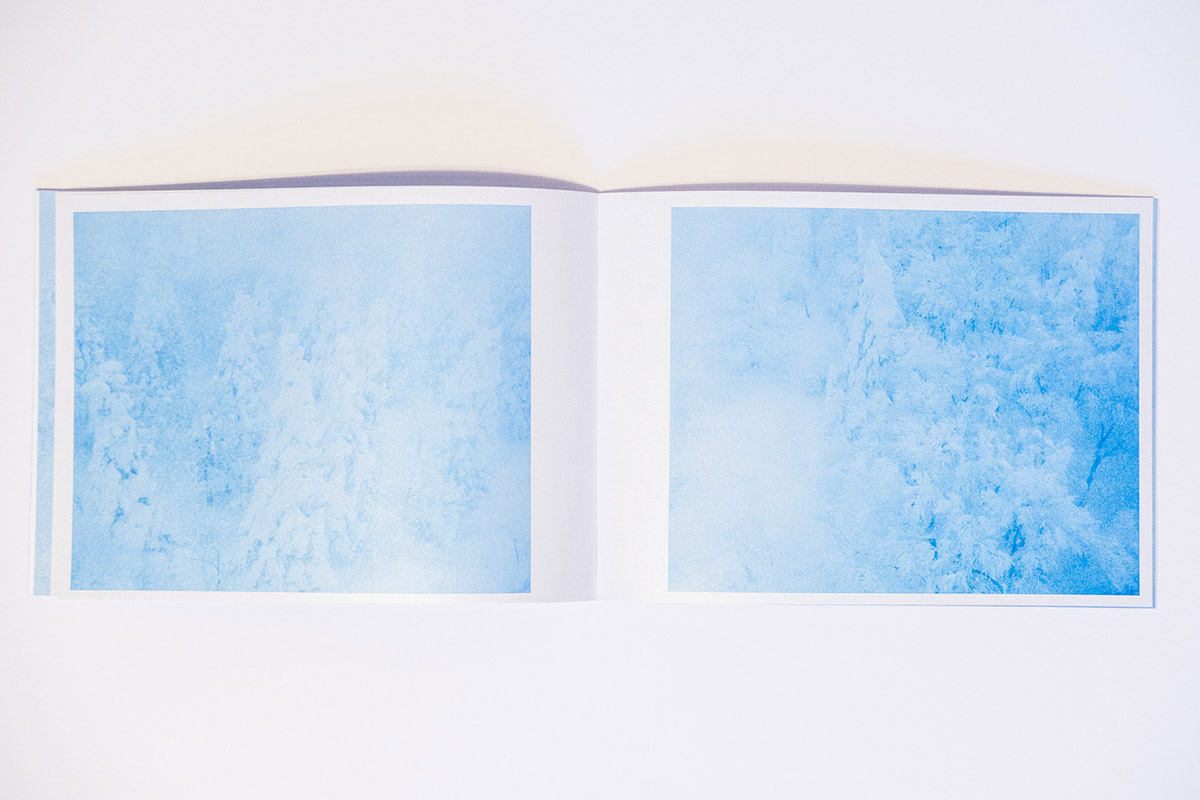
Then, Hirokawa provides a sequence that captures motion and even more density with the snow. In one image, a strong wind, or perhaps a slight avalanche is captured along the bottom part of the frame. Then, pulling back, our lens seems to be obscured, perhaps itself caught in the storm, yet adding to the ethereal dimension of these pictures. When horizons are obscured and some motion is captured, we also lose a sense of the horizon line, as we seem to experience the difficulties of this cold landscape with the photographer. In the next moment though, a bit of light appears, and we can see the ever-blue horizon and the forested landscape more clearly again.
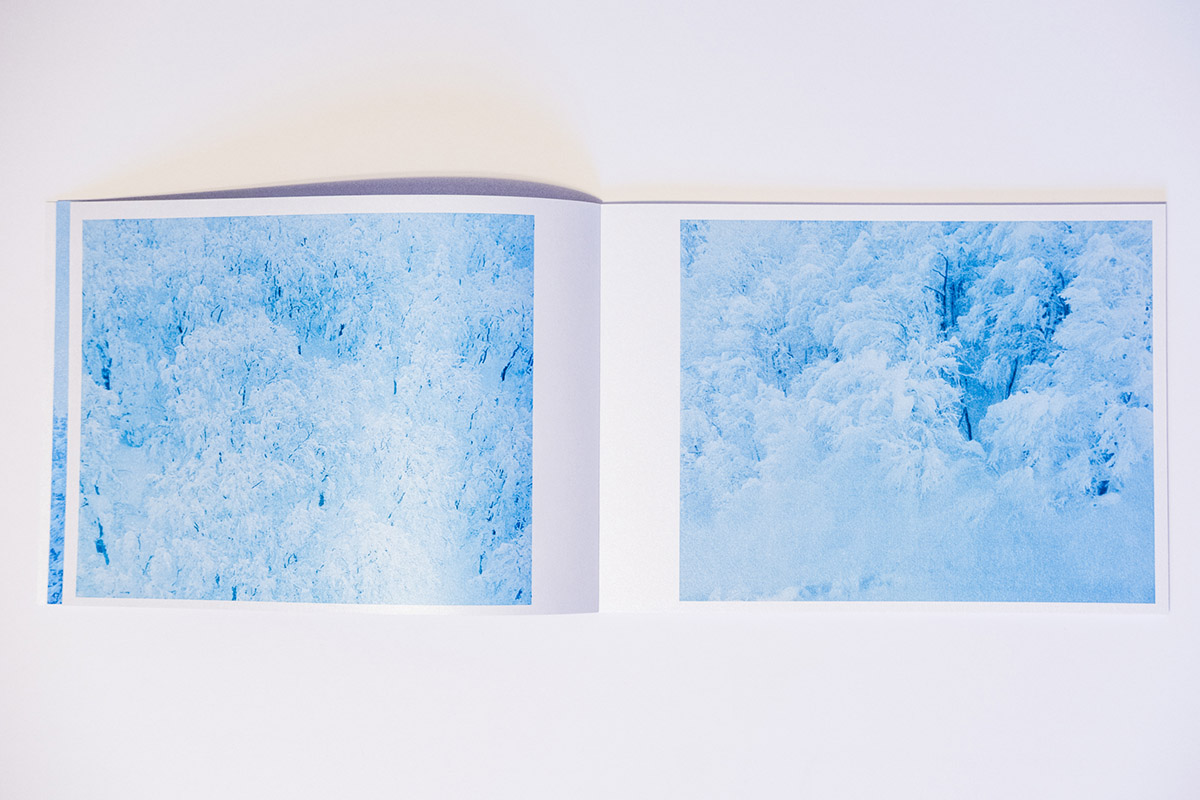
After, and in a sense coming up for air, we make our way back into the shadows of the snow-covered canopies of the forest. Here the trees are leafless. They do not seem to be the healthy conifers in the first part of the book. It is a new landscape. Here, Hirokawa obscures our view of the horizon in a different way. With a normal length lens (Hirokawa made all these images handheld from inside gondolas and ropeways amidst the landscapes, using a Mamiya 7 and either 80mm and 65mm lenses), we take in the landscape less from an aerial perspective, but from that of a transient visitor, confronted with myriad shadows and globular forms. Eventually, some of those familiar conifers reappear, but one also notices the variability within the landscape as we come to know it though this kind of close, intimate encounter. Then, as a mist seems to roll in, we again get a few of the images that appear to be made from a higher plane of view and it is the articulation of vertical vantage points that sustains the viewing interest through to the conclusion, as the images become noticeably more filled with shadows, and the figures of the snow covered trees once again become highly obscured, until the viewer eventually seems to re-emerge from the canopy.
Following Hirokawa through the forest, the sense of floating, as we might imagine some spirit might do, is emphasized by his play with perspective. As mentioned, the lens is always elevated to some extent. Noticeably, we never see footprints. Nor is ever a trail made evident. Ultimately, it is difficult to not develop a sense of the eerie and the unhuman as you float along through this book’s pages. Indeed, as theorist Mark Fisher has defined it, eerie is not a catch-all term for something that seems mysterious or unsettling. Instead, he tries to identify why an aesthetic work is unsettling. Hirokawa’s Floating in the Snow directly offers purchase on Fisher’s conception: that the eerie is characterized by a sense of unease produced through an absence of something that seems as though it should be made visible or knowable (Fisher discusses how the eerie is not weird – weird involves the presence of something that “should” be absent).
Indeed, as I moved through Hirokawa’s forests, any number of literary references came to mind. The narration of many of H.P. Lovecraft’s stories allow for certain imaginative parallels, such as in his story, The Nameless City: “In and out amongst the shapeless foundations…I wandered, finding never a carving or inscription to tell of those men, if men they were, who built the city and dwelt therein so long ago. The antiquity of the spot was unwholesome…there were certain proportions and dimensions in the ruins which I did not like” (page 319 of Black Seas of Infinity, edited by Andrew Wheeler – emphasis in original). However, and fascinatingly, the forests and the strange shapes and sensations therein among Hirokawa’s photographs are completely real.
All of these qualities raise questions in one’s mind about the spatial relationships that are at work throughout the book. In other words, distances and locations are never clear. This strategy further allows Hirokawa to lean into the development of the book’s atmosphere by juxtaposing a tight shot of snow-covered branches with a blurry, nearly aerial view of the forest. The result is not a journey in a traditional sense, nor is there a destination. It is some kind of passing through that is taking place. Yet, the book holds the viewer’s attention through the juxtapositions of light and shadow that keep one guessing what might appear out of the mist and snowy haze. In the mountains, no two moments are alike.
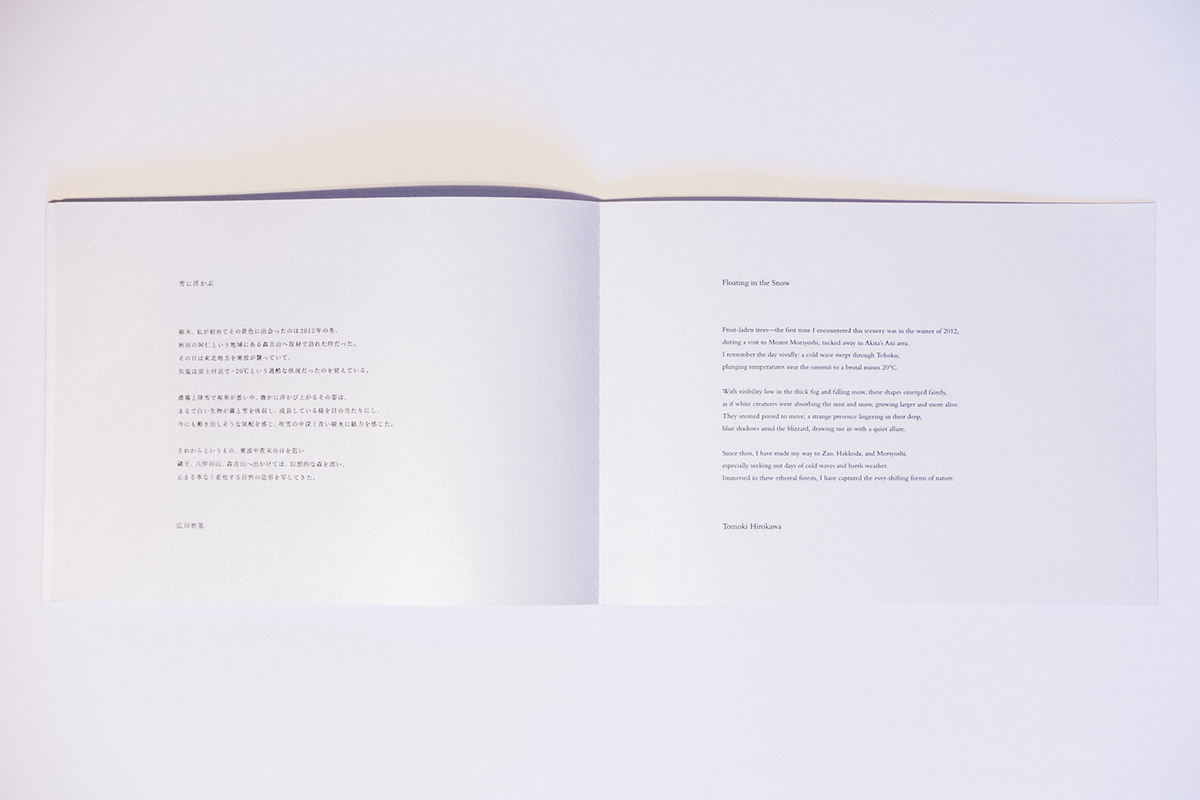
Earlier in this essay, I mentioned the locations in which Hirokawa photographed. I wrote that the book is about those places. While this is accurate, what is true about Floating in the Snow is that it is about something diffuse and difficult to define. It is about the atmosphere and sensuous experience of Japanese winter, and about its risks and joys. As Hirokawa writes at the end of the book, he was interested in the “ever-shifting forms of nature” in the “ethereal forests” of these places. This is well-observed and in fact resonates with contemporary theory on atmospheres and aesthetics. For example, German philosopher Gernot Böhme has argued that atmospheres arise in the space between subject and object, radiating affectively from material things and permeating surroundings. Light, in this view, is not merely a medium for seeing but a generative force that grants objects their sensorial presence—the way they project themselves outward, inflecting the space around them. Through the unreal positive qualities of Hirokawa’s choices to use sparkling paper and to process his images to highlight their blue tones, he has managed to carefully describe the experience of the wintery Japanese mountains and the specificity of their atmosphere.
While one could perhaps classify Hirokawa’s book as a contribution to a particularly Japanese tradition of photograph and photobooks that poetically connect humans, nature, and history, such as in certain (and less widely known) works by Tsuneo Enari, such as his 1998 book Natural Scenery: The Sagami River (I cannot find a single reference to this book on the internet, but if you go to Higashi, you can find it on the shelves at Photobook Diner Megutama), Floating in the Snow is not a repetition of old themes or a tired attempt at landscape photography. The remarkable thing about Floating in the Snow is that amidst the quiet that Hirokawa sought out, amidst his lingering in the blue shadows of snow-covered Japanese conifers, he has captured here a unique and fantastic energy within the atmosphere that is the book’s subject. It places you inside a feeling: the feeling of a parka, toes and fingers chilled from the melted snow seeping into your clothing, the feeling of being at once in awe of these places and in some moments, of the danger that comes with locating oneself in a blizzard and low temperatures. And yet, somehow despite these precise sensibilities that bubble to the surface as you page through Floating in the Snow, there is sublimity. You wonder, what kind of reverie have I come to inhabit? Is it a dream or nightmare. Whichever it may be, it is truly striking. I have difficulty thinking of a recent work of landscape photography that has such a palpable ability to transport me to a place that I have never been.
Brian F. O’Neill is a photographer and sociologist based in Phoenix, Arizona.
____________
Tomoki Hirokawa – Floating in the Snow
Photographer: Tomoki Hirokawa (born 1979, based in Tokyo)
Publisher: Hirokawa Photography ©2025 (Shinjuku, Tokyo, Japan), self-published
Book Design: Yuta Ukai
Translation: Ayumi Negishi
Printing and binding: inuuniq
PUR binding, approx. 10 X 7 inches, 48 pages, 29 photographs
____________
Articles and photographs published in the PhotoBook Journal may not be reproduced without the permission of the PhotoBook Journal staff and the photographer(s). All images, texts, and designs are under copyright by the authors and publishers.
 PhotoBook Journal
Leave a comment