Interview by Hans Hickerson ·
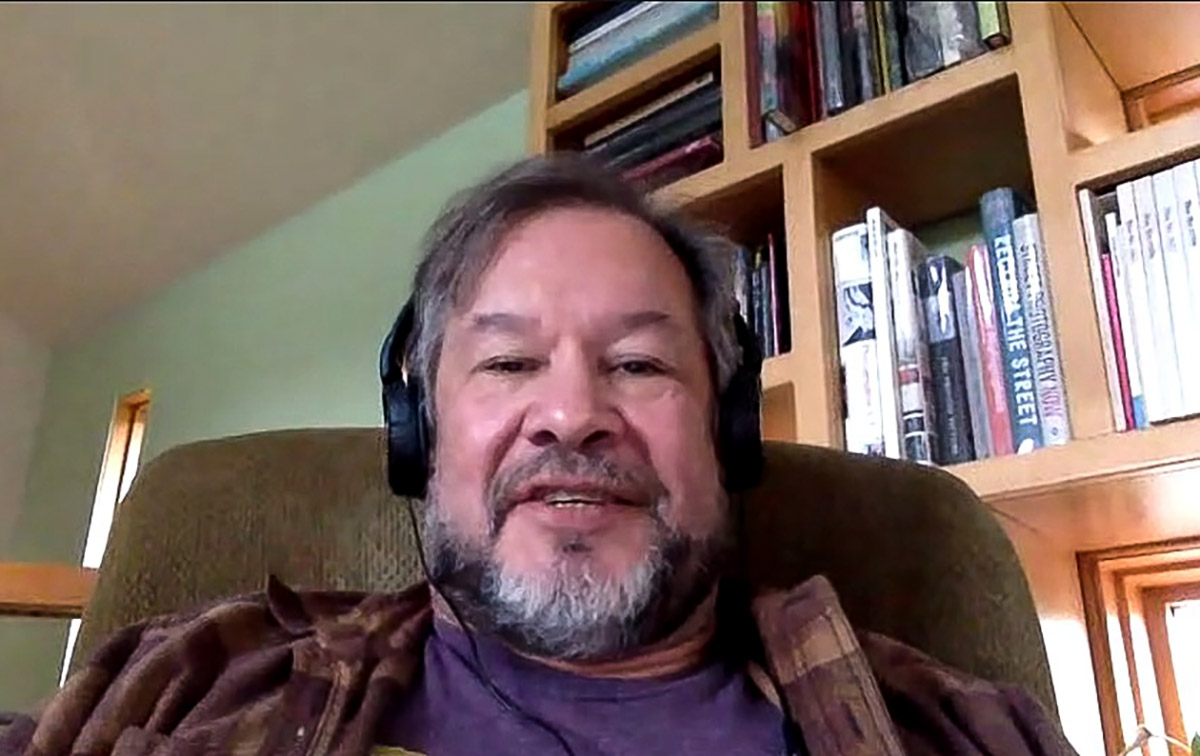
Blake Andrews is a photographer, long-time blogger, and book reviewer. He reviews for Collector Daily as well as on Instagram. PhotoBook Journal recently reviewed his debut photobook, asa nisi masa.
(This interview has been edited for clarity and length.)
HH: You’re an interesting guy. For me, you are a prototypical “photo bro.” I don’t know if you like that word…
BA: (laughing) That’s probably fitting.
HH: In terms of accessibility, and I don’t know if you have interacted with a lot of folks out there, it’s like if they need you, they’re friendly, but if you need something, they don’t, you know, they’re not operating on the same level.
BA: It’s hard to generalize. Every person is a little bit different. I guess “photo bro” might be the same as photo nerd. I think of myself as a photo nerd. I’m looking at photos all the time, I’m taking photos all the time, I’m looking at books, I’m basically in that world. So photo bro, I guess that fits. As far as how I relate to the photo community, it’s like what you just mentioned – sometimes it’s like a big wall that is obtuse, and sometimes it’s more inviting.
HH: Someone I was reading recently described it not as a monolithic world community but it’s lots of little villages, each one with its own culture and network of social relationships.
BA: That fits with our digital world with all these communities strung together, whereas 50 years ago it was much more monolithic. There were these gatekeepers that sort of decided things. And they still exist, but now it’s much more diverse.
HH: You and I are gatekeepers of a sort.
BA: Gate openers maybe. I guess that’s true in a way, but I don’t want to be a gate keeper. I want to be a facilitator… you and I are performing a public service. I get stuff sent to me regularly. A lot of it is books I might not know about or seek out on my own. I think what most photographers want basically is someone to look at their stuff, whether it’s photobooks or pictures or whatever. Even if it’s just one person looking at it, even if I don’t write anything, most photographers just want an audience. And maybe critical feedback is a bonus.
HH: What we do is pretty rare. There’s a lot of recycling of press releases, and the real thoughtful analysis is so labor-intensive that nobody could make any money doing it. Collector Daily, maybe, they can pay you guys.
BA: Those reviews take a while. I put much more time into them than into my Instagram for example. And that site is kind of a special case. Loring funds Collector Daily all himself. Paid writing is a rare thing in Photoland.
HH: Let’s get to some questions. How and when did you start making photographs?
BA: I moved to Portland in my early twenties, and I took a photo class, back in the film era. This was like the 90s, like 93, before there was anything digital. The way you learned was in a darkroom, shooting film, and making prints. I mean you probably used the exact same process I’m guessing. That’s what my initiation was. I was like 24 maybe. I didn’t do anything photographic before that in school or college, not until I settled down as an adult.
Then I just started taking pictures. I was in Portland. I would use that as my subject, and walk around everywhere, took a camera everywhere, which is the stereotype of the street photographer or found documentary work. And it’s kind of what I’m still doing now, like 30-something years later. I gained an interest in photography early on, and then it became more and more obsessive. I got deeper and deeper down the rabbit hole. I never pursued it in any formal way. I never went to school for it after that first class. I’m basically a self-taught photographer.
HH: Why do you take so many photos? Will you ever get around to editing them? I can’t imagine you having tens of thousands of negatives and wondering who is going to deal with them, or will you ever…
BA: It’s not like they are completely unedited and I’m not dealing at all with them. I deal with them as well as I can. Photography is by nature a mass operation. It’s a volume thing. You’re dealing with thousands or millions of objects, and trying to shuffle and edit and mix them. You’re not an architect or a sculptor. They might do fifty major things in their life. It’s a much more high-volume thing.
HH: Do you ever think like Lee Friedlander, who has this huge archive, and he can do a book on Christmas, a book on trucks? Have you ever thought about going back and mining your work?
BA: Well yes, I am always mining, I have my things in boxes, kind of like Friedlander. Friedlander is a special case. I don’t think he’s very involved in any of those books that you just mentioned. He has all these photos and he has staff or people that – the Christmas book for example, I think Eakins probably came to him and said hey, can you send us some Christmas photos, we want to do a book. I don’t think that’s initiated by him. But I could be wrong.
He’s a good example of the medium’s volume. He has so many photos.
HH: You haven’t thought about shaping them into books?
BA: Well, I’ve got one book done.
HH: Yes, it’s like a collection. So actually let me ask you, how did that happen, how did asa nisi masa happen?
BA: Just through chance connection. I was on Eyeshot’s radar screen because I had written an introduction for them some years ago. Do you know Simon Kossoff? He did a book for them, and I did the introduction, and I think that’s how they became aware of me. They sent me an email one day and said, hey, do you want to do a book?
I have all these boxes of different categories of photos, different projects. But I have one box, maybe more like three boxes, that is just pictures I like in general. Solid pictures. I basically used that collection as the premise for this book. To make it a catch all, not any specific subject, more like a highlight reel. Which is what the book turned out to be, although it’s more condensed. It’s just a brief glimpse.
I sent them a bunch of photos and they did the rest. Edited it, sequenced, printed it, distributed it, did all the marketing. It was about as easy as a book can be, I think. That’s the only one I’ve done, so I don’t know.
If I could have been more in control, I probably would have, but that’s not the way they do things. I think that may be true of a lot of publishers, they want control. The way you’re doing it, you publish your own and you can be much more hands on, but that wasn’t a possibility for me.
You’re asking why I don’t turn some of these other projects into books. I find the process hard to figure out – InDesign, finding a printer, materials, all the details are daunting.
HH: It’s a specialty thing and I used other people until I started learning it, painfully, on my own. It’s really liberating, it’s so much cheaper, saves so much time. You’re not depending on someone else’s schedule, and all the back and forth.
BA: How is it cheaper?
HH: Well, if you’re paying someone 75 or more dollars an hour to do the design work and work on the photographs, digitize and proof them, adjust all the proofs.
I’ve learned so much. It’s like anything, it’s not rocket science.
BA: My excuse is that I would just prefer to go out and take more pictures. Editing feels like a chore. I’ve always been that way. I’d rather shoot than deal with what I’ve already shot.
HH: How and when did you start blogging on photography?
BA: 2007. If you go to my blog, you can go right back to where it started. It was in the early days of social media. Right around that time a lot of blogs started popping up. For photographers and a lot of other people, there was an explosion. I had been writing for myself since I was kid, basically. I have always been taking notes, making journals, commenting on stuff. And I figured, hey, I can do this. I should start a blog too. So I did just that, and it just kept going, and it snowballed. It took on a life of its own. It became like an obligation. If I hadn’t put something up there in a few days, I felt like, oh, I should write a post. It came to the point where it was controlling me a little more.
It’s definitely tailed off in the last three years. I started writing for Collector Daily and some of these other outlets. I put more energy into that and into the Instagram reviews, and my blog in general like a lot of the blogging world has tailed off.
HH: Where else do you review besides Collector Daily?
Instagram is my regular daily thing, but those are like capsule reviews. Collector Daily is the main one. I’ve written a few things for Eugene Weekly and Oregon Arts Watch, but those have tailed off recently as I’ve been more focused on photobooks, every day photobooks that people send me. For those, Instagram is the main outlet.
I don’t know how you feel about Instagram. I have mixed feelings on that. It’s an insular space that not everyone goes to or spends time on. I know it turns a lot of people off because it can be a little hollow in some ways, like a doom scroll.
HH: You have a lot of followers, like five thousand.
BA: Instagram sucks you in with the numbers. It’s like a video game. You keep accumulating followers and it makes you incentivized to keep going. Maybe in the old blog days, it was better, because I had no idea who was reading or how many people. I would post something, and it would go out into the world, and that was it. A more pure process maybe. But it took a lot of time and energy. I spent days writing some of my posts. I guess my attention span has shortened as everything speeds up here near the end. So I have switched to Instagram and it’s my bread and butter.
HH: Do you encourage anyone to submit a book to you to review on Instagram?
I don’t actually say that in so many words. But if people see what I’m doing, they might ask, hey, can I send you a book? You might get the same offer from PhotoBook Journal. A lot of these folks have published their own book or are first-time authors. It’s not the big publishers, it’s people who just want to get eyeballs on a book. That might be half the books that I review on Instagram. I’m happy to put a spotlight on people where they may not have one. But there’s nothing on my profile that says, “Send me your book.” It goes without mentioning.
HH: Do you get to choose books at Collector Daily or are you assigned books?
BA: Each person gets to choose. Is that how it works at PhotoBook Journal?
HH: Yes.
BA: I would say it’s pretty wide open, with a few parameters. There are four of us writing, and each person has their own taste and specialty, so it works well, because we do books in different areas. We also try and make it diverse in terms of gender, geography. Actually Loring (Knoblauch) just published an article looking back at the year 2025. He’s very conscious about representing different publishers and segments of the photo world and areas, and in choosing books that’s one thing that I have in the back of my mind. We don’t accept book submissions. Instead every book is purchased retail. So we help support photographers financially as well as critically.
HH: What changes have you seen in the photobook world since you have been an observer?
BA: A lot more stuff published, a lot more small publishers, a lot more volume in general. There are so many publishers, books, people. There’s a lot more activity. But at the same time, no central focus, like it’s much more scattered. Someone might put out two hundred copies of their self-published book, and there are ten thousand people doing that. It’s much harder to keep tabs on what’s out there, what’s important, what to focus on. I think it’s good in a lot of ways but it’s also for reviewers much more wide-open. It’s like the Wild West.
HH: Where do you see the best photobooks coming from? Countries? Publishers? Self-publishing?
BA: That’s a hard question. I have a lot of favorite publishers. I’m sure you’re familiar with all the ones I would name, TBW, Twin Palms, Nazraeli, etc. Over in Europe there’s Void, Loose Joints, GOST, Chose Commune, Fw:, Witty, Stanley Barker…I like some of the Mack books although they are going in a weird direction lately. All the usual suspects basically. Since these are private enterprises, I will sometimes get a broader view by going to bookstore sites, browsing what they have in stock. There are no photobook stores in Eugene, so it’s all online. I have four or five bookstores I can check regularly just to tabulate what’s out there. And PhotoBook Journal or other places, just to keep tabs on the scene.
HH: We are pretty random. It’s whatever people like, and whatever people send us.
BA: Random is good. I like random.
HH: Have you been able to travel to different countries and events and look at the photobook scene?
BA: Well, I’ve traveled a lot of places, but not as a photobook reviewer. I haven’t been to any of the big festivals, anything like that. I used to go to a street festival in San Francisco every year and people would bring photobooks to that. But Paris Photo, I’ve never been to that or Arles, Tokyo, any of those places.
HH: It’s quite the scene.
BA: It’s a lot of time and money and it feels – I’d almost much rather just look at books online and choose instead of diving in to that whole mess with small talk and mingling and stuff – I’m not a very social person. I like to operate more like a restaurant reviewer. An anonymous critic, in and out with no fanfare.
HH: If you go to those fairs, though, maybe not the bigger publishers, you’re going to see so many books you did not know existed.
BA: True.
HH: And so many things people are doing and they’re not in bookstores. They don’t get to Portland or Eugene.
BA: There’s another whole world out there. Actually I did go to the LA book fair, like two years ago. Like you’re saying, there’s a lot of stuff there that I didn’t know existed. I went to that actually like three years running. But not Europe. Maybe if I make a book with a big publisher, that will be an excuse for going there. I’ll wait till then.
Hans Hickerson, Editor of the PhotoBook Journal, is a photographer and photobook artist from Portland, Oregon.
 PhotoBook Journal
Leave a comment