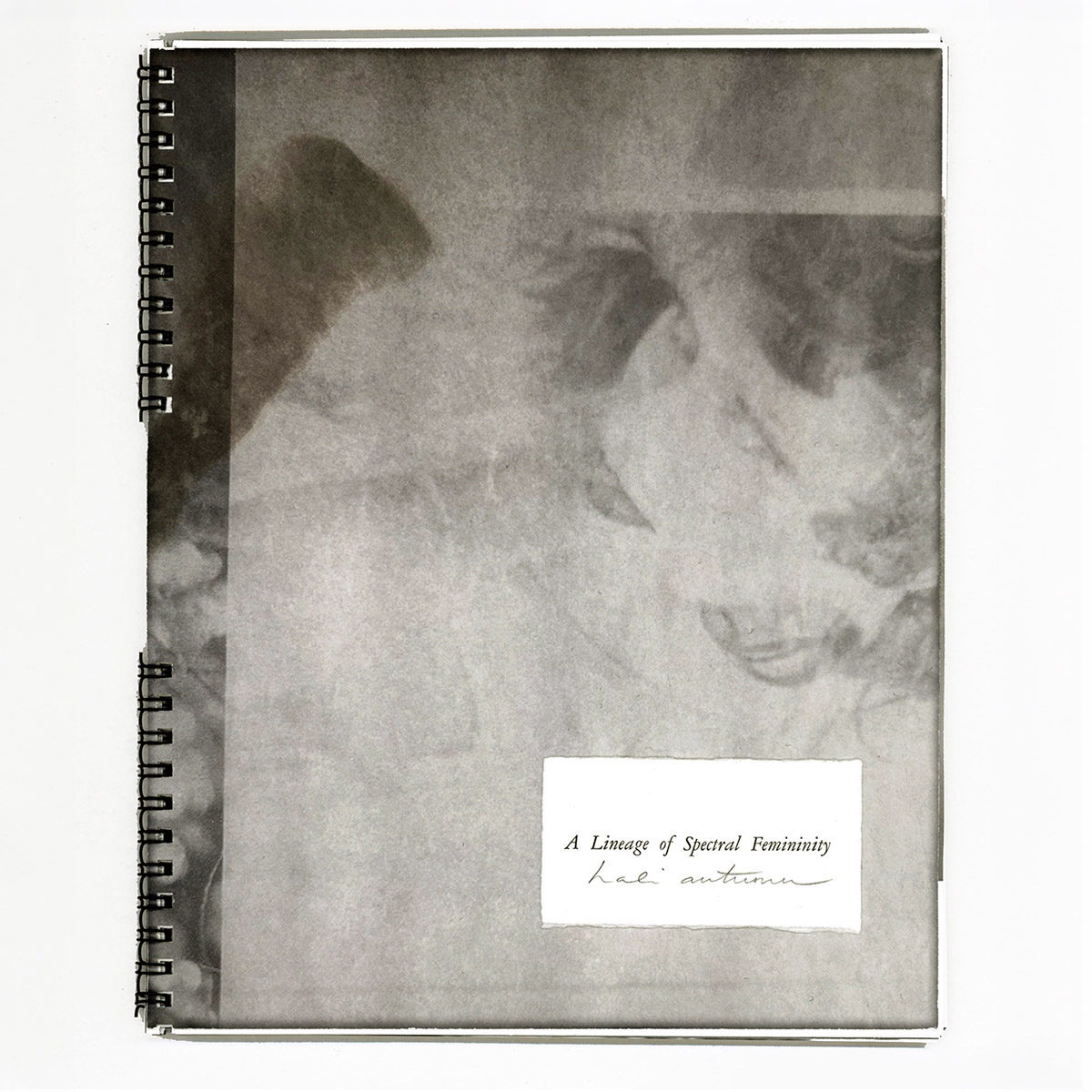
Review by Gerhard Clausing •
Since its beginnings 200 years ago, photography has occupied an uneasy territory between what is seen and what is not. Photographs record moments that have already vanished; they transform the visible world into a trace of itself. In A Lineage of Spectral Femininity, Hali Autumn embraces this condition not as a limitation but as the approach of her work. Through layered analog processes, blurred bodies, double exposures, and material interventions, she constructs a visual meditation on feminine identity as something elusive, mutable, and perpetually in the process of becoming.
Autumn’s artist statement situates the project within feminist visual studies and phenomenology, drawing on Jacques Derrida’s concepts of hauntology (things from the past that haunt us in the present) and the trace, while acknowledging artistic predecessors such as Francesca Woodman, Maya Deren, and Alix Cléo Roubaud. Rather than simply citing these influences, however, Autumn expands our horizons through her contemporary investigation of how femininity can be represented through fleeting appearances. The feminine figure in these photographs is rarely stable – it flickers, dissolves, overlaps with itself, and occasionally seems to vanish altogether.
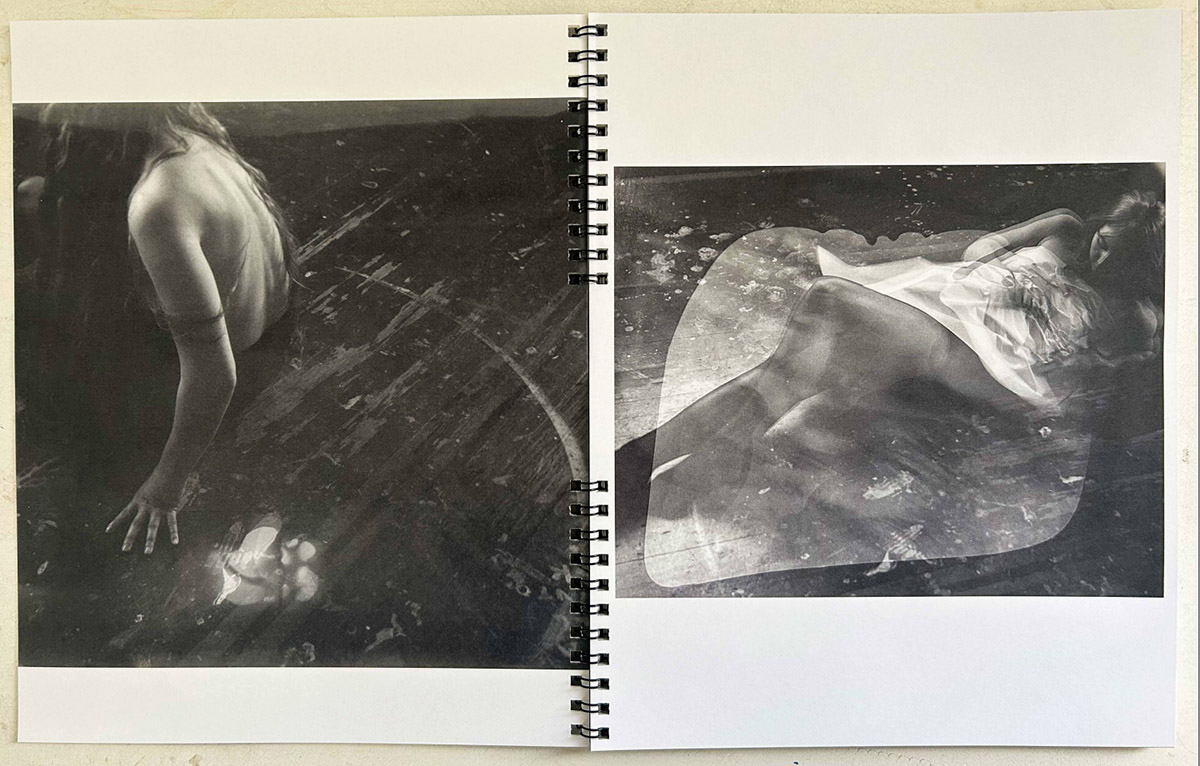
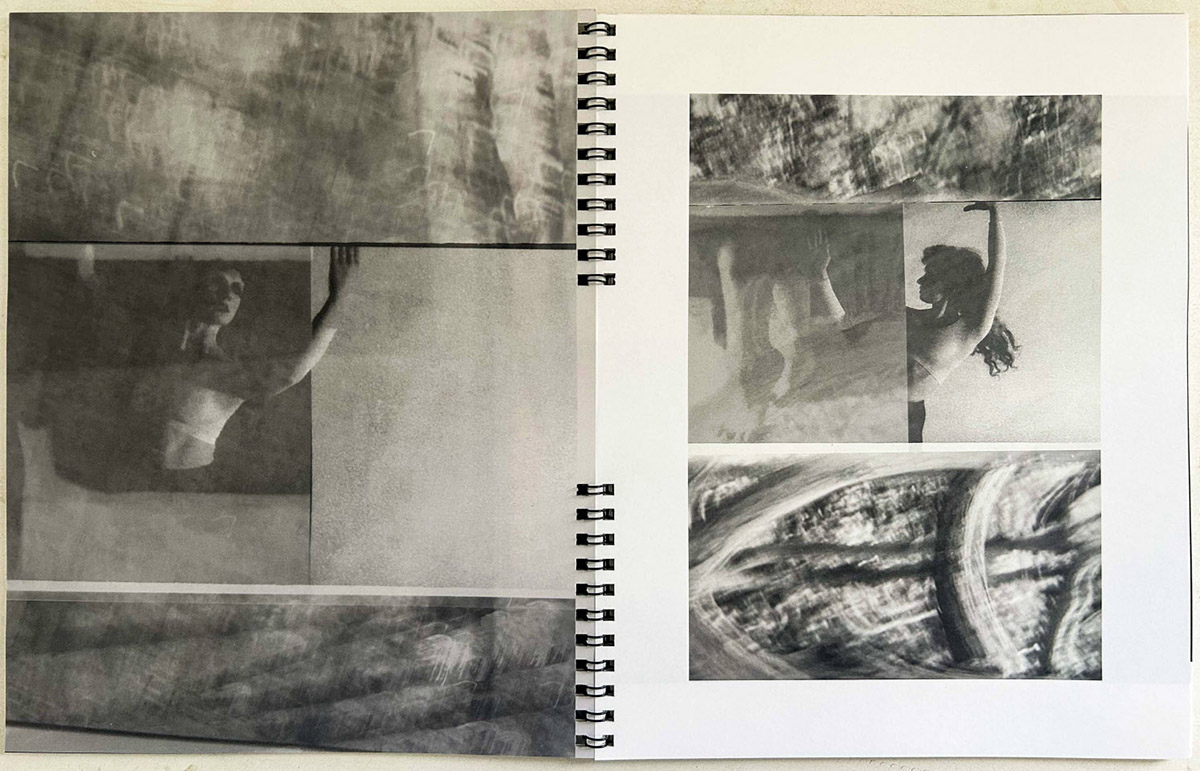
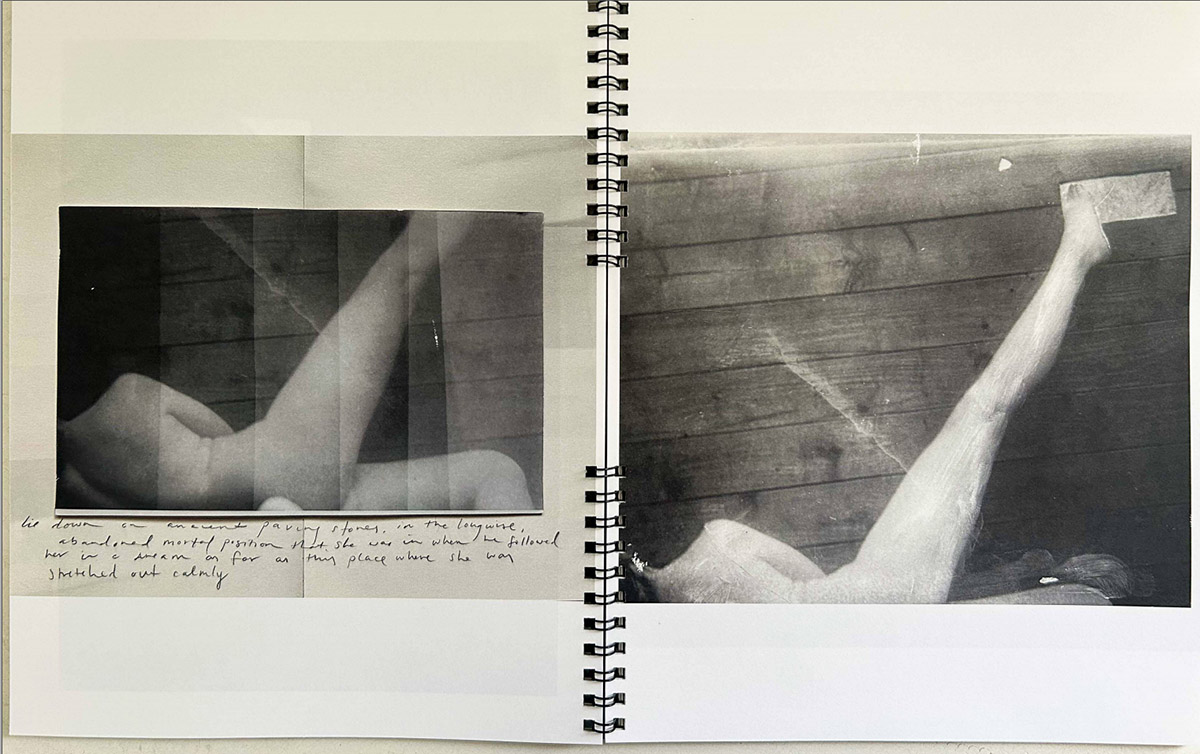
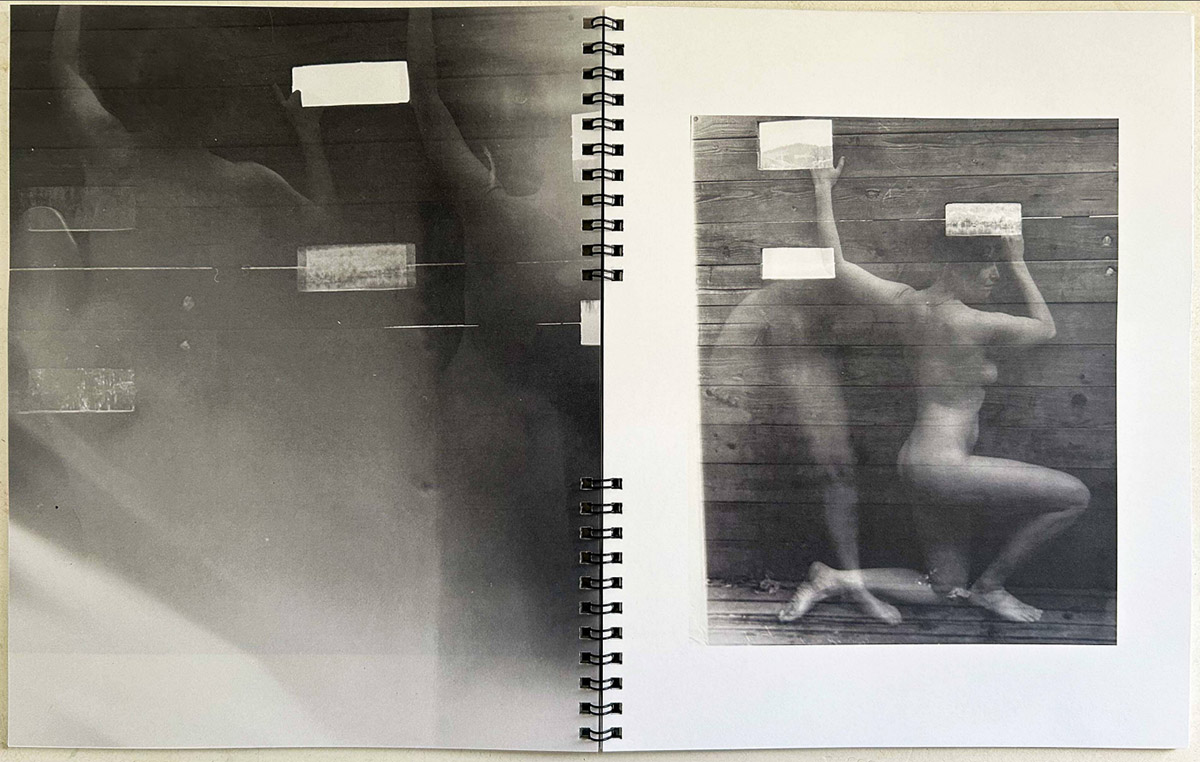
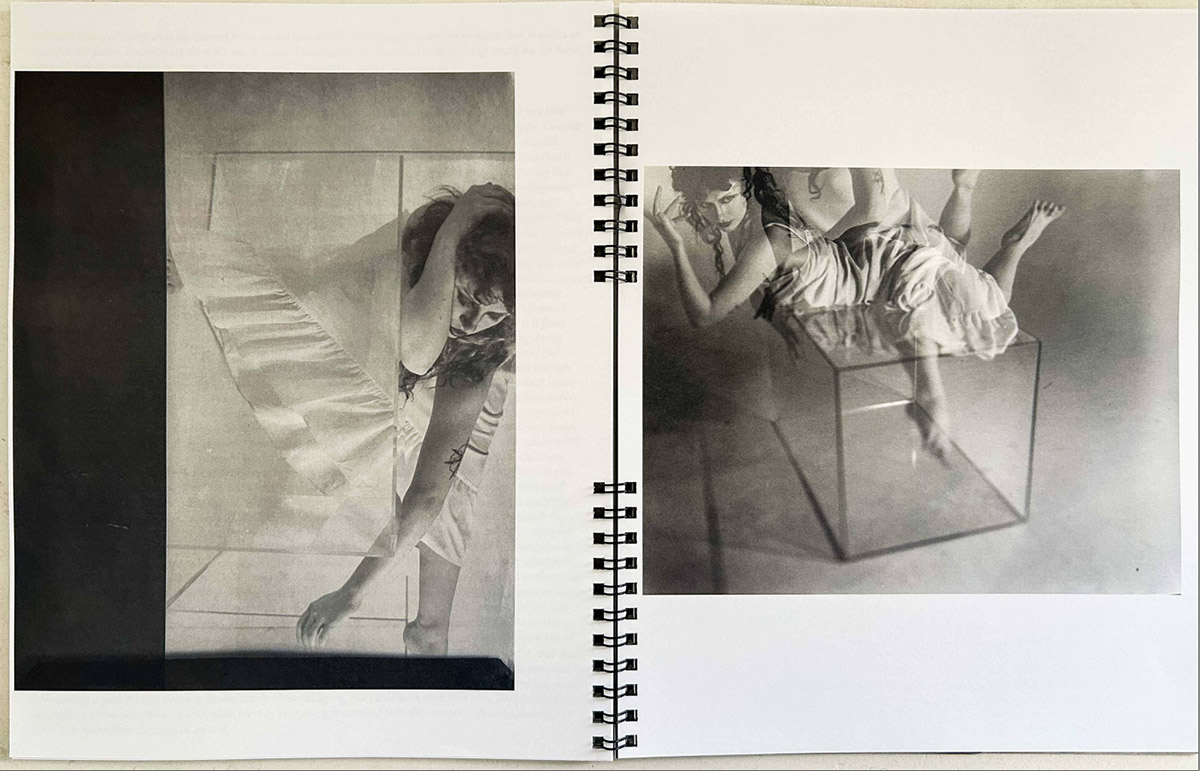
The book opens with images that immediately establish this approach. Bodies emerge from darkness only partially visible, often fragmented by motion blur or layered transparencies. A woman reclines across a floor while multiple exposures create competing versions of her form. Elsewhere, a hand reaches toward a luminous patch of light, as if attempting contact with something beyond the frame. These early sequences introduce a recurring tension between embodiment and immateriality. The body is present, yet never entirely available to the viewer. The fragmentation of physicality lays open a multitude of psychological dimensions that invite your interpretation.
Autumn’s use of analog processes is particularly effective because it avoids becoming merely nostalgic. Scratches, chemical marks, blurred emulsion, and overlapping negatives are not decorative gestures. They function as visual equivalents of memory itself: unstable, fragmentary, and resistant to certainty. Throughout the book, photographs appear less like documents than recollections. Their surfaces carry the evidence of handling and transformation, reminding us that the image is not a transparent window but a material object shaped by time and process.
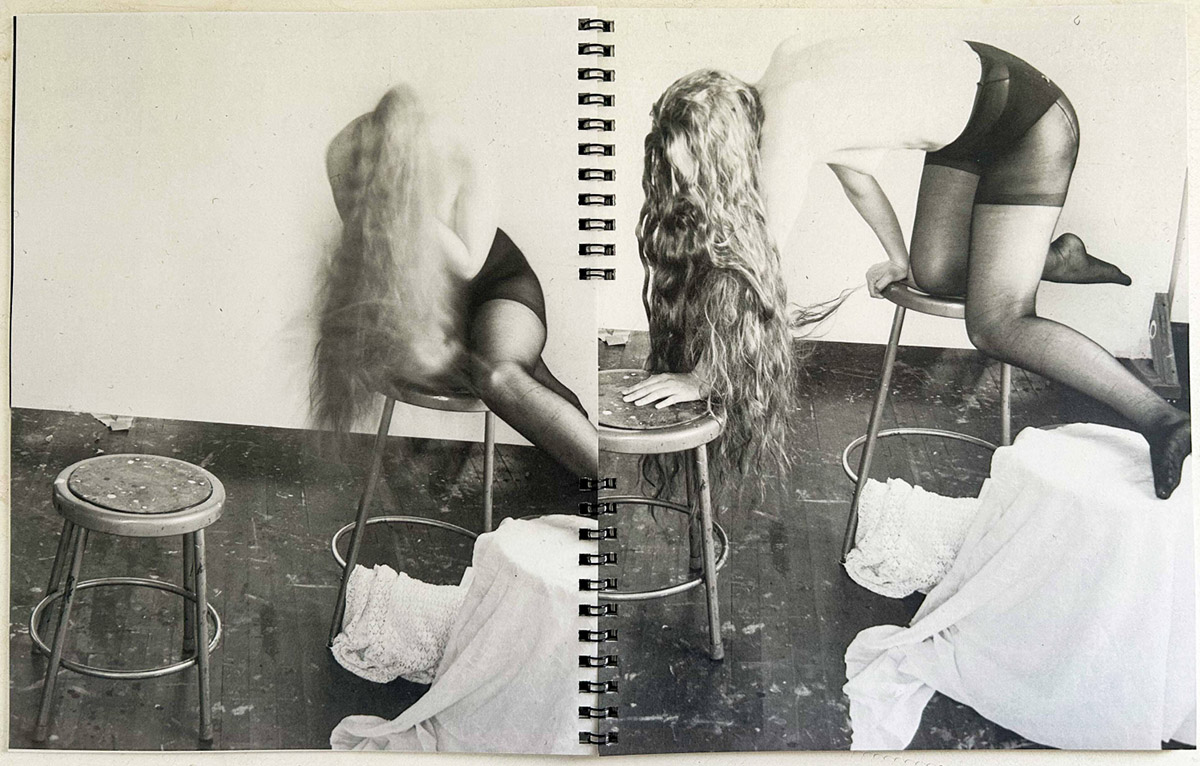
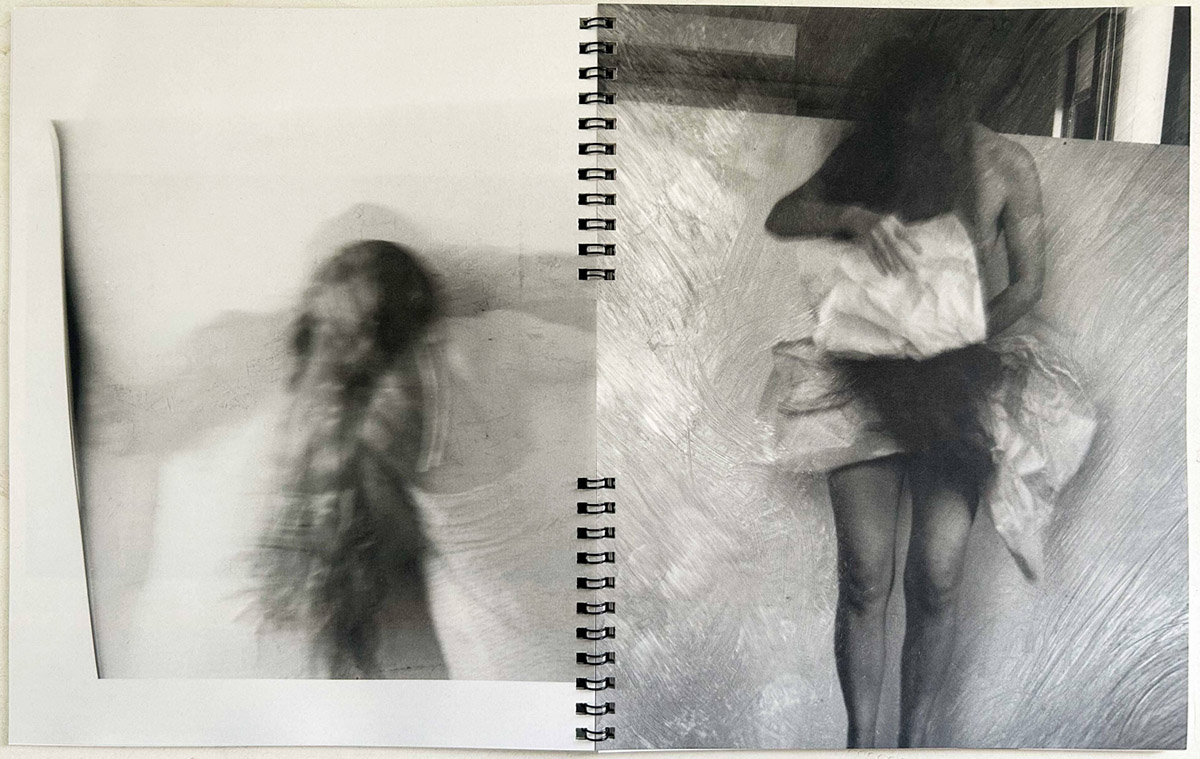
Some of her strongest photographs are shown in a sequence featuring a figure draped over stools, her long hair cascading toward the floor, evoking both vulnerability and transformation. The body appears suspended between collapse and emergence. Nearby, images of movement rendered as soft, almost painterly blurs suggest emotional states rather than physical actions. Here Autumn demonstrates an intuitive understanding of how photographic ambiguity can generate psychological resonance. The images strongly resist fixed interpretation, inviting viewers to project their own memories and associations into the spaces left open by the artist.
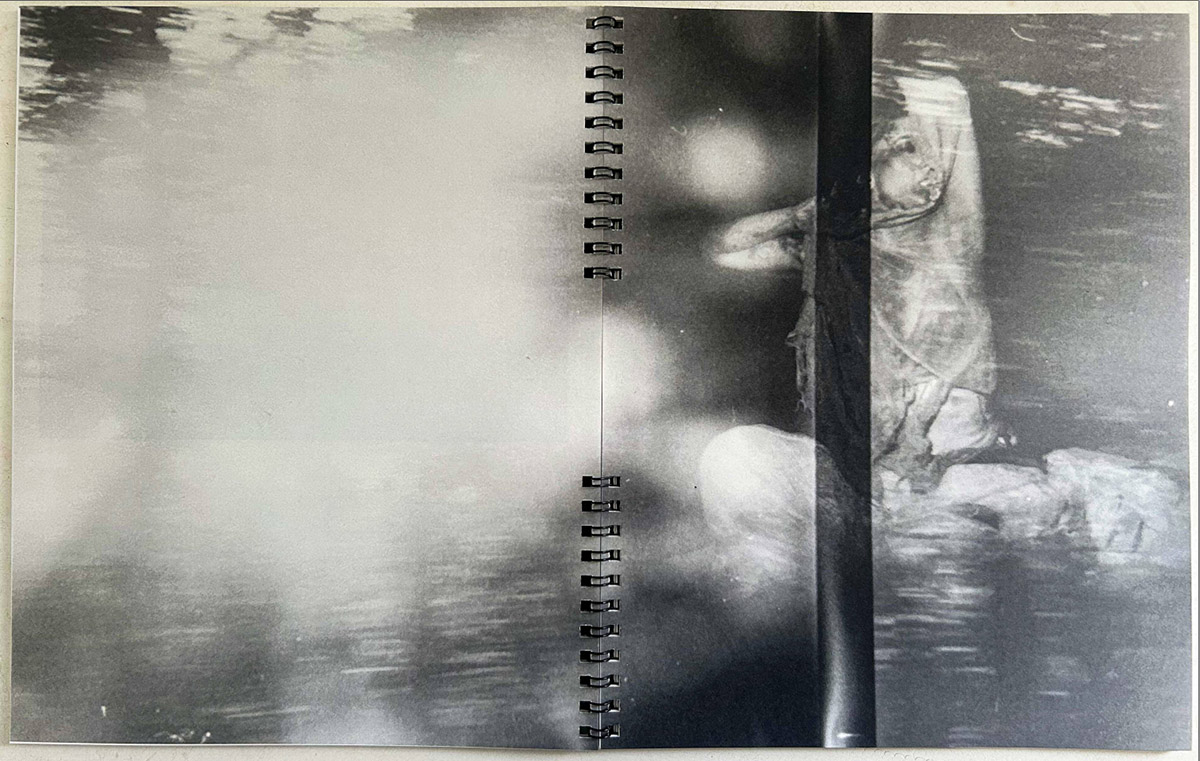
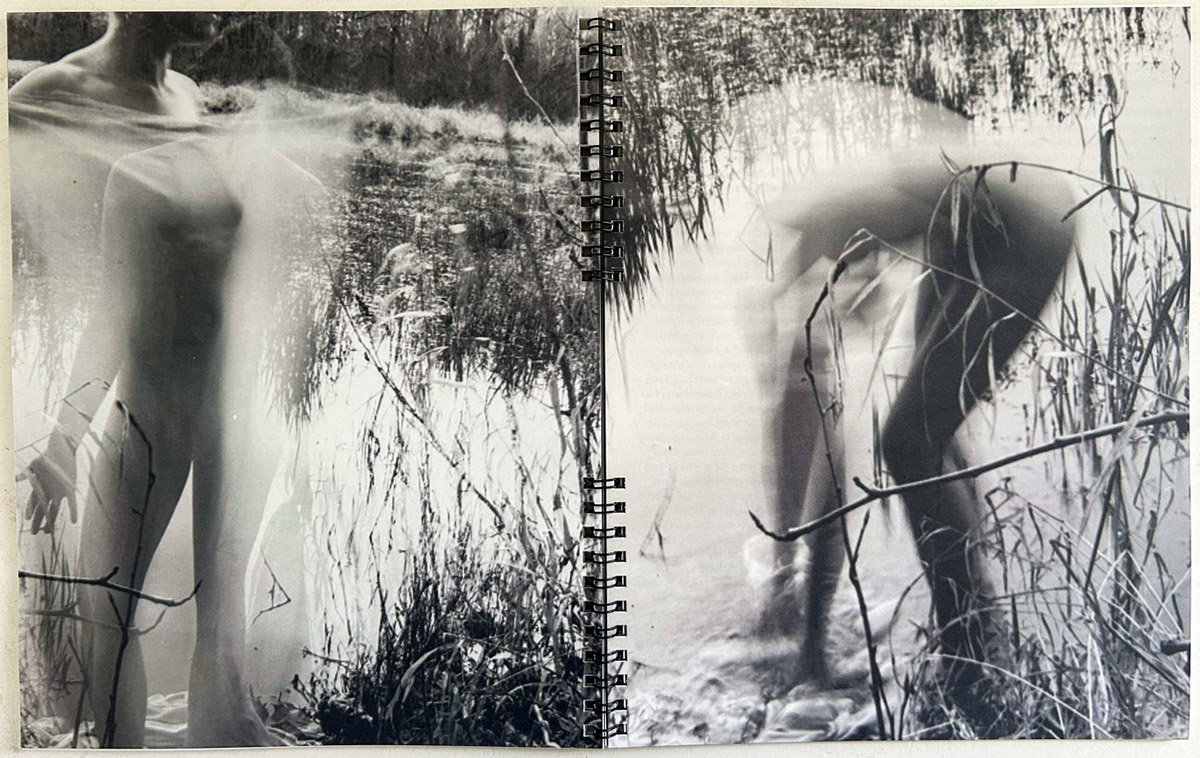
Water becomes a more important motif in the latter portion of the book. Figures appear partially submerged in marsh-like environments, their forms dissolving into reflections and vegetation. These photographs expand the project’s exploration of spectrality beyond interior spaces. Nature itself becomes a site of transformation, a place where boundaries between body and environment become porous. The images simultaneously suggest rebirth, disappearance, and return. The meaning of landscapes is expanded. While references to hauntology, psycho-geography, and feminist phenomenology provide a rich intellectual context, the strongest moments in the book occur when the images are allowed to operate on their own terms. A blurred profile emerging from darkness, a body fragmented by overlapping negatives, a figure disappearing into reeds – these photographs communicate their emotional complexity without requiring theoretical mediation.
One of the most compelling aspects of A Lineage of Spectral Femininity is its willingness to embrace uncertainty. Contemporary photography, whether conceptual or visual, often prefers clarity. Autumn moves in the opposite direction. She seeks meaning through obscurity, fragmentation, and incompleteness. The project invites consideration within a broader history of staged and performative photography. The influence of Francesca Woodman is perhaps the most immediately apparent, particularly in the use of blurred self-representation, fragmented bodies, and figures that seem suspended between appearance and disappearance. Echoes of Alix Cléo Roubaud emerge in the embrace of photographic imperfection and the treatment of the negative as a site of transformation rather than mere reproduction, while Deborah Turbeville’s dreamlike atmospheres and psychological interiors linger in the background. Building on the foundation of her predecessors, Autumn positions herself within a lineage of women artists who have used photography to challenge stable notions of identity and presence. The strongest images move beyond homage and establish their own voice through an insistence on material process, embodied vulnerability, and the productive instability of the photographic image itself.
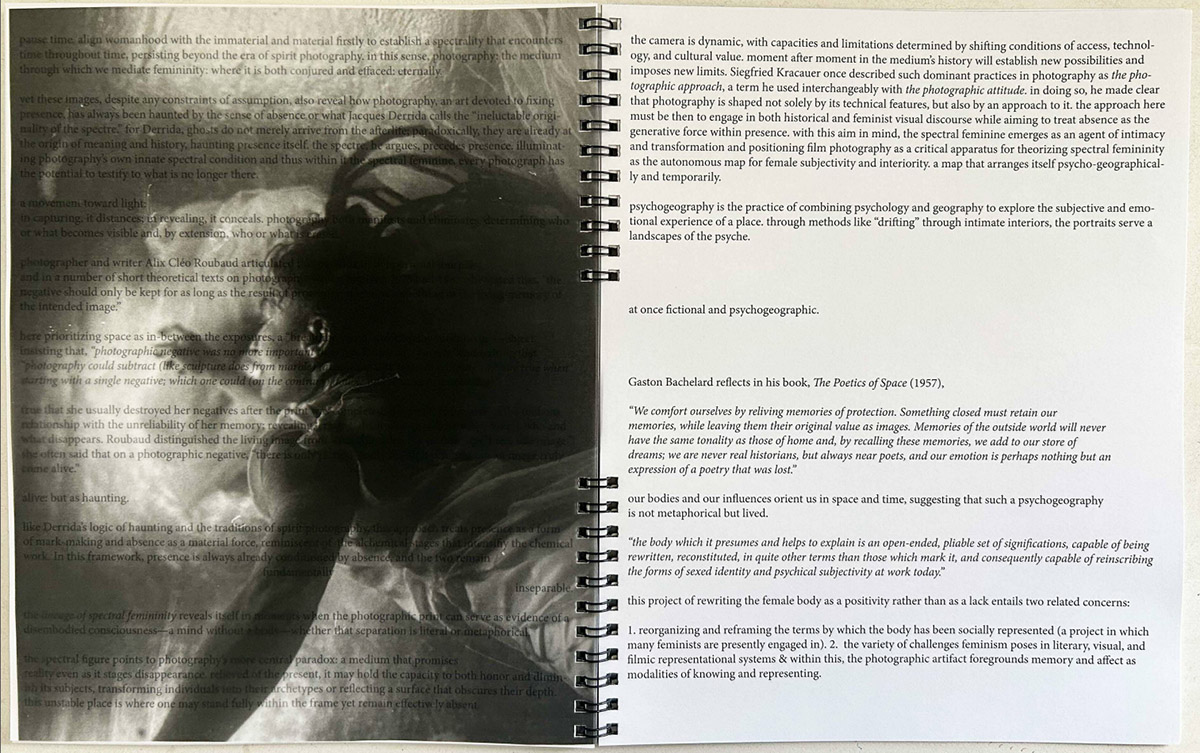
As a physical object, the spiral-bound format lends the work the appearance of a working archive or artist’s notebook, maybe even a kind of personal research dossier. Thus the book invites personal searching; it reinforces an emphasis on process, memory, and ongoing inquiry. The generous use of white space, intermittent blank pages, and varied image sizes creates a contemplative rhythm that encourages slow viewing. Reproduction quality preserves the tonal subtlety essential to the work, allowing delicate layers of transparency, blur, and surface texture to remain legible. Rather than functioning as a neutral container, the book’s design becomes an extension of the project itself, embodying the provisional and exploratory qualities that animate Autumn’s investigation of spectral femininity. The project reinforces a sense of drifting through a psychic landscape. The sequence represents a journey through memory, where certain moments emerge vividly while others remain obscured.
Ultimately, A Lineage of Spectral Femininity succeeds because it understands that photography’s power often lies not in what it reveals but in what it withholds. Hali Autumn’s images inhabit the threshold between presence and disappearance, constructing a visual language in which memory, desire, vulnerability, and identity remain fluid. The result is a thoughtful and often haunting meditation on feminine subjectivity that asks viewers not simply to look, but to linger within certain realms of uncertainty.
____________
Gerhard (Gerry) Clausing, PBJ Editorial Consultant and Editor Emeritus, is an author, visual artist, and educator from Southern California.
____________
Hali Autumn –A Lineage of Spectral Femininity
Photographer: Hali Autumn (born in California, lives in Portland, Oregon)
Language: English
Publisher: Self-published; © 2026
Softbound, with illustrated cover and spiral binding; 68 pages; 8 x 10 inches (20 x 25 cm); printed in the USA by Fireball Printing; initial edition of 20.
____________
Articles and photographs published in the PhotoBook Journal may not be reproduced without the permission of the PhotoBook Journal staff and the photographer(s). All images, texts, and designs are under copyright by the authors and publishers.


Leave a Reply