Review by Douglas Stockdale •
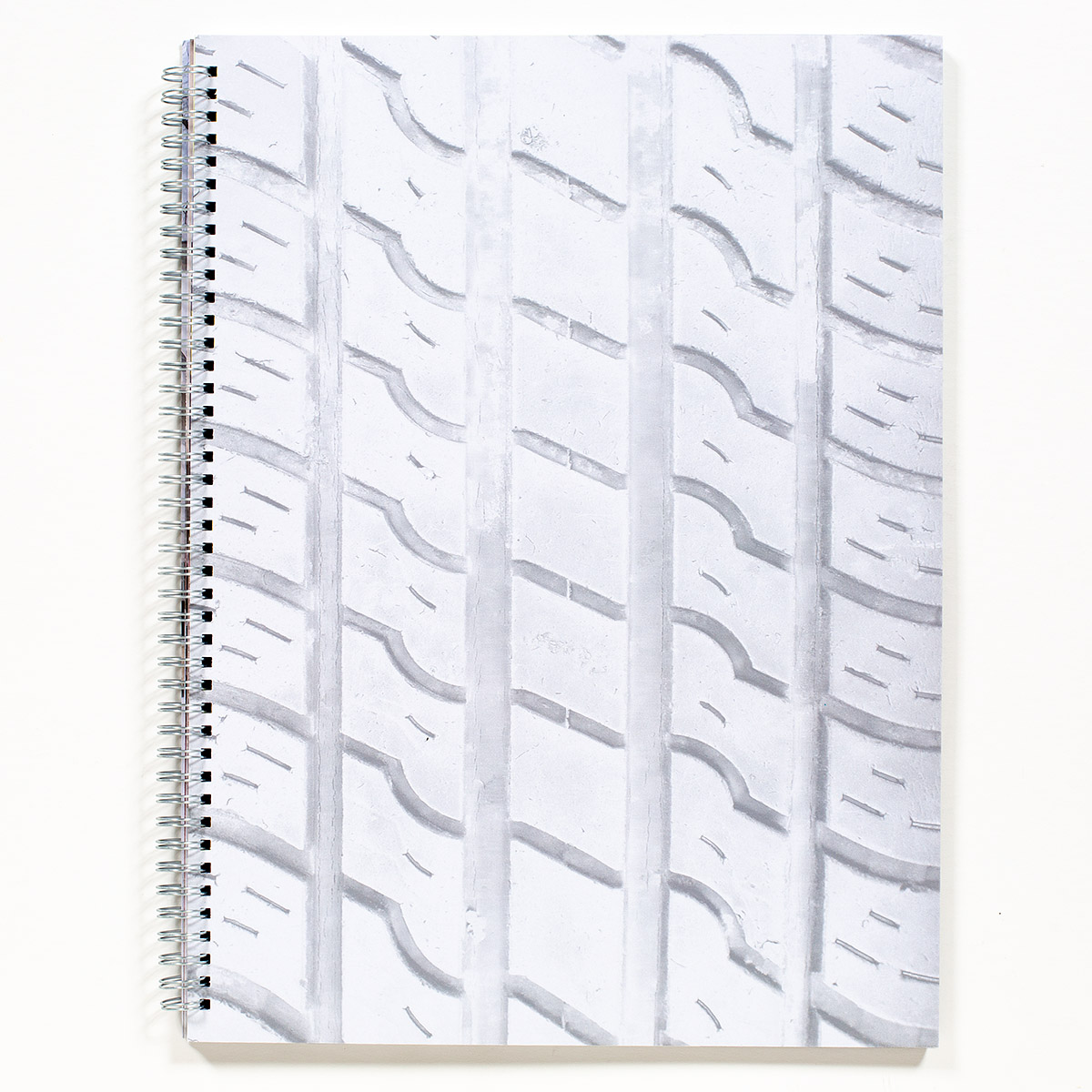
The book cover for Christian Kasners recently released photographic book, Woodward, has an interesting graphic design, printed full bleed. The repetitive pattern stirs the memory until it is apparent that this is a tire tread pattern, a subtext for the location of Kasners photo-documentary of Woodward Avenue, one of the main urban throughfares of Detroit, Michigan, affectionally known as the ‘Motor City’.
Woodward Avenue, or M-1, begins in the heart of downtown Detroit and extends out to the northern toney neighborhoods of Birmingham and Bloomfield Hills, and eventually to the city of Pontiac, where it eventually morphs into Michigan Route 24. Michigan trivia is that this roadway follows the old Saginaw Trail, an American Indian passageway. Likewise, Woodward Avenue has become synonymous with Detroit’s cruising culture, which is what perked my initial interest in this photobook. This is where I need to admit being a Woodward Avenue cruiser in my High School car days, hanging out at Big Beaver Road to cruise the Birmingham stretch of Woodward Avenue, but that of course is another story.
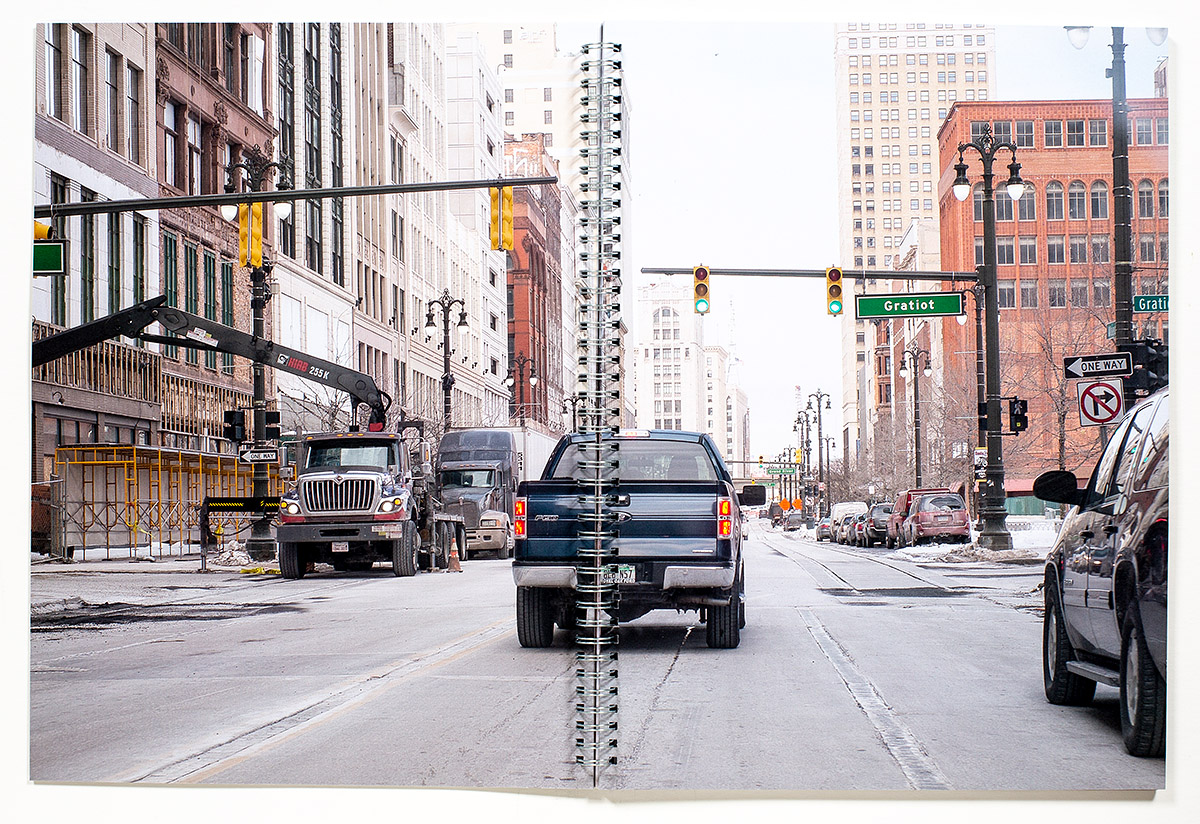
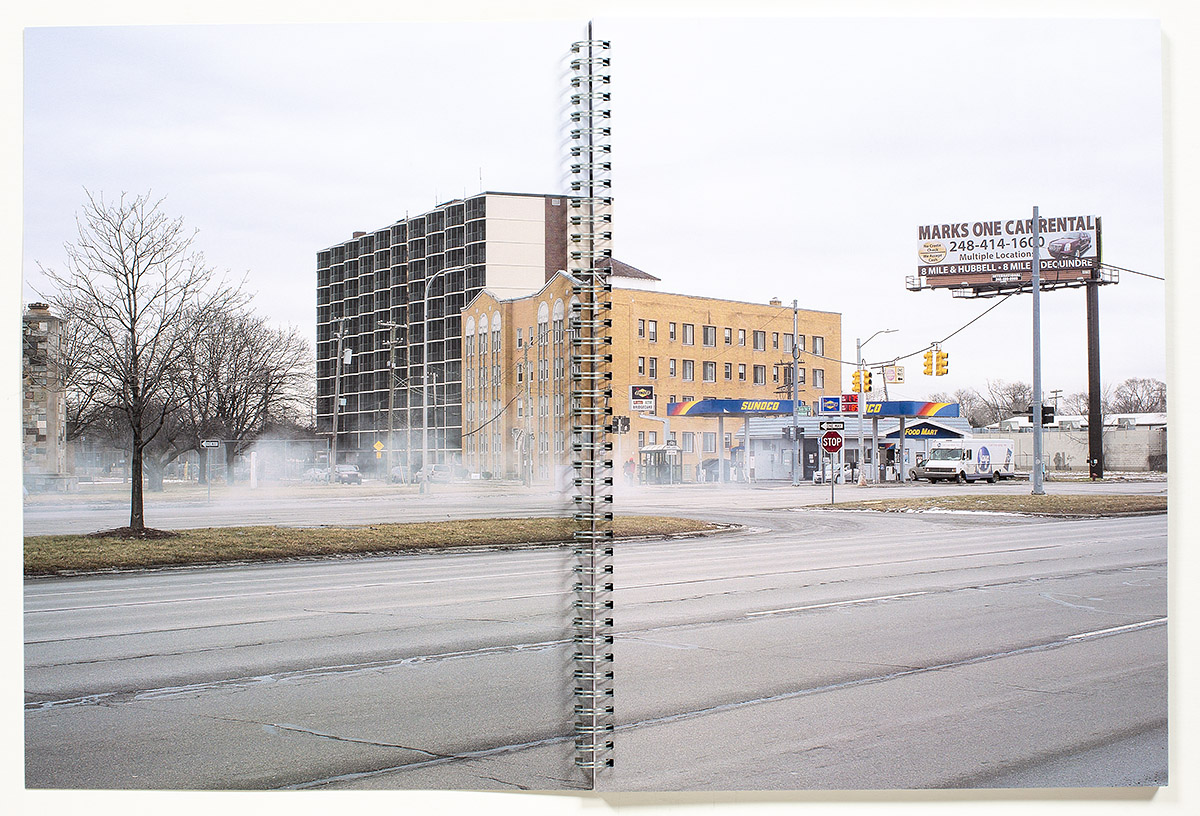
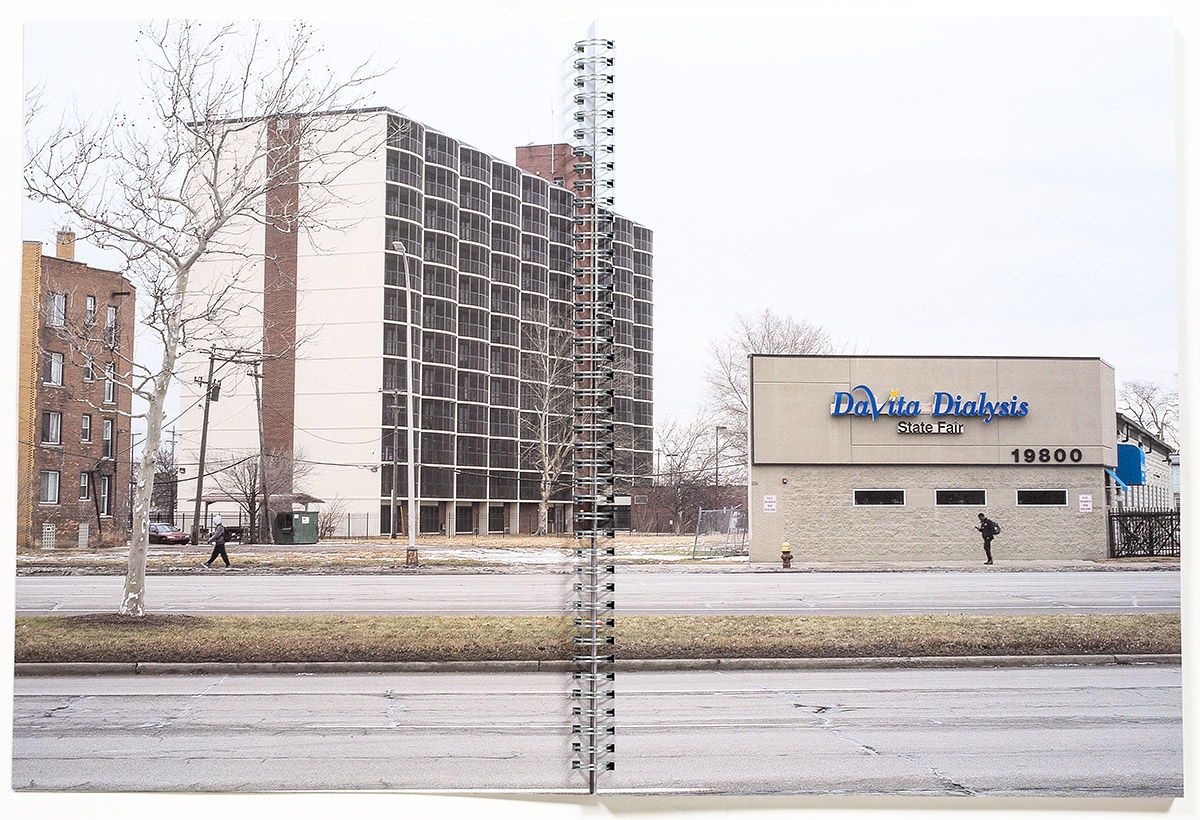
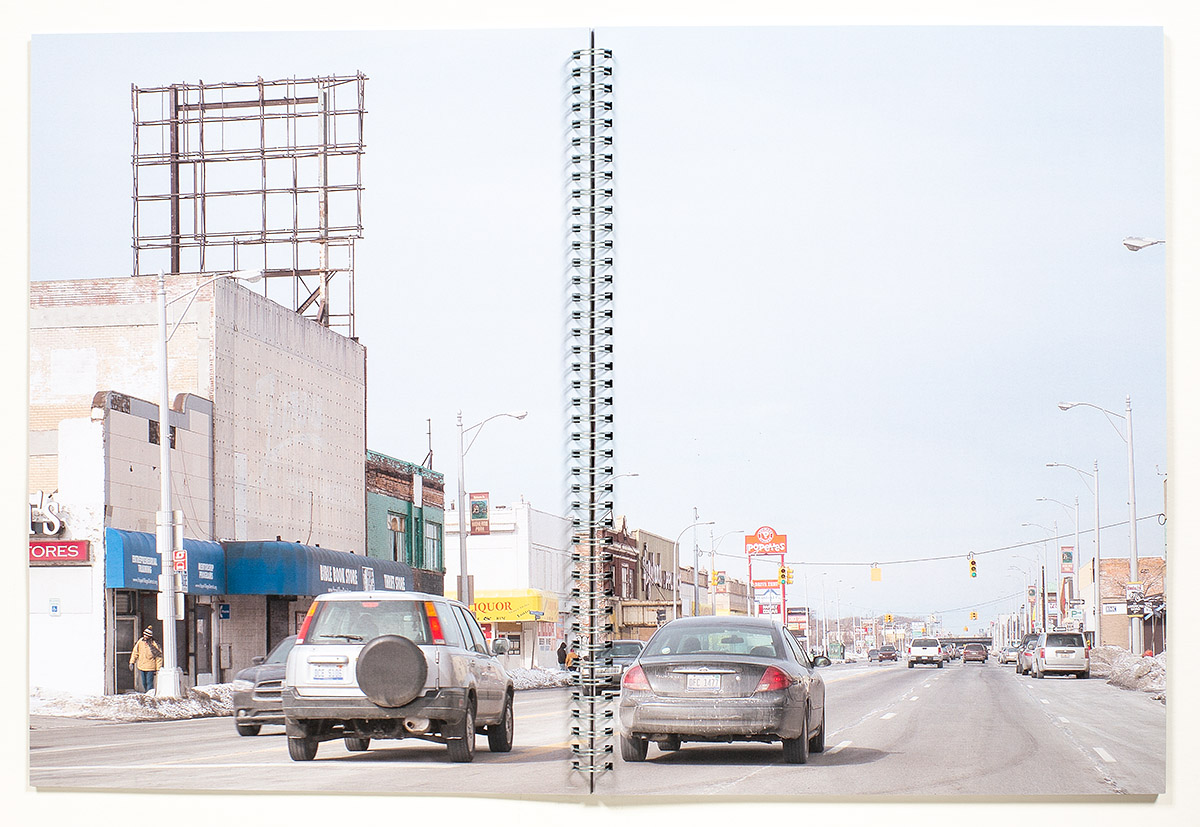
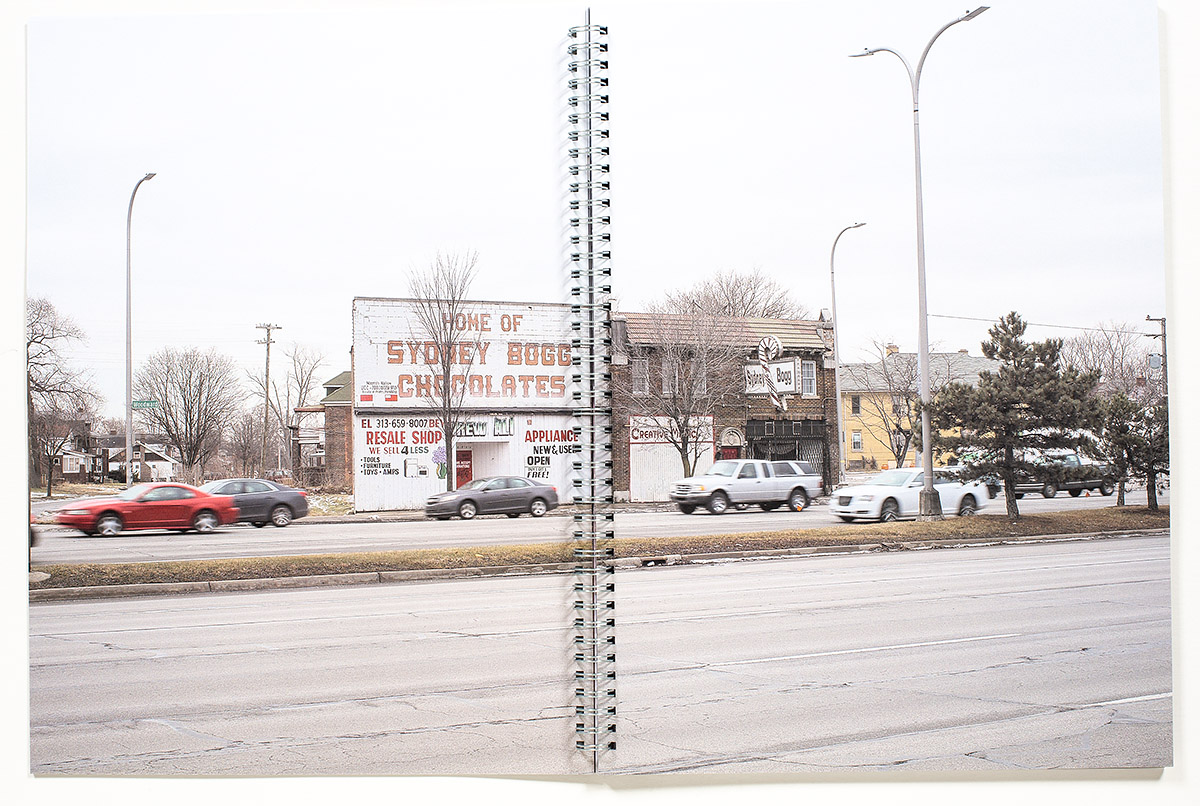
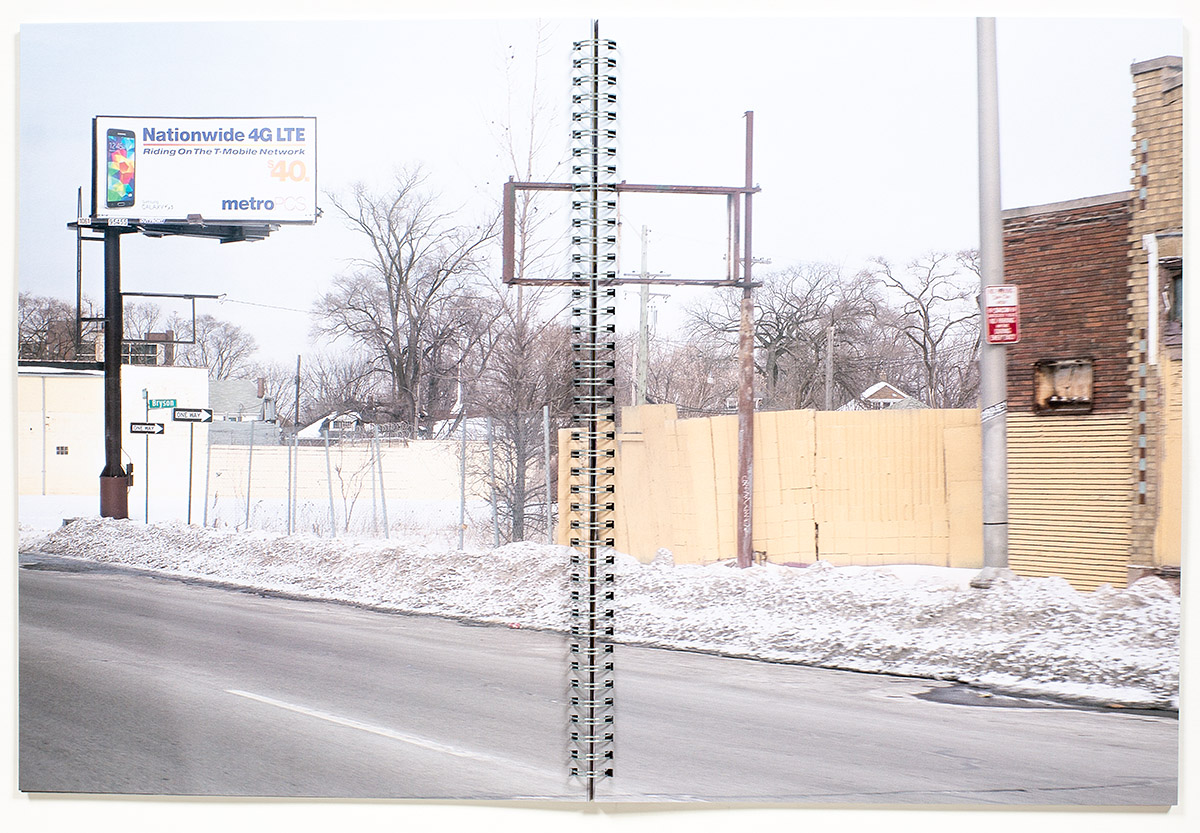
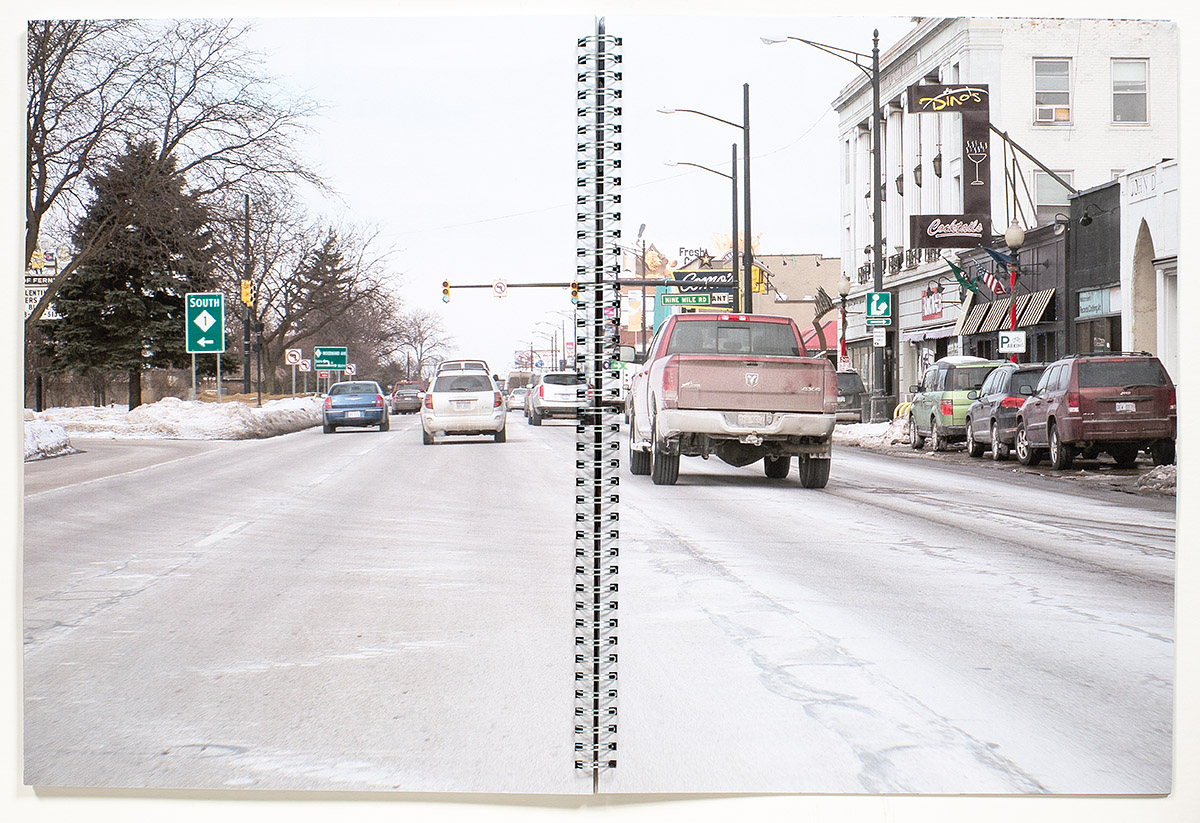
Kasners’s photographic oeuvre has a matter-of-fact photo-documentary style without benefit of humor or decisive moments, while functioning more of a dry social commentary of ‘this is what I saw’ in his perspective of this urban city that is foreign to him. He provides a sobering perspective and while the winter griminess does look familiar to me, I need to consider that I was blinded by my local upbringing and unable to see the forest for the trees as to the actual economic conditions that are present. My teenage romantic memories of cruising Woodward is punctured and deflated by Kasners book. And maybe this region was always this way, which is why an outsider’s perspective can be so valuable, to show us what we don’t ‘see’. In doing so, Kasners is also asking us as to what else don’t we observe?
There is no supporting text for this volume to provide any context. On his website for this project, Kasners does provide the following “The pictures taken as a pedestrian cover some of the distance that later was traversed by car. Thus, contrasting two speeds of movement, pertaining to different kinds of mobility and differing levels of peoples’ access to the city.” There are two different perspectives provided, one on foot while the other from a car. Nevertheless, there is one aspect of Detroit that appears to be overlooked, as a car-centric urban center, it sees everyone has access to a car, abet in various conditions and states depending on their economic statis.
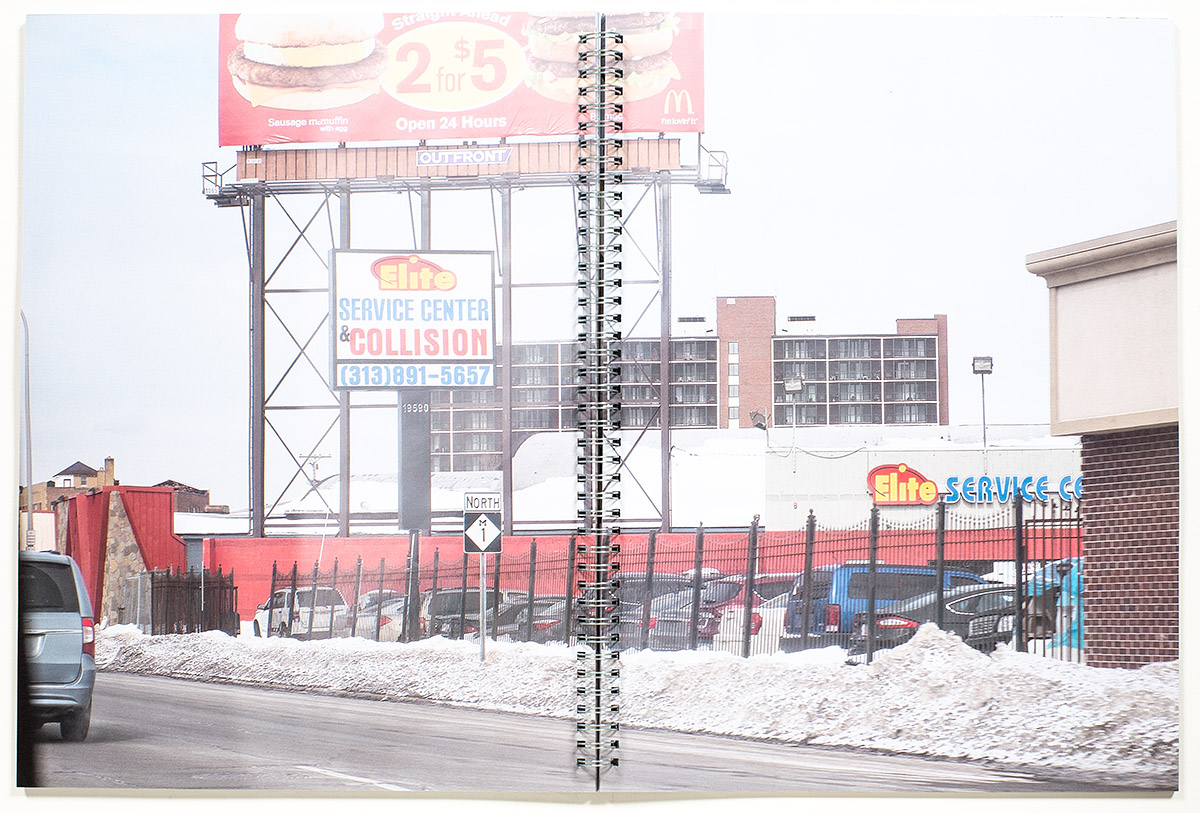
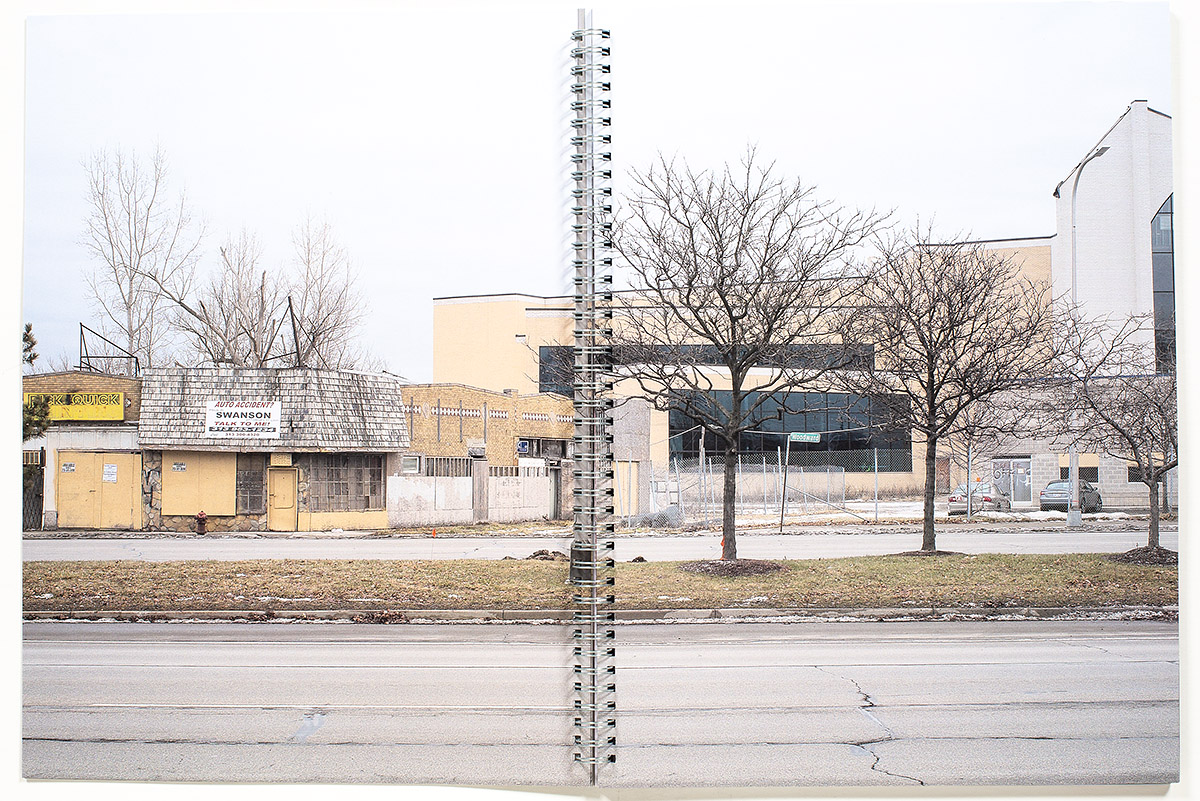
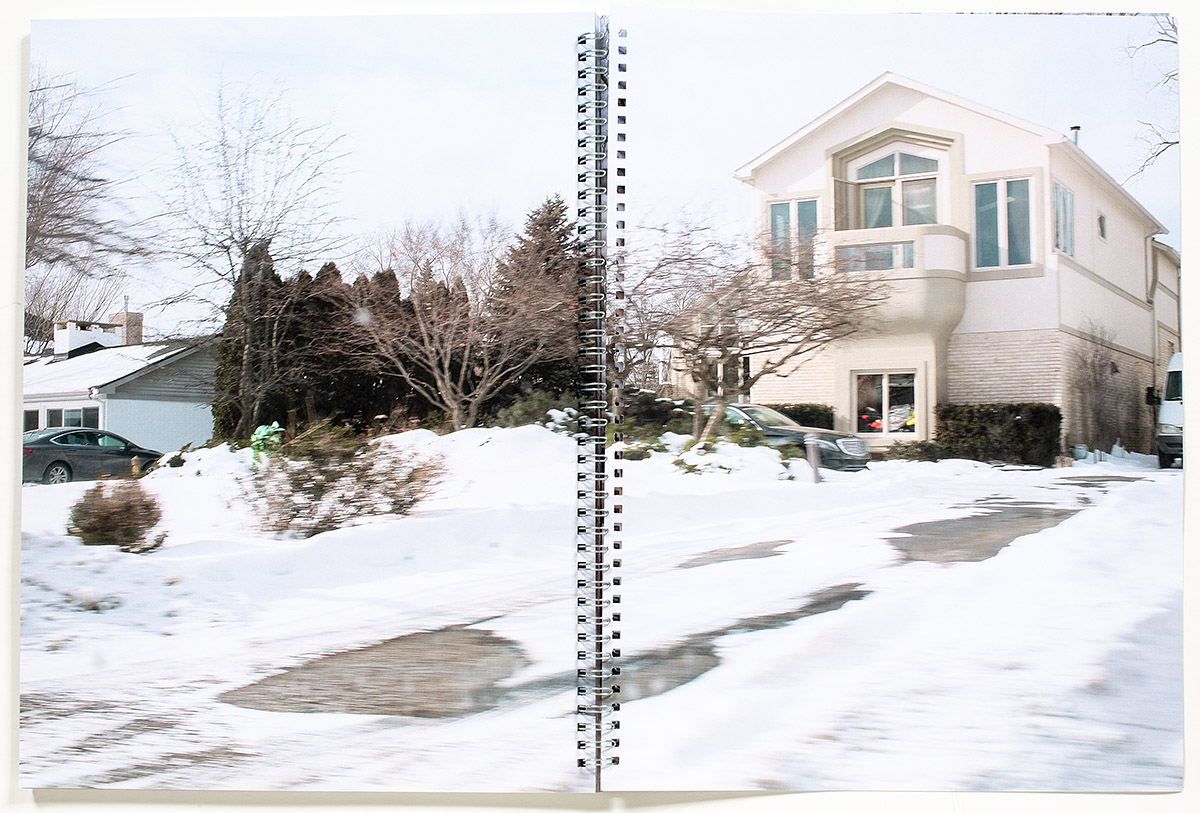
These are not ‘pretty’ urban landscape photographs, while revealing the grittiness of a large and older American urban environment. The book’s printing appears lower in contrast, perhaps due to the use of Digital Lithography with a matte paper, while I suspect that it helps set the overall mood for this dreary appearing urban landscape. This deadpan visual effect is further emphasized by the time of year, winter or perhaps very early spring, when this project was completed, which is resplendent with overcast skies and even what appears to be a clear blue sky, the resulting sunshine appears dull and muted.
The spiral bound binding allows a lay flat read for this large book that provides a massive 14-1/2” high by 22” wide photograph for each of the double-page full bleed images. The visual effect is stunning. The shiny wire binding running up the middle of the two-page spreads provides a subtle hint of the cover’s tire patterning as well as providing a common utility appearance, which reflects the underlying theme of this photobook. The overall design of this photobook is another great example of how a book’s layout and production elements can complement and support a photographic narrative.
It is not difficult to find traces or elements of disrepair to create an unflattering urban portrait of an American Midwest city that already has a reputation of being down on its luck. Even the more up-scale northern suburbs appear to lack any romantic appeal due in great part to the snow and gray slush of an overcast winter pall regardless of the expensive non-Detroit car observed in a driveway. This book does provide an unvarnished documentary ‘truth’ in the spirit in the New Topographics genre.
_____
Douglas Stockdale is a visual artist and Founder, PhotoBook Journal
____
Woodward, Christian Kasners
Photographer: Christian Kasners, born in Bottrop and resides in Leipzig, Germany
Self-published, Leipzig, Germany copyright 2022
Without supporting Essay or pagination
Text: English
Softcover, spiral binding, Indigo Digital Lithography, 11 x 14.7 inch., Edition of 100, ISBN 978-3-00-071270-8
Photobook Designer: Christian Kasners
Without supporting Essay or pagination
Text: English
Softcover, spiral binding, Indigo Digital Lithography, 11 x 14.7 inch., Edition of 100, ISBN 978-3-00-071270-8
Photobook Designer: Christian Kasners
_____
Articles and photographs published in the PhotoBook Journal may not be reproduced without the permission of the PhotoBook Journal staff and the photographer(s). All images, texts, and designs are copyright of the authors and publishers.
 PhotoBook Journal
Leave a comment