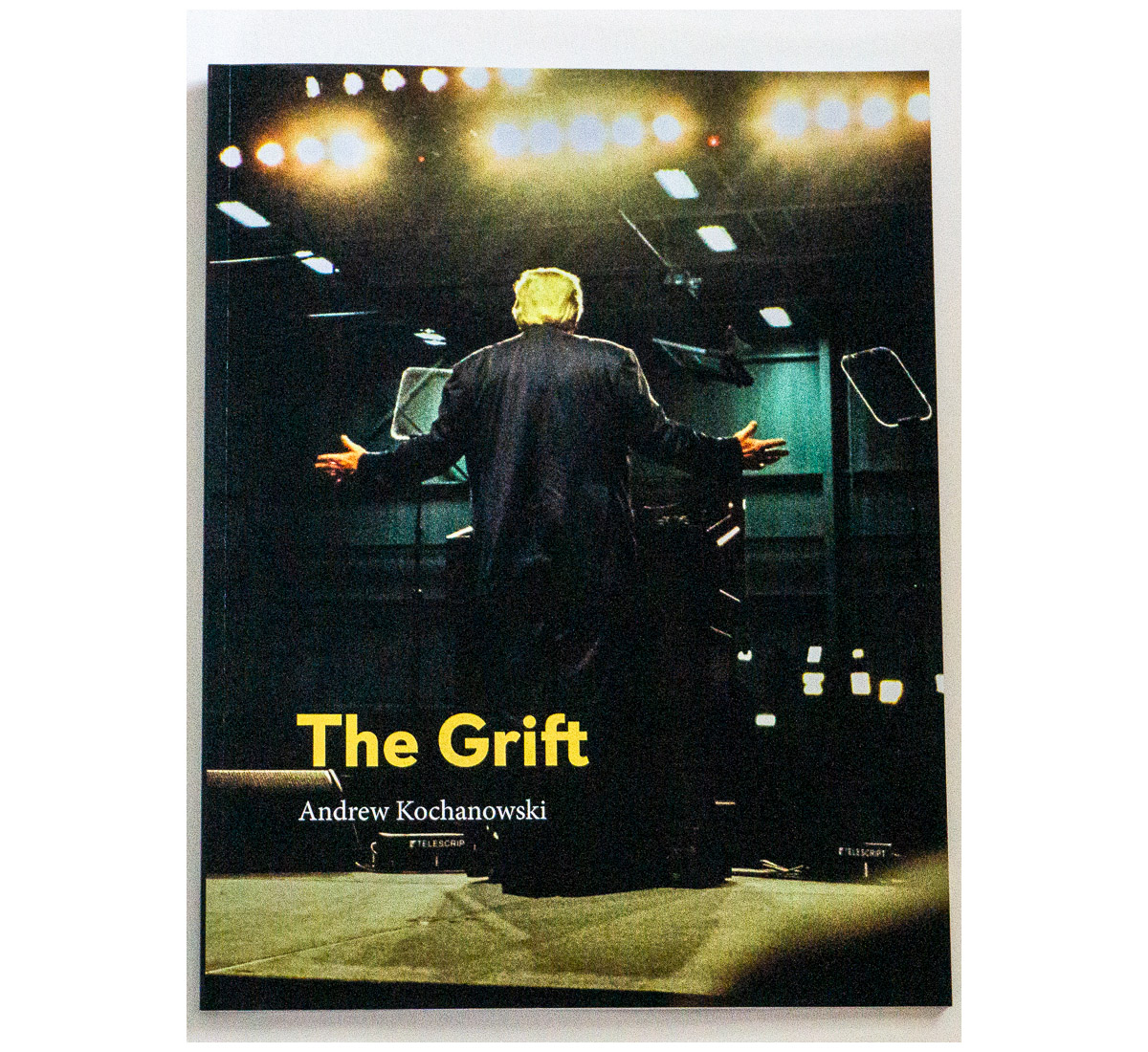
Review by Matt Schneider ·
The Grift begins with a short piece of reflective commentary by photographer Andrew Kochanowski. Here, he playfully describes something of a circus meets pyramid scheme. Crowds chanting now familiar phrases like, “Lock her up!” and “Build the wall!” Recurring bits about “Hoaxes, taxes, a grievance extravaganza.” Celebrity appearances from American politicians, the children of America’s most influential real estate mogul, and of course, the reality TV star and WWE Hall of Famer himself, Donald Trump. However, while it is free to enter this circus, he concludes, “Because for every winner there are 99 losers. Because no matter what you hear, you’re the one paying. There’s a reason the show is free. If you’re wondering about the mark in the room, it’s you.”
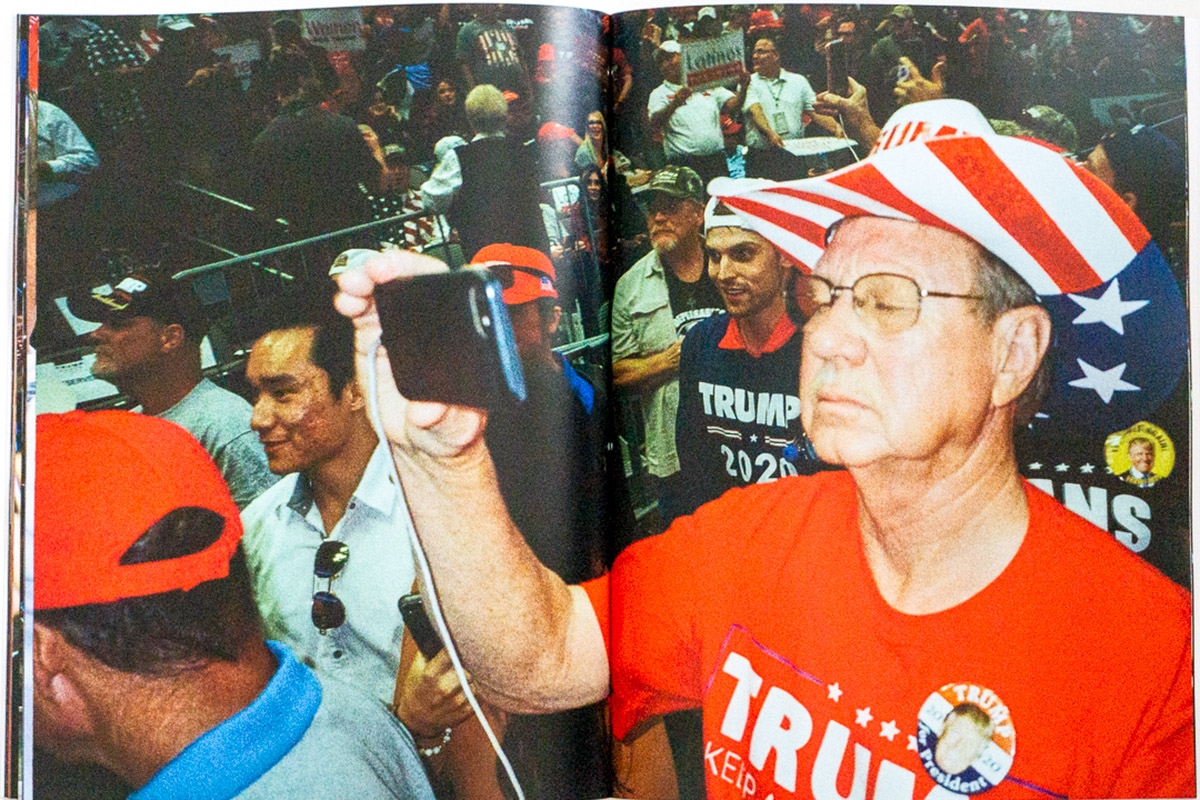
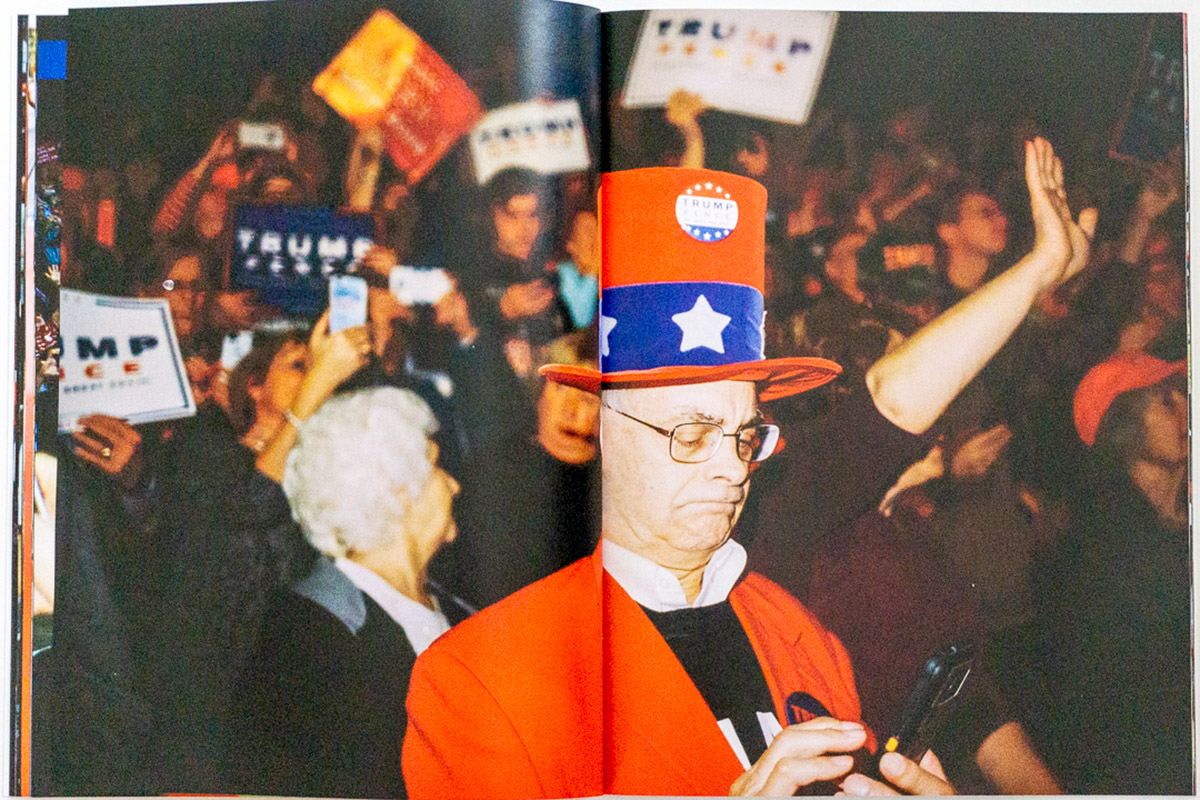
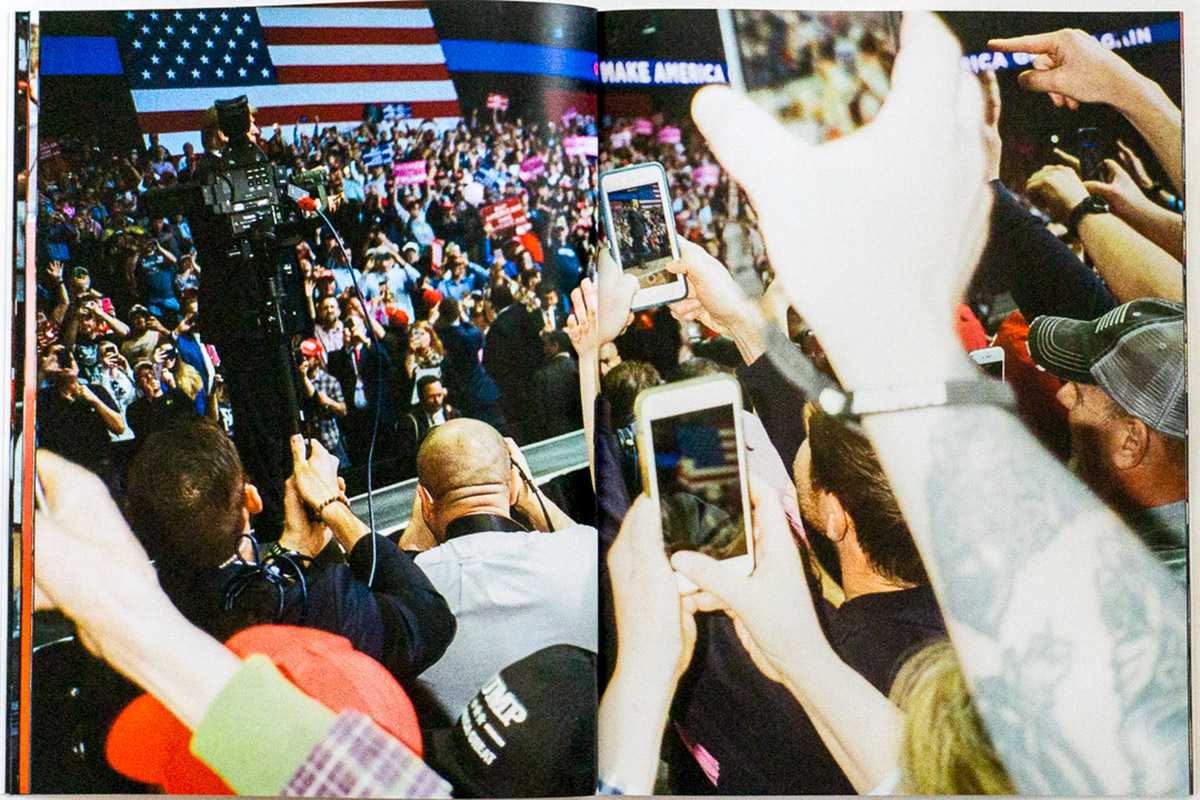
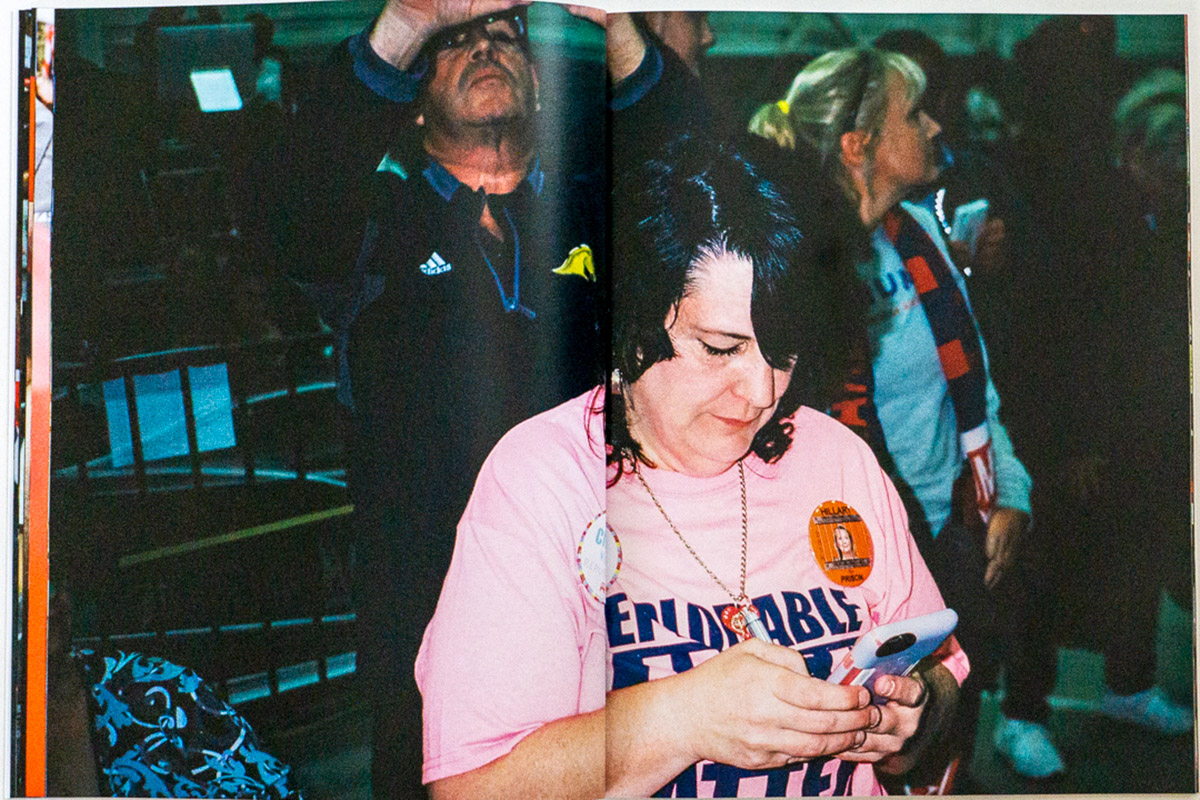
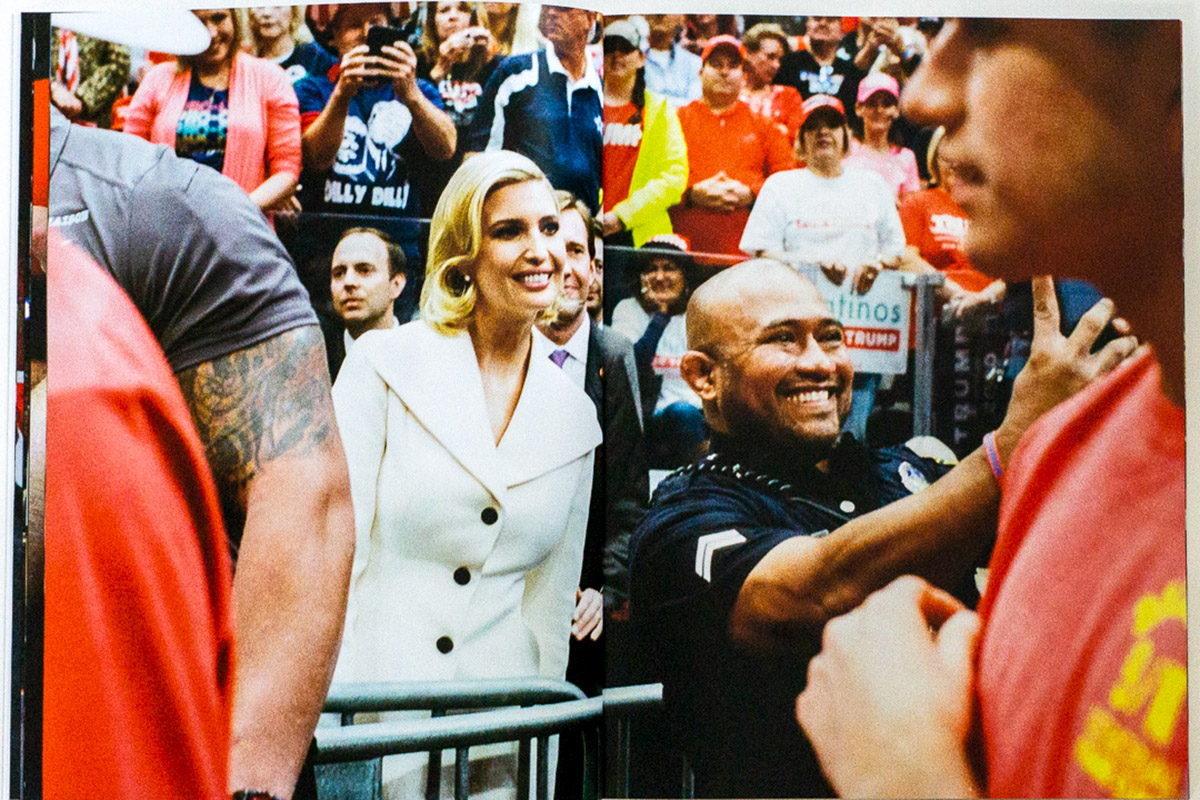
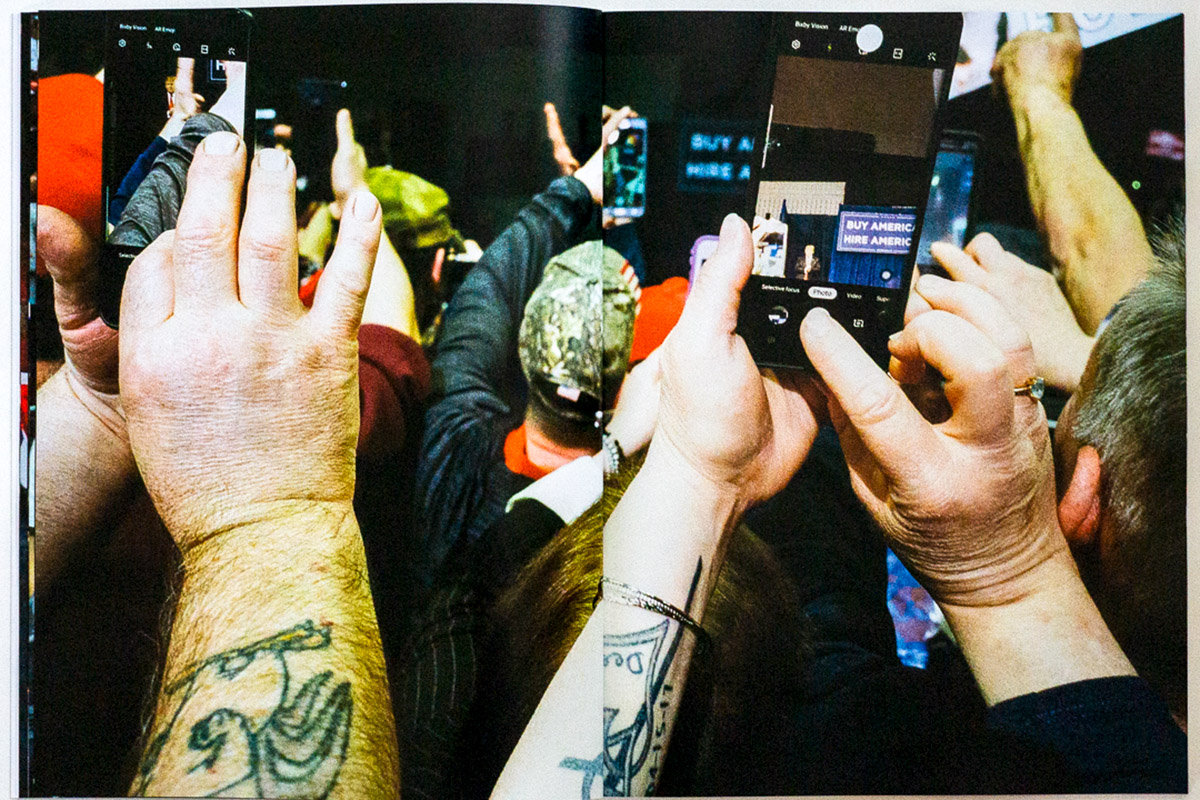
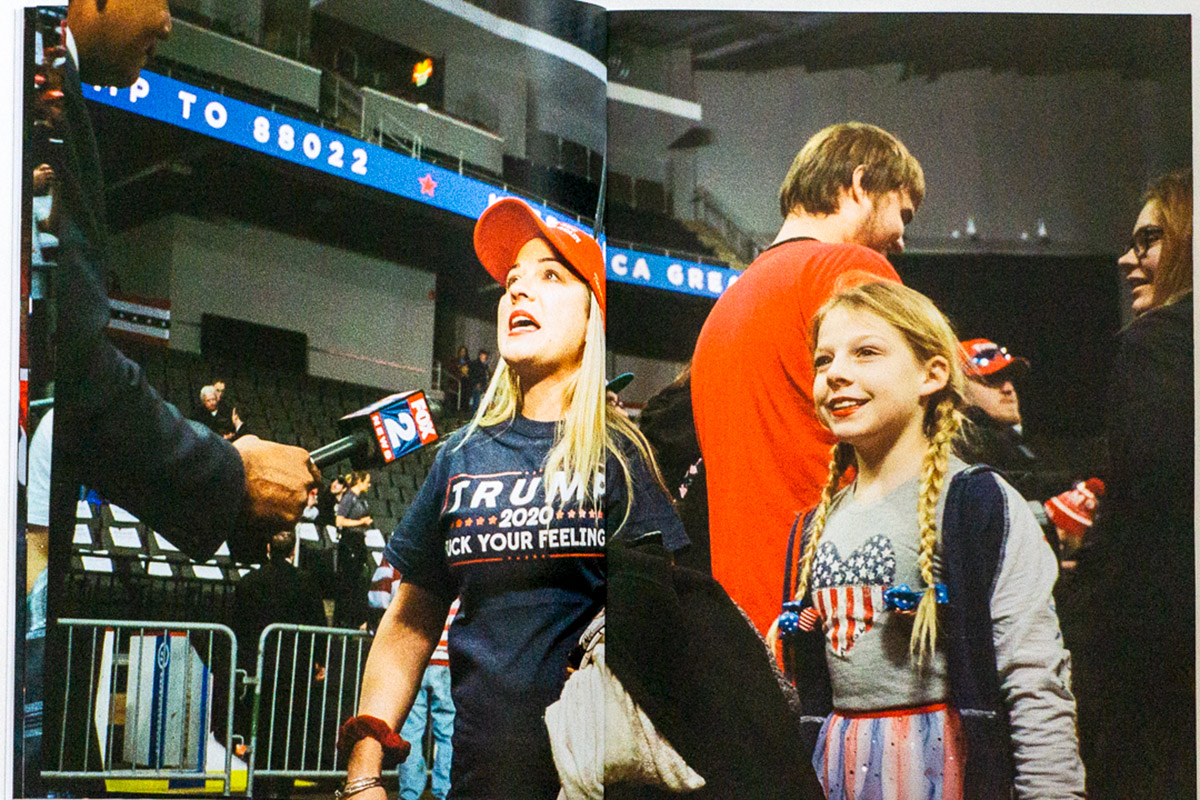
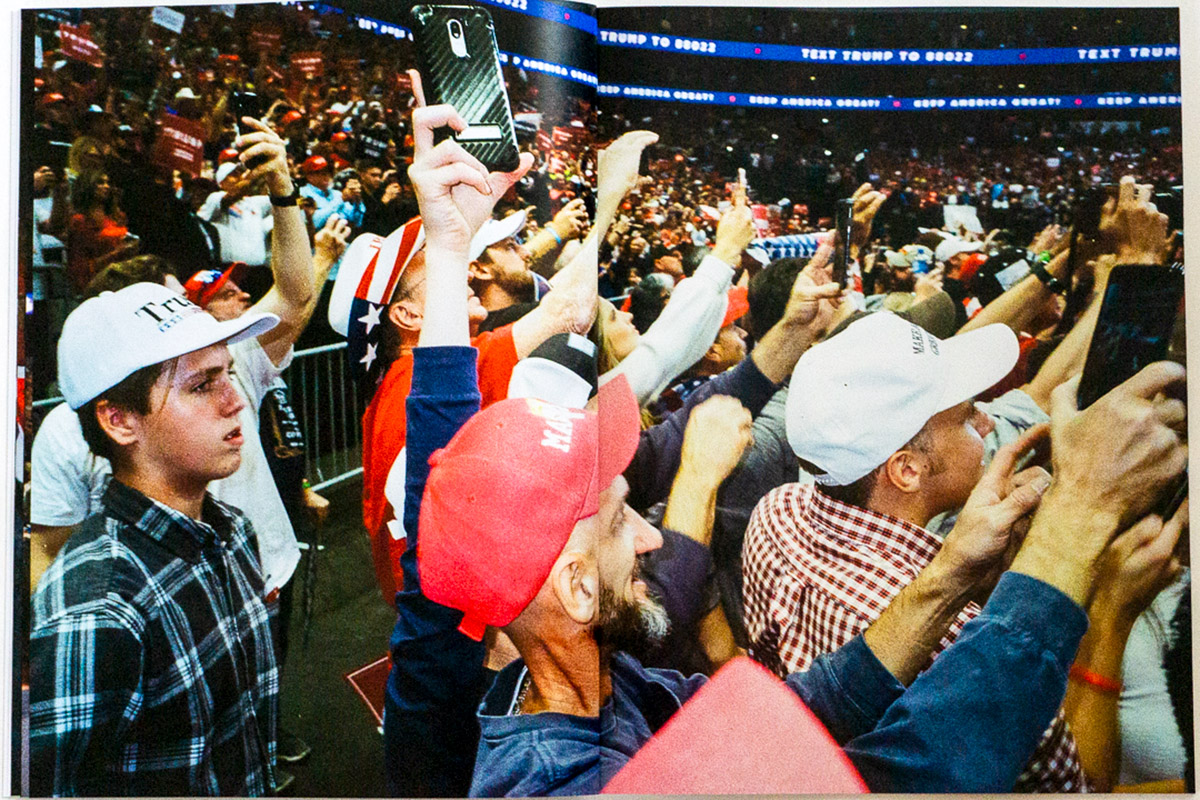
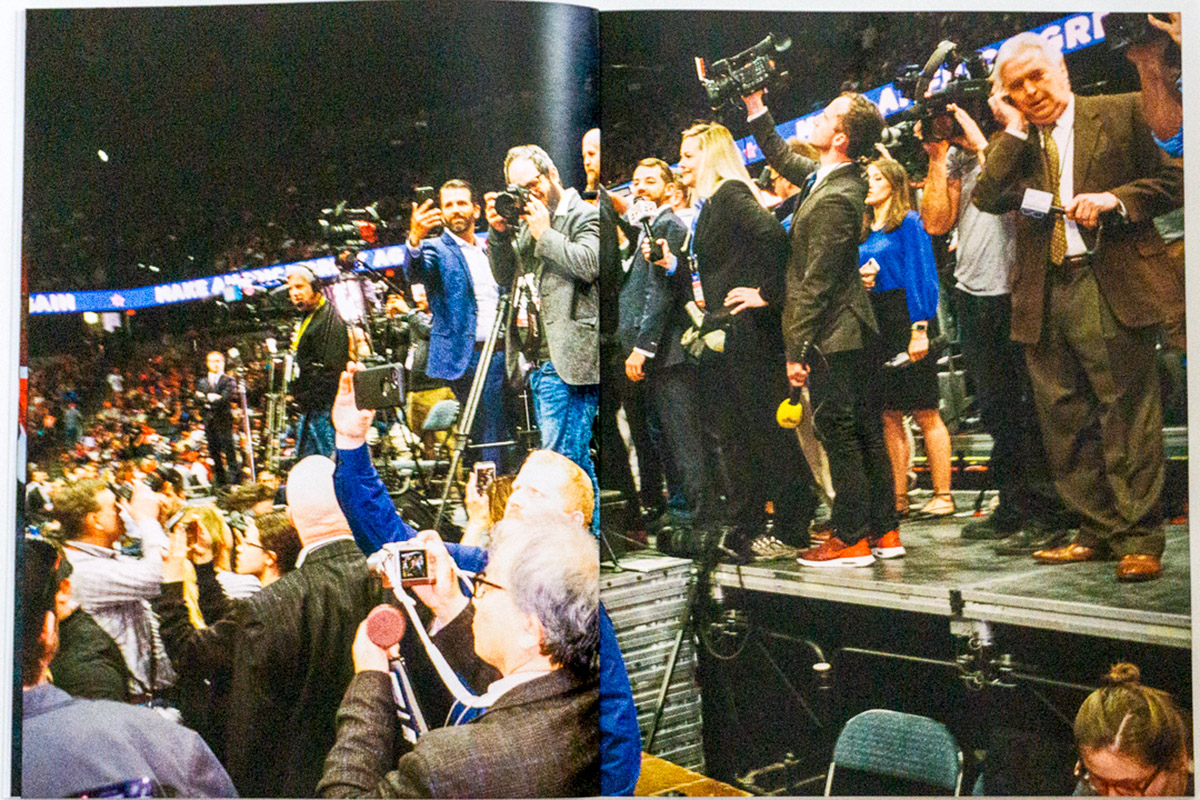
In the pages that follow, Kochanowski does a worthy job of depicting the frenzy of “the grift.” He shows scores of people crowding into tight spaces to prove that they were in the room where it happened; that they shared a space with Don Jr. or Ivanka; that they were within spitting distance of Don Sr. He shows middle-aged men and women leaning into the spectacle of it all, clad in red, white, and blue and adorned with buttons that allow rally-goers to literally wear their political beliefs on their sleeves. As I flipped through the pages of Kochanowski’s photobook, I could feel the excitement of the atmosphere.
However, the real strengths of The Grift are twofold and go unsaid in Kochanowski’s opening reflection. The first of these strengths is the commentary on political emotion that comes through the arrangement of photos. As scholars like Katherine Cramer have argued, contemporary right-wing politics are in no small part a “politics of resentment,” wherein conservative, often rural and white, voters are not drawn to Tea Party Republicans like Scott Walker, Paul Ryan, or Donald Trump because they favor low taxes and small government, per se. Instead, they are drawn to narratives of political corruption and unfairness because they do not believe the system as it is currently constructed benefits “real Americans.”[1]
Viewed in this light, the excitement – and sometimes anger – that jumps from the pages of Kochanowski’s book begins to make more sense to those of us not taken in by the so-called “grift.” Although it is tempting to view Trump and his entourage as grifters, this downplays an important fact that many Trump voters have not, in fact, been bamboozled by a con man but have deliberately chosen him as their candidate. They are driven to support him because he provides an unapologetic answer to cultural and political movements, such as Black Lives Matter and the LGBTQ+ movement, that challenge systems of white supremacist patriarchy perceived as beneficial to so many in the Trump base (even if they would not use this language).[2] The excitement that comes through the pages, then, may not come from the distraction of a good time, but from people rejoicing to be among their own.
Conversely, as someone often offended by the naked xenophobia, racism, and fascistic impulses of the Trump regime, this photobook also shined a spotlight on my own emotions. Even if the Trump regime does not actually serve his base in the ways that he promises,[3] what are we to make of Trump supporters that are not hapless marks, but political agents that demand cuts to education, public assistance, Social Security, and Medicaid because they do not perceive such programs to benefit them directly? As I studied The Grift, it was an opportunity to reflect on how seemingly benign objects, symbols, and actions have become imbued with meaning and invoke powerful emotions.
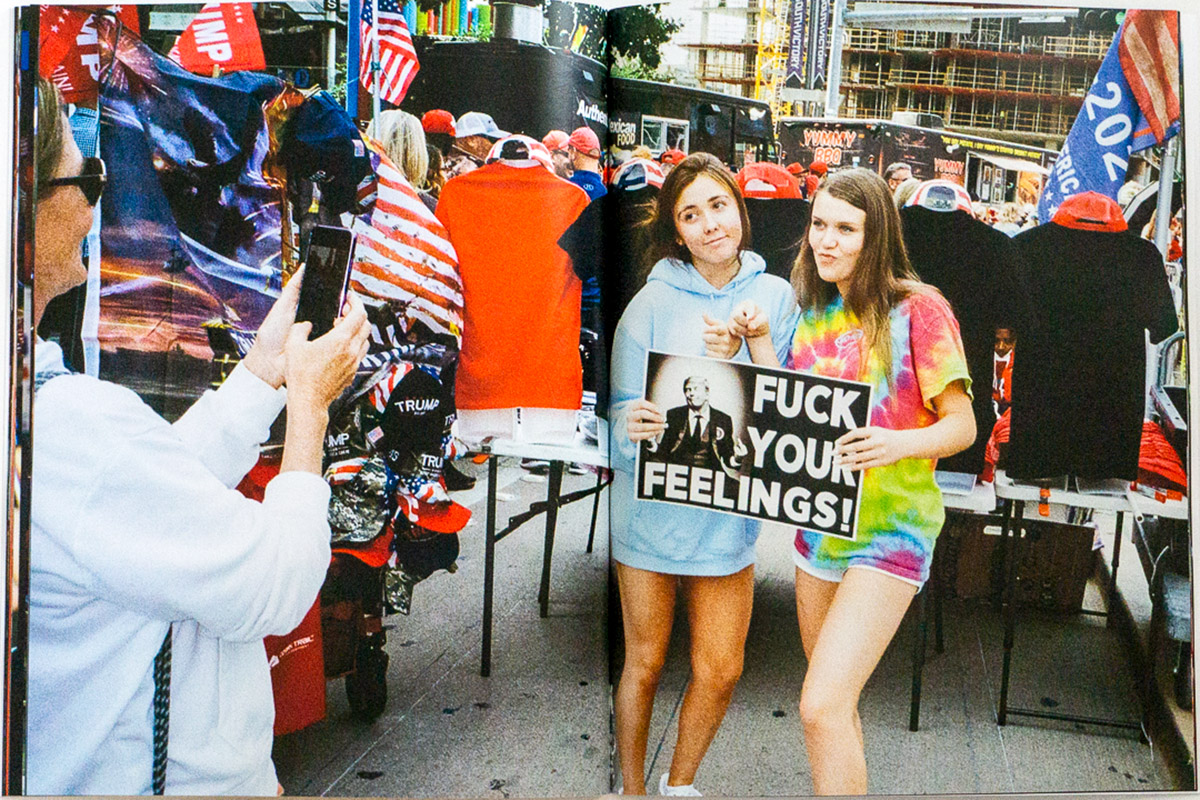
Flipping through the book, I felt my level of anger slowly creeping up as I viewed images of Trump supporters wearing “Hillary for Prison” buttons and the iconic red “Make America Great Again” hats as they engaged in mundane activities like scrolling on their phones and taking selfies. Then, as I began to question my anger, the book makes its most provocative move. My stomach dropped as I was hit with an image of two girls, perhaps 14 years old, posing for an older woman (their mother?) who was taking their photo; my eye was immediately drawn to the sign the girls hold: an image of Donald Trump smirking at me with two middle fingers up and text that reads, “FUCK YOUR FEELINGS.”
The second major strength of The Grift is that although the rise of Trump often feels unprecedented, Kochanowski’s photos highlight that even if Trump is new, his rise and political celebrity are not. I have already mentioned in passing Tea Party Republicans like Scott Walker and Paul Ryan. By portraying their opposition to Obama Era policies as a virtuous stand for personal and fiscal responsibility, this so-called “Party of No” laid the groundwork for Trump’s successful 2016 presidential run. Beyond this, though, there is a familiarity that comes through these images. While it would be unfair to imply that one-to-one comparisons can be made between Obama, Trump, and even recently emergent political figures like Alexandria Ocasio-Cortez and Marjorie Taylor Greene, they have a shared ability to effectively leverage their celebrity and a similar mastery of the art of spectacle.
Likewise, on the night in which I received The Grift in the mail, I happened to be watching the recent series White House Plumbers, a show that incorporates media clips from Nixon’s ’72 presidential run, and I was taken aback at how closely the Nixon election celebration scenes mimicked Kochanowski’s images. While Trump may be exceptionally skilled at invoking a sense of nationalism and commitment through a combination of spectacle and at sowing feelings of distrust, anxiety, and fear, Kochanowski’s images found a way to remind me that Trump is not the first — nor will he be the last — to exploit such skills for personal gain.
The Grift is certainly worth the read. The high-quality printing on sturdy 8.5×11 inch pages makes for a wonderfully satisfactory experience. Again, the images are striking, and the careful layout and ordering of the photos is both thought- and feeling-provoking. At this point, I own a number of photobooks from Immaterial Books – Machine Learning, Natures, and Beach Boulevard, for those who are interested in other excellent reads – and this is a welcome addition to my collection. On first pass, I felt The Grift lacked the subtle but deep commentary I have come to expect from Immaterial Books, but I am glad that I took a second (and third, and fourth…) pass through the book. I think readers will find that it nicely balances the noisiness of the Trump era with more subtle (and I would argue meaningful) messages that come through the book’s composition and arrangement.
____
[1] See Katherine J. Cramer’s Politics of Resentment: Rural Consciousness in Wisconsin and the Rise of Scott Walker.
[2] Elsewhere, in “Bottom-Up Violence Work: Exploring the Case of Armed Racial Justice Counter-Protest”, I and co-author Musa Jalal have written at greater length about armed counter-protest at Black Lives Matter events as an attempt to protect, if not restore, policing’s historic white supremacist functions.
[3] For example, see Jonathan M. Metzl’s Dying of Whiteness: How the Politics of Racial Resentment Is Killing America’s Heartland.
____
Matt Schneider is a sociology professor living in Whiteville, North Carolina.
____
The Grift, Andrew Kochanowski
Photographer: Andrew Kochanowski, born Warsaw, Poland and resides near Detroit, Michigan
Publisher: Immaterial Books, Champaign, IL, copyright 2023
Language: English
Stiff cover, perfect bound, 8.5 x 11”, 56 pages, edition of 100, printed by Dixon Graphics, Champaign, IL, ISBN: 978-1-7355008-9-8
Design by Phillip Kalantzis-Cope
____
Articles and photographs published in the PhotoBook Journal may not be reproduced without the permission of the PhotoBook Journal staff and the photographer(s). All images, texts, and designs are copyright of the authors and publishers.
 PhotoBook Journal