Review by Matt Schneider ·
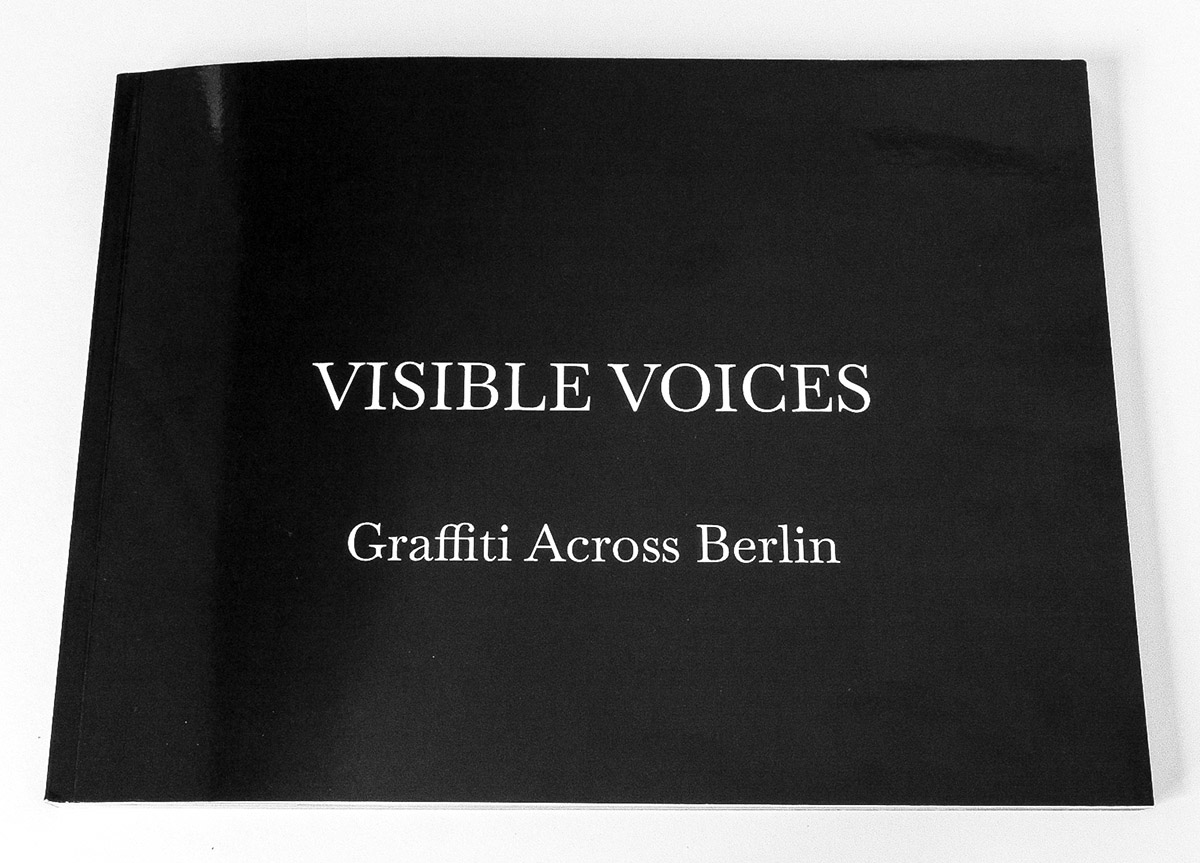
Social scientists distinguish between space and place. Space is a location defined by size, distance, and boundaries. Place, on the other hand, is about the social characteristics of these physical locations. Places contain meanings that are derived from the people, social practices, and cultures that comprise them. Meaning becomes emplaced in physical, often human built, environment. In this way, Kaushik Mukerjee’s Visible Voices: Graffiti Across Berlin, which features photographs of everyday graffiti from the neighborhoods of Schöneberg, Wedding, and Mitte, Berlin,is a photobook about the making of place. While the photos featured in this work differ from the large, commissioned murals also characteristic of Berlin and other cities, this bottom-up approach to street art nonetheless contribute to a definition of Schöneberg, Wedding, and Mitte, with each individual piece representing a political and aesthetic statement.
Yet, even as these works help define the neighborhoods in which they exist, they are often overlooked. In the pages of Visible Voices, Mukerjee’s monochrome photographs draw attention to these often-overlooked statements. In some cases, graffiti helps reimagine the spaces as something fantastical; rectangular metal structures can be reimagined as nervous looking robots or an iconic Volkswagen microbus. Other times, artists provide expressly stated political commentary, spray painting in English, for example, “Fuck WHITE M*N!” on the side of a seemingly random building. Other times, the meaning of the stylized letters remains unclear, but nonetheless fundamentally alter the feeling that a grand and arched train station entrance would otherwise inspire. Yet, even when the meaning remains unclear to the average passersby, these paintings work individually and collectively to contest what a place means, who it is for, and the purpose it serves.
The content and arrangement of Visible Voices is thoughtful, although some images appear in the book multiple times (perhaps this was intentional?). Outside of a brief opening description of the work, the book features no written commentary or interpretation from the photographer. While this may allow for the reader a greater ability to interpret the street art for themselves, as someone unfamiliar with Berlin and very little understanding of the German language, I fear that some of the book’s more interesting insights might have been lost on me. Nevertheless, I think this book will appeal to most readers, and it will be of particular interest to those interested in documentary photography, urban landscapes, and public art. As the reader engages with this photobook, they will undoubtedly be reminded of their own adventures through urban places and will hopefully revisit those experiences with the same critical eye offered here by Mukerjee.
Matt Schneider is a professor and visual sociologist in Wilmington, North Carolina.
____________
Kaushik Mukerjee – Visible Voices
Artist: Kaushik Mukerjee
Publisher: Variable Press
Copyright: 2025
8” x 10” Perfect Bound paperback, 156 pages, black and white
100lb Satin Cover with Gloss Lamination, 80lb Satin inside pages
____________







Articles and photographs published in the PhotoBook Journal may not be reproduced without the permission of the PhotoBook Journal staff and the photographer(s). All images, texts, and designs are under copyright by the authors and publishers.
 PhotoBook Journal
Leave a comment