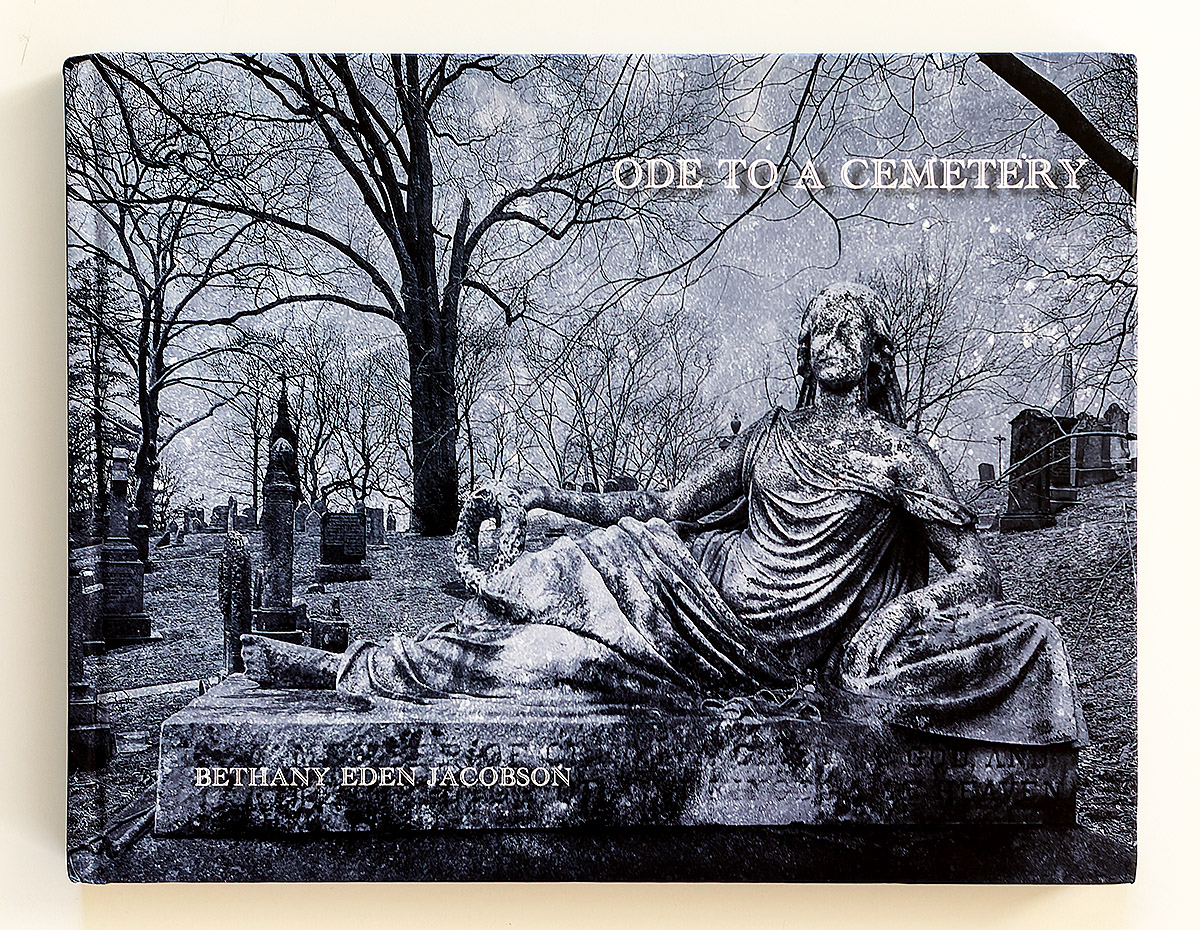
Review by Brian Rose ·
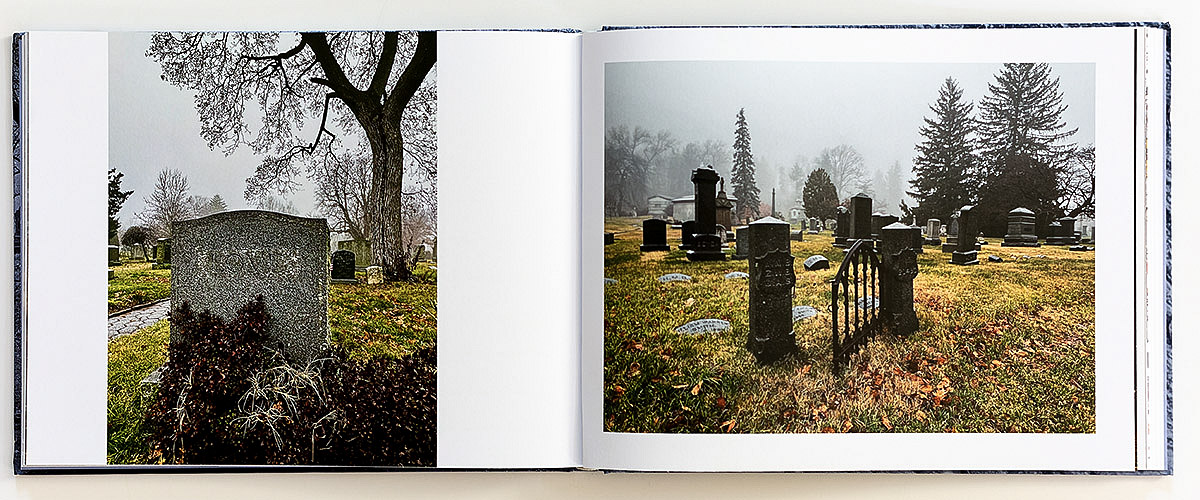
During the 2020 pandemic, Bethany Jacobson escaped the confines of her apartment and took to the winding paths of Green-Wood Cemetery in Brooklyn. For those of us in New York, the whoops and wails of sirens seemed never to cease, a constant reminder of the presence of disease and death in our midst. The history of New York is replete with past epidemics: yellow fever, cholera, influenza, and tuberculosis. Undoubtedly, many who are buried in Green-Wood were felled by one or another of these plagues.
Jacobson, however, was not morbidly obsessed with death as she photographed the monuments and meticulously designed landscape of this ancient glacial terrain. An 1857 directory for visitors stated: “You are about, kind reader, to enter and explore a still yet populous Village of the Dead. Through its labyrinths of roads and footpaths- of thicket and lawn- you will need a guide. Take one that will be silent and unobtrusive, and not unintelligent.”
Jacobson is that guide in her book “Ode to a Cemetery.”
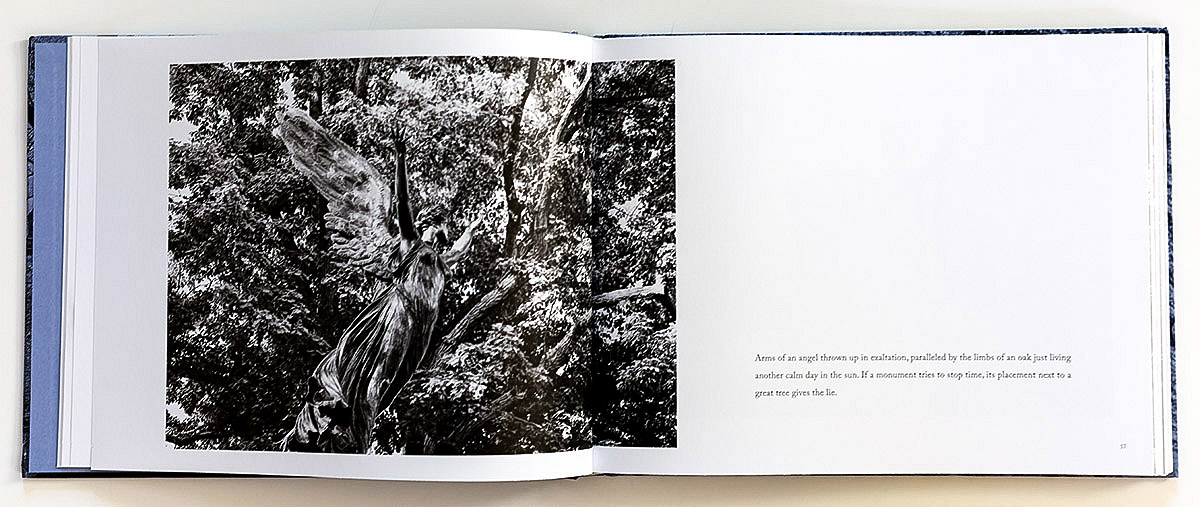
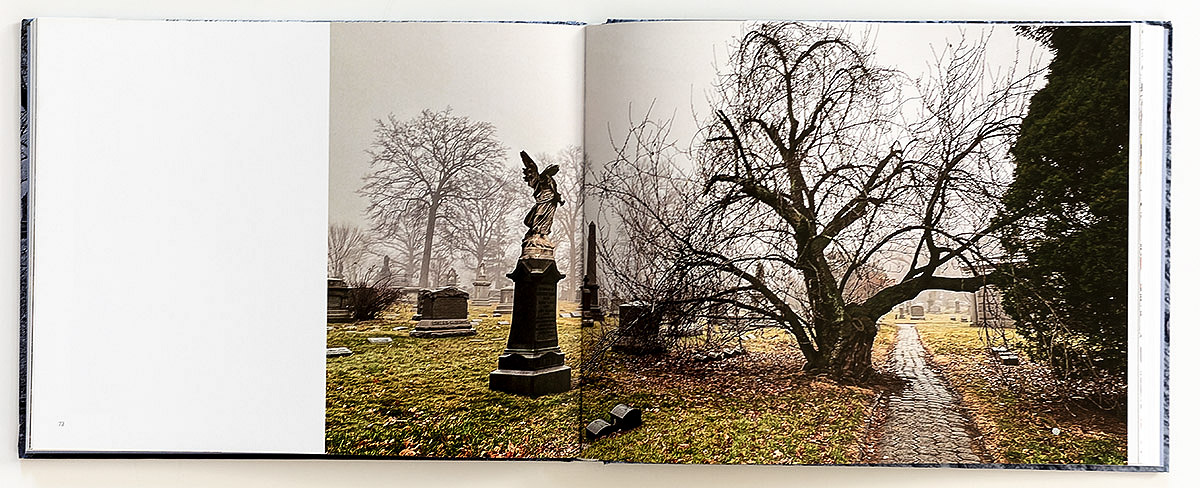
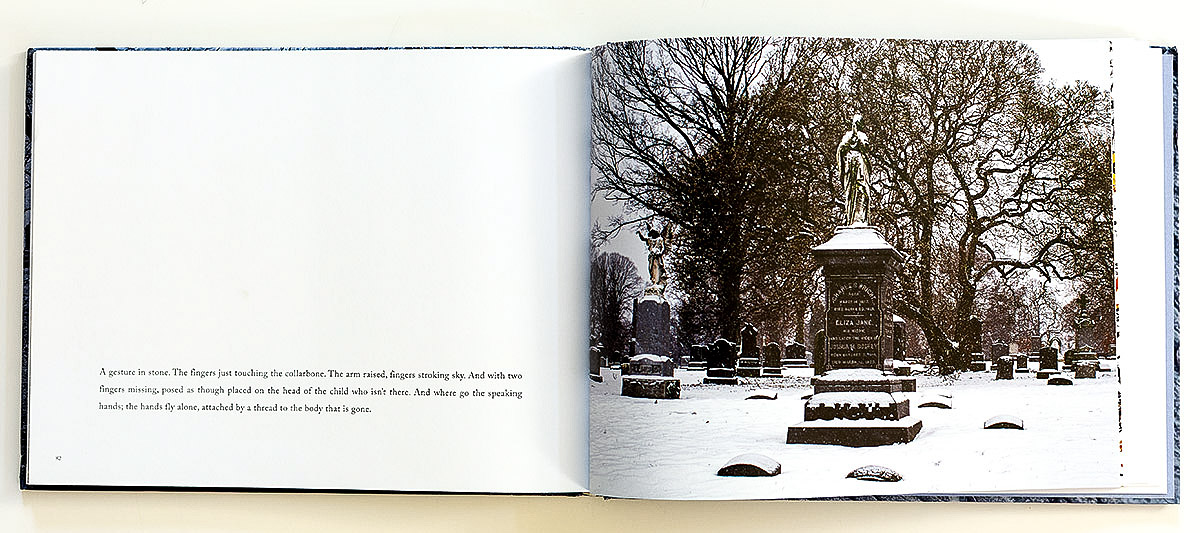
The Green-Wood she leads us through, however, is not the one of famous personages, tombs, and outward vistas to the surrounding city. It is an inward journey, a meditation on the passage of time – timelessness – a reflection on the liminal space between birth and death. We are lost in a landscape of memory among the weathered stones of shrouded ghosts and angels. There is something romantic and Keatsian about Jacobson’s visual ruminations, made all the more evident by the accompanying text of poet Cole Swensen. Here her words illuminate an image of an angel with uplifted arms:
Arms of an angel thrown up in exaltation, paralleled by the limbs of an oak just living another calm day in the sun. If a monument tries to stop time, its placement next to a great tree gives the lie.
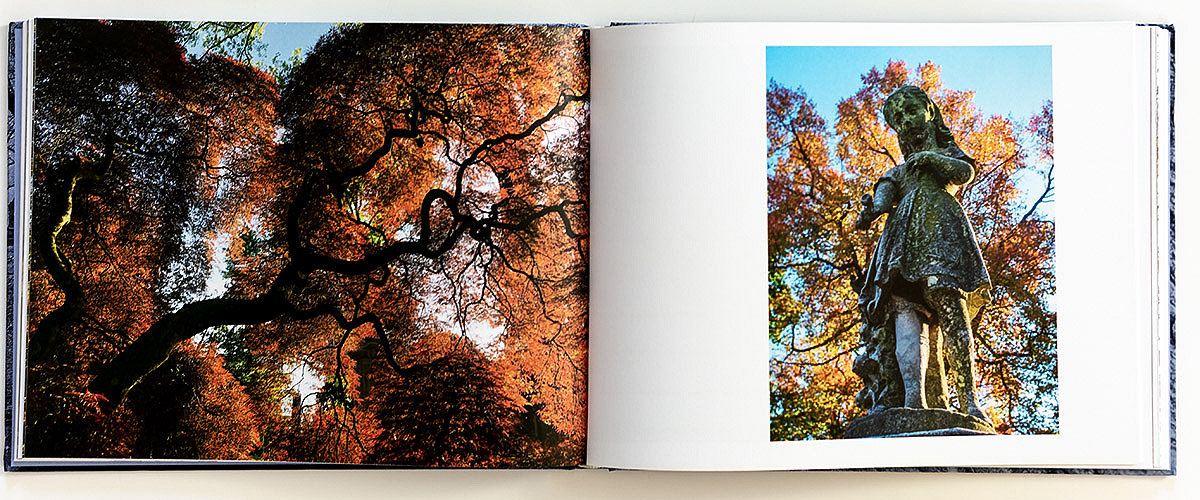
There are numerous stone figures throughout “Ode to a Cemetery,” and only two fleeting glimpses of human flesh and blood presence: a woman seen walking on a roadway with a white balloon, a touch of whimsy, caught in the branch of a tree, and another woman seemingly lost among a group of headstones, but probably just wandering. Despite our best efforts, all the granite and marble permanence bely the reality of the matter, that humans are passing through, and that nature untamed is ultimately victorious.
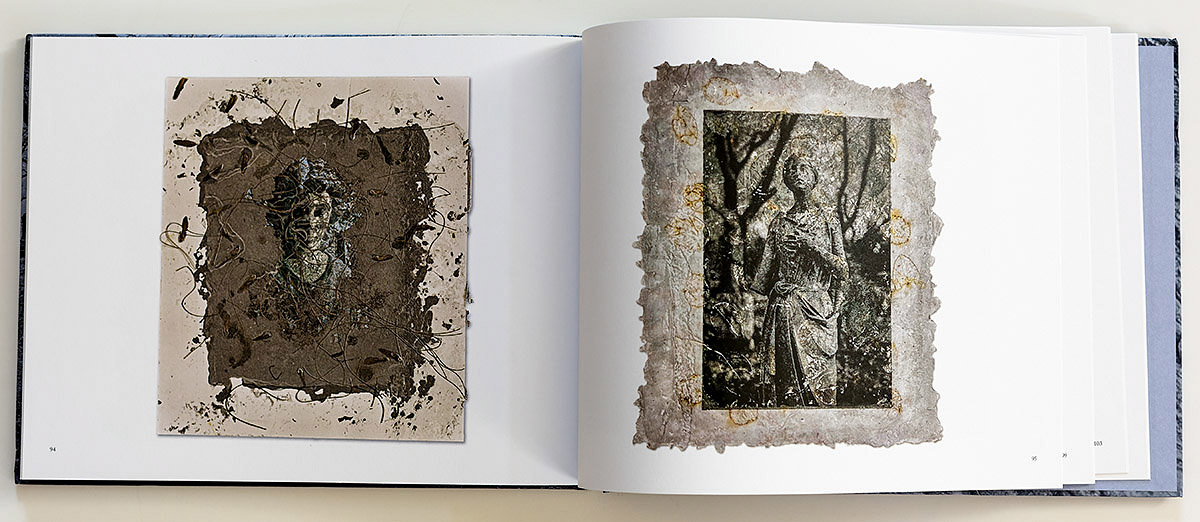
“Ode to a Cemetery” is divided into two sections. The longer of the two is a series of photographs of Green-Wood, which is followed by 13 works on paper. While these are among the strongest images in the book, they have a very different presence in that they are reproductions of photographic transfers on handmade paper. In several, the visages of stone statuary are overlaid with the imprints of leaves and twigs. They are beautiful and poignant expressions of loss and longing. Rather than an addendum, however, they might have worked better interspersed throughout the book acting as pauses or dividers between passages of photographs.
There are two images in “Ode to a Cemetery” that stand out as emblematic, both rendered in monochrome. One, near the beginning of the book, shows a statue of Minerva, the Roman goddess of justice and wisdom, as well as the arts, her arm stretched out, her hand raised palm forward. The other is a tight closeup of a hand, palm facing out. Are these offerings of peace and solace? Or admonishments to go no further, that we have reached the edge of the known world? Perhaps, they are both.
____
Brian Rose is a NYC urban landscape photographer
____
Ode To A Cemetery, Bethany Eden Jacobson
Photographer: Bethany Eden Jacobson, a British/UK dual-national and lives in Brooklyn
Publisher: Hirmer Verlag, Munich, Germany copyright 2024
Essays: Cole Swensen, Roy Skodnick, Art Presson
Text: English
Hardcover book, List of plates, Printed and bound, Printer Trento s.r.l., ISBN 978-3-7774-4364-5
Book Design: Hannah Alderfer, HHA design
____

Articles and photographs published in the PhotoBook Journal may not be reproduced without the permission of the PhotoBook Journal staff and the photographer(s). All images, texts, and designs are copyright of the authors and publishers.
 PhotoBook Journal
Leave a comment