
Review by Brian F. O’Neill ·
The range of the willow oak tree species includes New Jersey, Pennsylvania, and the Washington, DC area of the United States. It also extends to Florida and Texas. The species (Quercus phello) is most often found in environments where there is some year-round moisture. As it is a deciduous tree, it sheds leaves each year to conserve energy and water for winter survival. While the oak and willow oak are both part of the red oak family, the willow oak’s leaves are distinctive, being lengthy and narrow. This is the reason for the association with the willow tree. Although, the willow is not an oak. Yet, like the willow, the willow oak is thought to be “charming” due to the way that light is cast through the leaves, offering shifts of light and shadow. As the leaves sway on the branches, they articulate, moving pleasantly when catching gusts of wind, or perhaps less charmingly, being gnawed on by insects. Not that one should have anything against regular old oak trees, or insects.
Amanda Sauer is not a botanist or a park ranger. At one time she did write about climate change, but now, she is a photographer and educator. And it is not just willow oaks that interest her, but a specific one does. Sauer’s monograph, Giant Willow Oak, published in 2025 by L’Artiere Edizioni, is concerned with just such a tree that was called “a great old specimen” by the U.S. National Arboretum. It was described as robust and nearly evenly shaped: 100 feet tall and 98 feet wide in 1995. The tree was first catalogued in 1949. At that time, it was 50 feet tall, when it was also noted that “it was here long before the arboretum was formed.” But, one doesn’t come upon this information in Sauer’s 2025 monograph until the very end of the book; what one encounters beforehand is the giant willow oak itself.
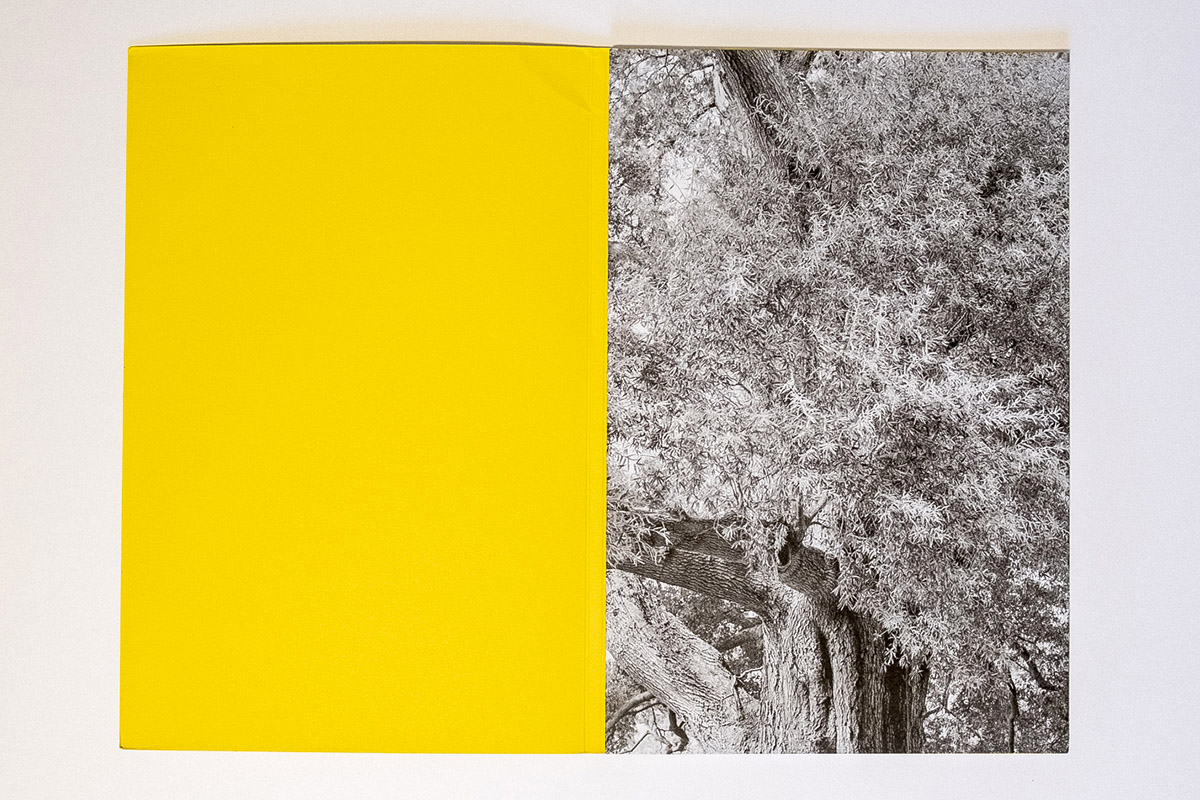
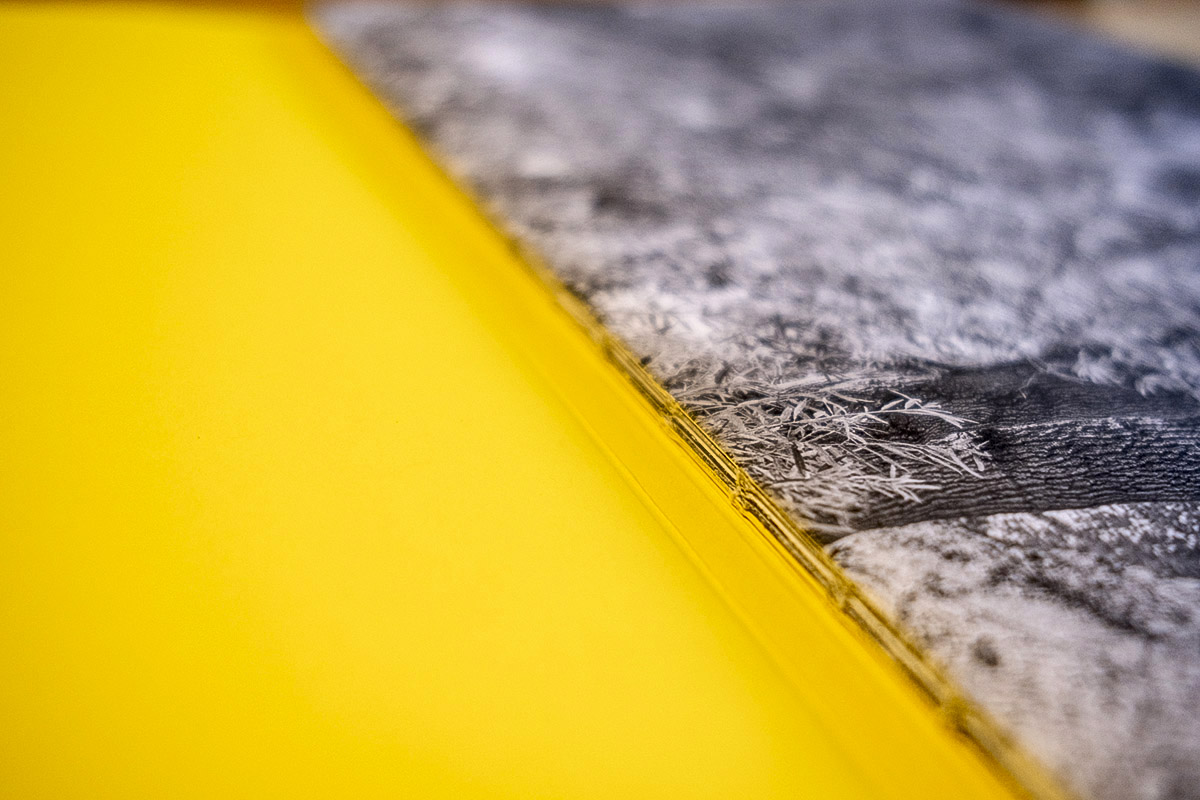
Opening the strikingly designed book with its yellow cardstock cover (reminiscent of the sun that encompasses both trees and humans), the book’s tallness (13 inches x 8.5 inches) cleverly mimics that of the tree, which is its subject, declaring the photographer’s interest in the natural world, but also to how humans interact with nature. For example, a closer look at the cover reveals some scientific notation, as one might find on tree rings, perhaps to indicate some measurement or age. In fact, I asked the author about this. The circular notation tracing the tree ring differed from the counting of tree rings as is done in dendrochronological research. And indeed, it is instead a socio-environmental-photographic numbering. The cover indicates a numbering system of 1-18. There are 18 vertical, bordered images in the book. As Sauer described it: #1 is the first photograph with the boy and #18 is the last photograph also with the boy – taken moments apart to connect the circle” (personal correspondence, March 13, 2026). Thus, within the book we have the connection of images created over the course of a full human and earthly cycle, but also we see how the cover design was created from Sauer’s own schematic – of where she made the images in relation to the tree’s location. These are just a few examples of how each component of Giant Willow Oak has been the result of a thoughtful sequence of decisions.
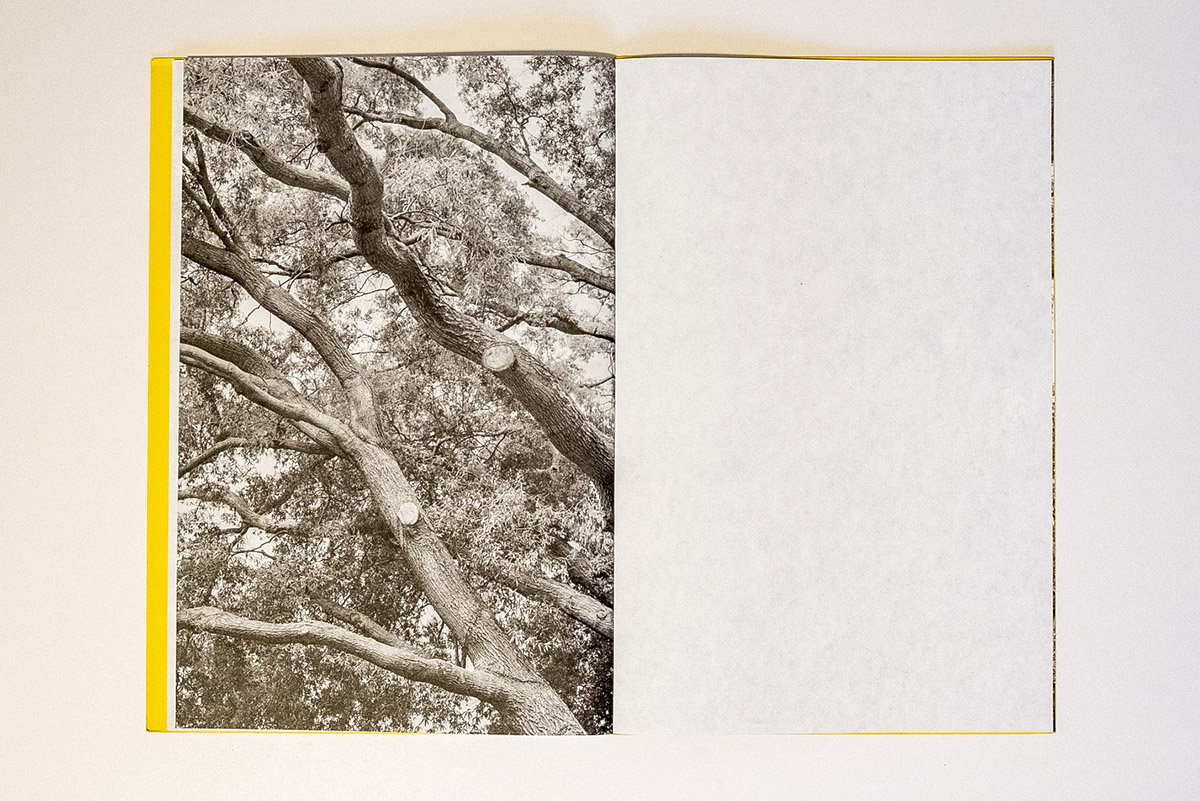
Sauer has written in her artist statement for this work that “the symbolic gravity of the tree became an invitation to invert the human centered narrative, to see myself as part of a greater system.” This sensibility is apparent from the first couple of images in the book, as the full page is subsumed in the robustness of those majestic long leaves, with the light and shadow dancing through them.
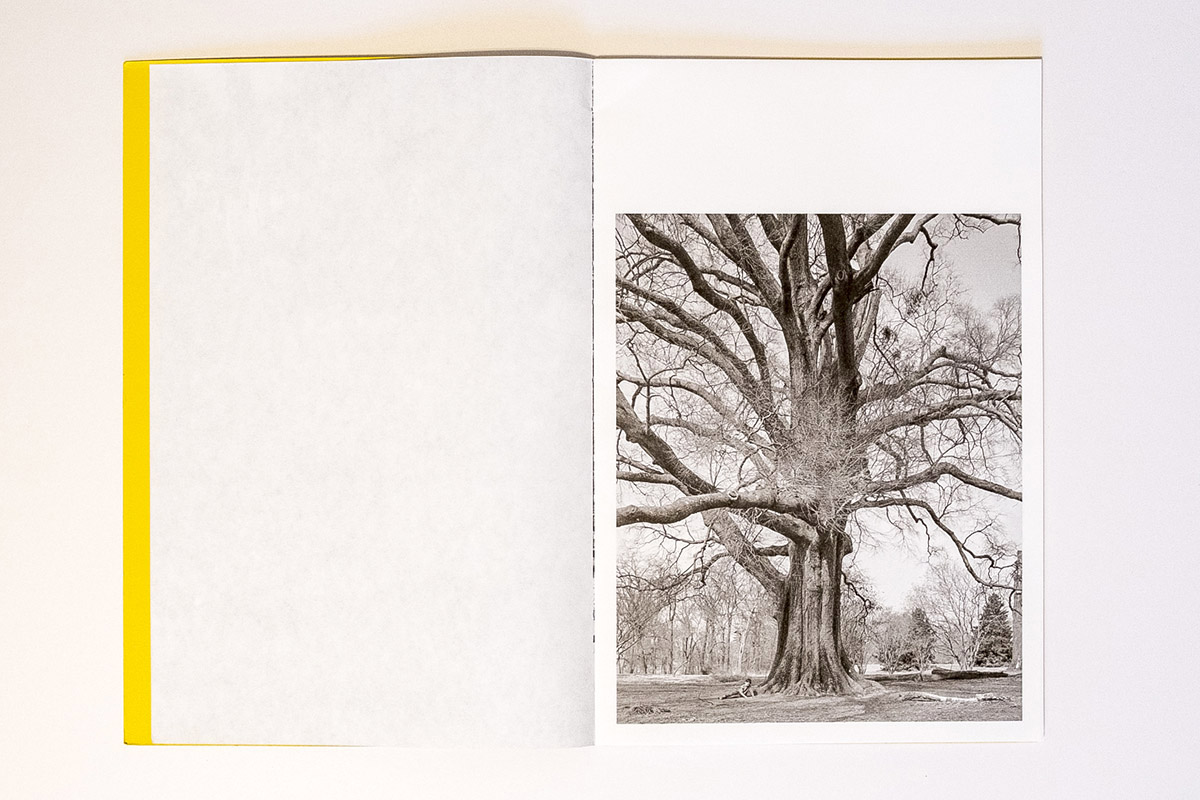
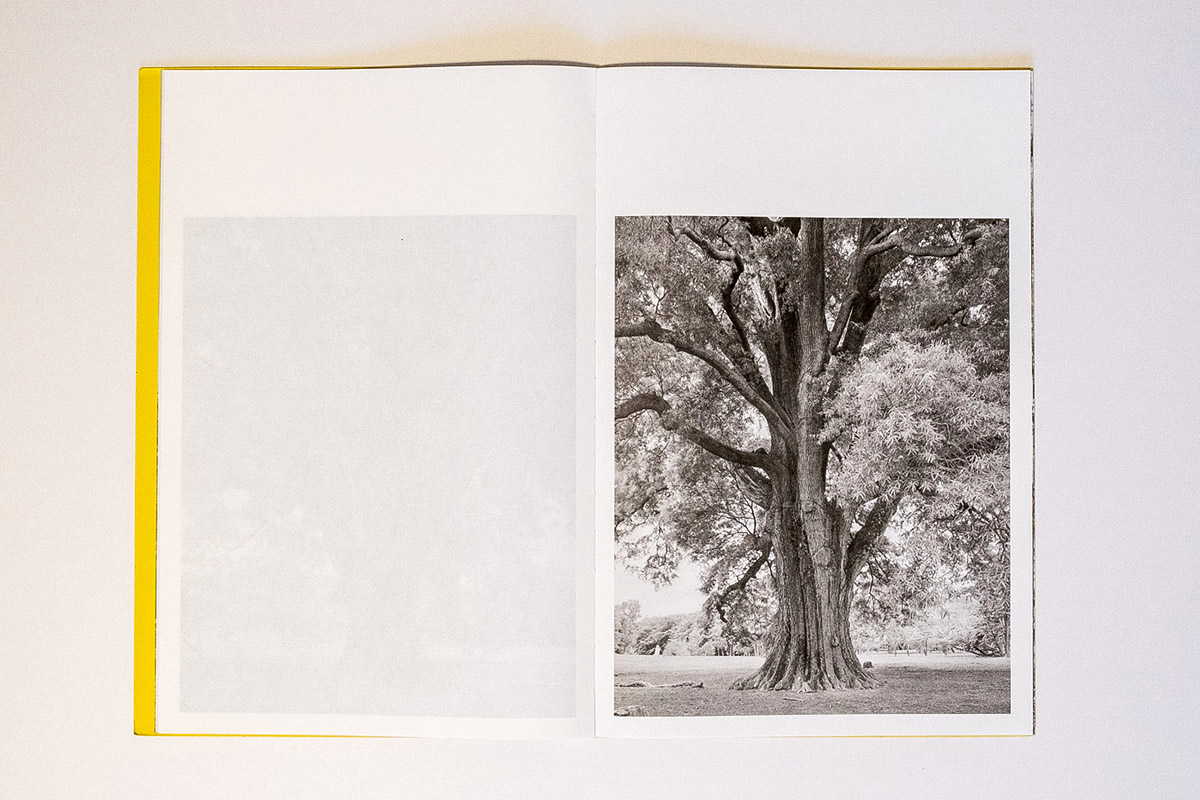
From this point, we encounter a significant image that will be echoed later in the book: a human eye level view of a large, significantly leafless tree with a young child lying, legs outstretched, beneath it, and playing in the dirt. The gentleness of this moment, of how the child’s (one might even read it as a kind of Adam) hand has been caught by the camera – outstretched and just making contact with the shoe trodden dirt near the base of the oak’s enormous trunk – is further reflected in the image as a whole. From the leaf-less-ness of the tree, and the sweater worn by the boy, it is clear that this could be a cool day. Winter, or something like it, is approaching. From the bird’s eye type view that held the viewer’s attention with just the first two photographs, now we are with the photographer, appreciating the tree as she did. From within the foliage, we have come to ground level.
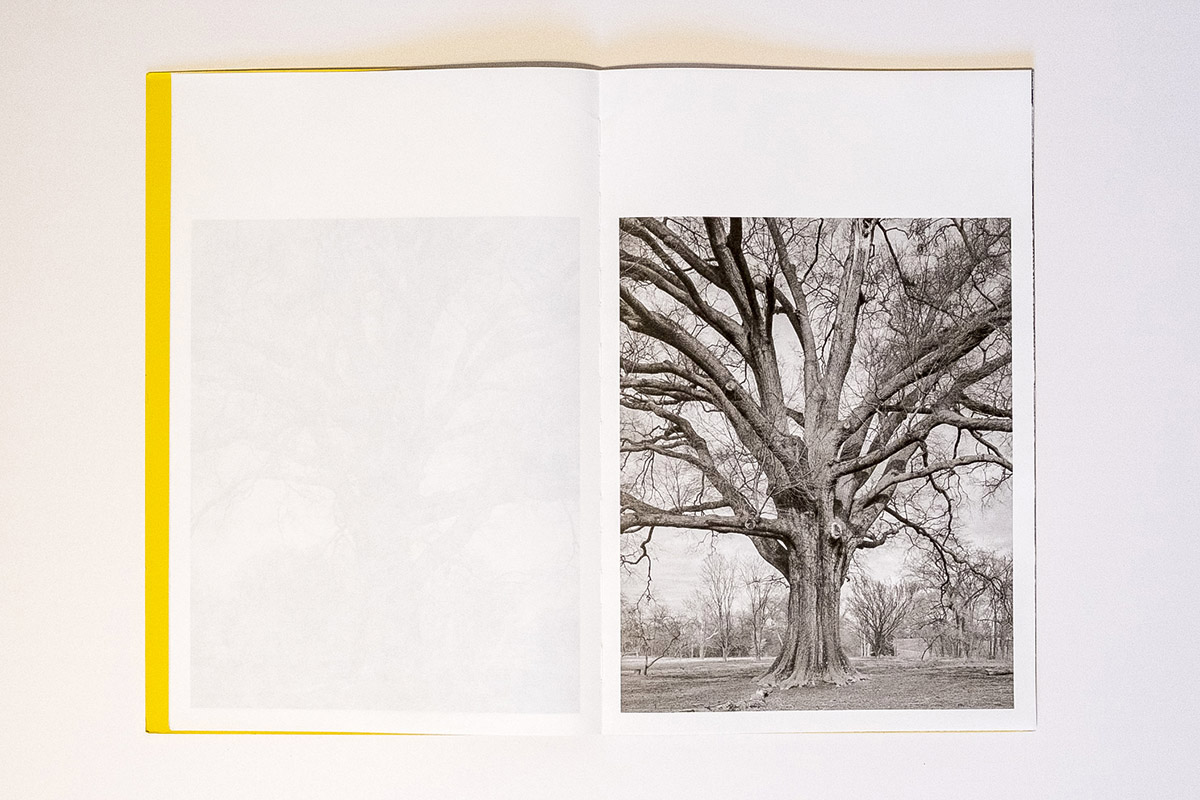
There are other notable features of how Sauer has photographed this tree. For one, the tree seems ungraspable by one glance alone. The choice of the figure, the boy, adds to the sense of scale – that this is indeed a giant, a profound tree. So enormous is it that the tops and sides seep out of the edges of the rectangular frame, pointing to some other horizons of contemplation. In these and the other richly detailed monochrome images, one can almost hear the faint rustling of leaves getting brittle as they have changed color and begin to desiccate and fall. The light distant branches are rattling in the wind and amidst the oldest, most ligneous portions, a deep creaking sound rumbles.
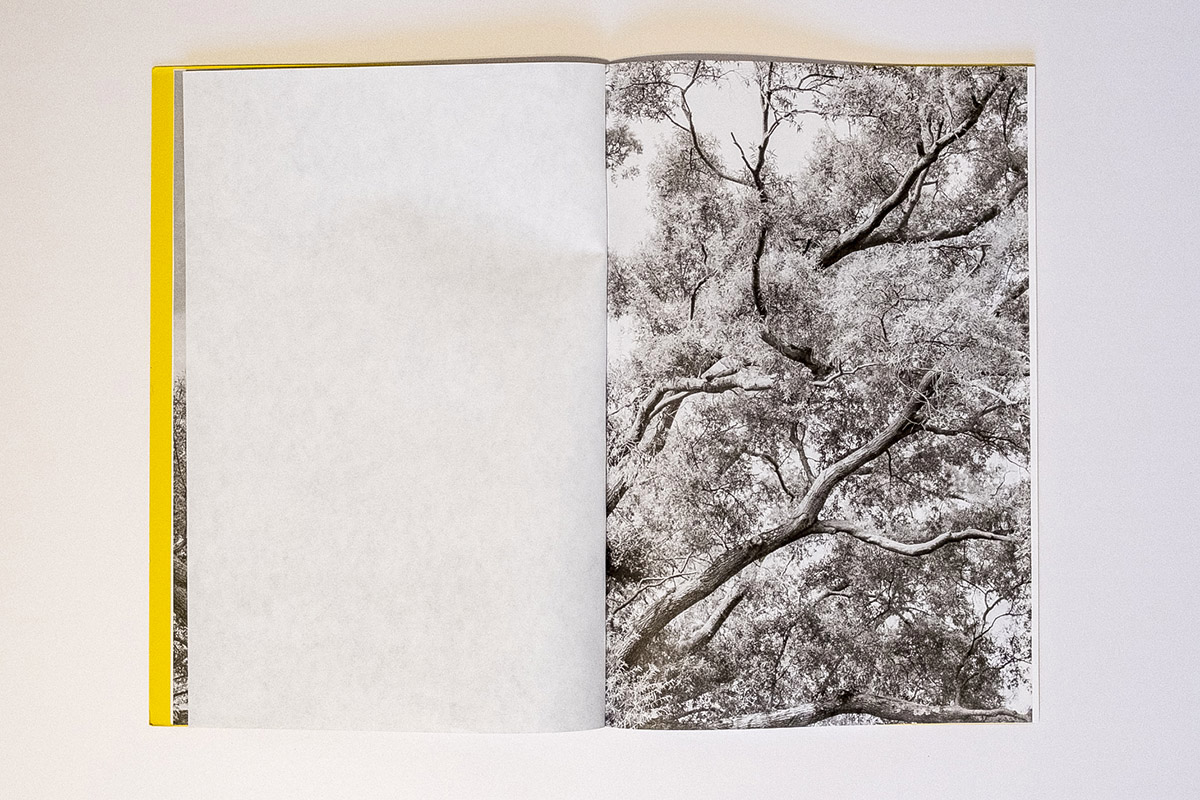
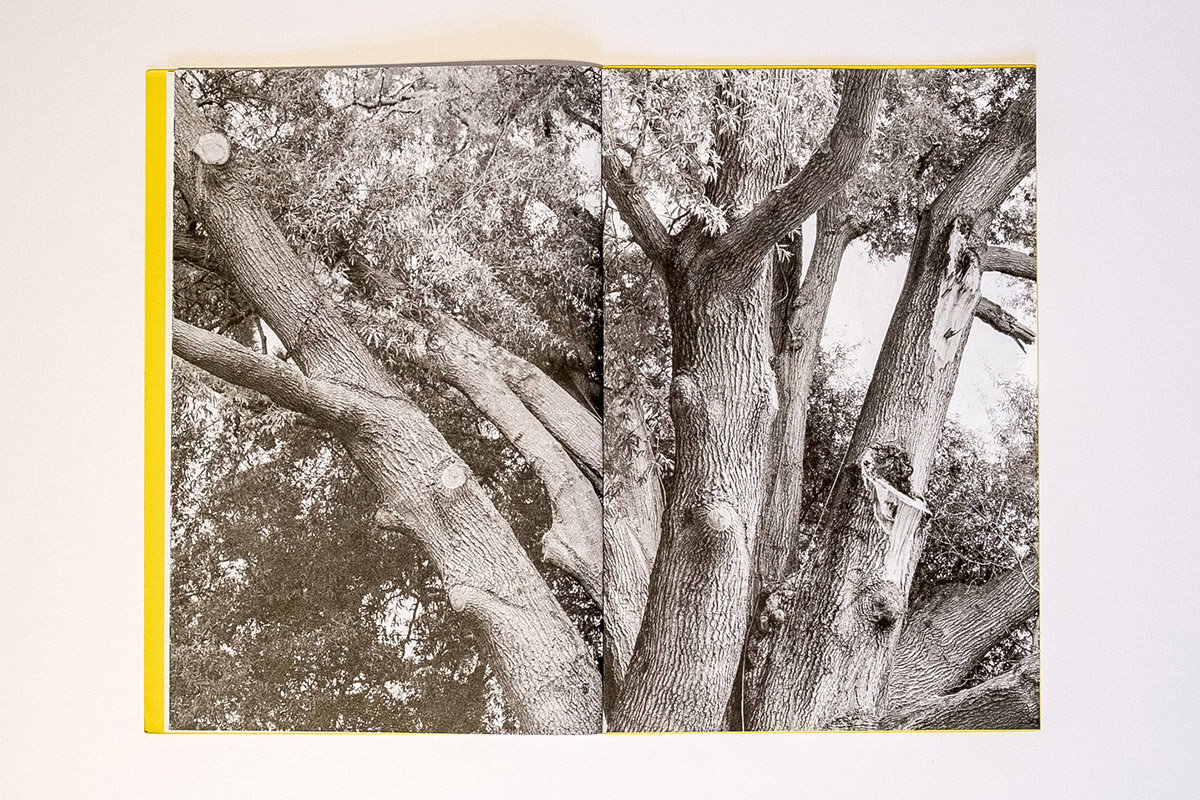
It is a rare thing to evoke an aural dimension with a photobook. The sensory realm is further articulated by Sauer in the choices concerning the materiality of the book. As the reader flips through the pages, they seem to rustle, and one can feel a coarseness to the paper that provides a slight texture to the pictures. Interestingly, the paper is made from Favini Tree Free Bamboo Natural 90g. While Sauer’s ecological commitments are clear in such choices, she has sacrificed nothing in terms of the quality of the book’s production. The depth of the images is also enhanced by the Tritone printing. The close-ups of the branches and leaves have more selective focus, while the eye level viewpoints offer a more traditional approach to framing. Additionally, movement is emphasized especially in the close-up images where time is a factor in yet another way: here we see the tree with the eye, the lens, pointed upward. The details of the bark and leaves in these pictures is satisfying, yet interestingly, by using 1/30 and ¼ second exposures, we also get some blur in some of the leaves. Again, it becomes difficult to not hear this tree. Through Sauer’s images, it seems to have begun to speak.
While one potential approach for how to document a favorite locus of personal reflection, in this case beneath a tree, would be to play with the many lens focal lengths and apertures, Sauer leans into a more interesting methodology. This becomes intuitively apparent to the viewer, and then is explained in the brief text that closes the book. In keeping with the connection to the Earth Sauer is exploring here (this is a consistent theme Sauer has mobilized in her other projects, such as with the book The Dreamer, which included written text as well as images of distant galaxies and stars, but also To Measure Time), the project documents the tree through time. She moved around the tree with her 4×5 camera in a counterclockwise motion that symbolically imitated the rotation of our planet. While reaping certain benefits for the photographer’s own embodied image making practice, the effect of rotation impacts the book’s viewers as well. Sauer’s consistent framing, centering the tree’s trunk, offers a vision that reminds one of a timelapse nature documentary. We get something that is less Planet Earth and more along the lines of the quieter effect of certain passages of a Godfrey Reggio film. Indeed, this is one of the beautiful effects of photobooks – they seem to offer us time and space. There is no pressure to move along or offer an interpretation, as one might experience in the gallery. This is a book to sit with, or perhaps, sit alongside.
But, just as Sauer seems to pull back in some images revealing some of its context, she thrusts the reader again into the interior of the tree, confronting the leaves and the spindly branches. The emphasis on both a very graphic presentation, and a typological one is something that is effective, but also is something that will strike seasoned photographers as a real achievement. To create cohesion out of the multiple vantage points like this is much easier said (or discussed as a concept) than it is done.
The consistency of the use of distance, particularly with the eye level pictures, invite the reader to discern the concept of subtle motion as well. The scene looks almost the same, yet the mind wonders: what has changed? The leafless tree starts to gain a few leaves, but just at the edges. Did I see that large knot on one of the lower right-hand portions of the trunk before? Is that the same scraggly branch that seems to reach down into the background, almost contacting another tree? How far away is that really, from the viewer?
By the time the boy appears again, this time he is on the right-hand side of the tree, rather than the left. He has made a kind of rotation too. The tree is fully covered this time in leaves, and the light can barely get through the tree’s canopy. It is providing plenty of shade. With shorts and sandals, rather than looking down at the ground, the boy and the tree are bracing for the incoming winter. He looks out of the frame to the right. Sauer’s subtle gestures of sequencing abound the more one looks.
But the story does not end here. A sequence of close ups and more straight-on shots of the tree follow. In the close ups we see what look like recently cut branches. The tree is outgrowing itself. It requires human management. In personal correspondence with Sauer (March 13, 2026), I learned that, in fact, the full bleed images in which we see the details of the canopy were made two years after the project was started, and just days before the tree was cut down. The book opens and closes, in a sense, within the tree. Another kind of cycle is closed, this time in the relationship between photography and the living, earthly, but non-human entity.
Throughout Giant Willow Oak, one gets the sense that what interests Sauer is not an escape to nature, but a dialectical relation to it. The images and the book are not exactly a romantic vision. Instead, they are an attempt at reckoning with one’s place in the world, if not humanity’s. Yet, this abstract way of understanding the images and the book is not negatively subsuming the whole project. It makes it all the more engaging and thought provoking. The final image we see of the boy seems to reinforce a certain reading. It is not summer any longer. He is wearing long pants and a shirt. He is facing inward toward the tree. In the distance on the right hand of the frame, a large tree has recently been cut back, perhaps awaiting the saw to finally take out the last trunk. This sentinel is a harbinger of course for what will become of the giant willow oak. Perhaps the boy is saying his goodbyes.
The conservation status of the willow oak, according to institutions responsible for such things, like the IUCN, is “least concern.” Yet, as we learn at the end of the book, the reader has just witnessed a tree that was cut down in 2023, or in botanical terminology, “felled.” In personal correspondence with Sauer, I learned that in fact, this was due to intense storm damage and stresses from heat and drought, two variables which are themselves driven by climate change, generally speaking. Perhaps part of the point of this book is that someone is concerned, and not just about individual trees, but the larger patterns by which such trees are being lost. But it is also of course that trees like this are much more than what they seem to be in terms of their positive, observable properties. They can be imbued with cultural and personal import that outweighs what it could mean as a statistic or to an institution. And even unexceptional things can be exceptional, as Sauer reports that this tree was an “extraordinary specimen,” which incidentally enough, was recognized in the 1940s due to aerial photography. Luckily, we now have a record of it from eye level that gives us a less scientific appreciation for its depth and dimension, its texture, and its connection to us.
An exceptional work that demands rereading and close observation, Giant Willow Oak reminds us about the power and distinction of photobooks as cultural objects in terms of their ability to suggest, yet also poetically comment on, if not analyze, contemporary predicaments. And, photobook lovers, as well as photographers, will find this work instructive, as it has real takeaways within it in terms of sequencing and choices about method and methodology. While a thin volume, I am finding myself coming back to Giant Willow Oak and spending time with it as Winter turns to Spring.
Brian F. O’Neill is a photographer and sociologist based in Phoenix, Arizona.
____________
Amanda Sauer Giant Willow Oak
Photographer: Amanda Sauer – (American; born in 1977; based in Washington D.C.)
Publisher: L’Artiere Edizioni 2025
Design: Amanda Sauer
Cover Design: Martina Soffritti
Printed and bound in Italy
Swiss binding; 8.25” x 13” (21 x 33cm); 68 pages; 35 tritone printed photographs; screen-printed cover; ISBN 979-12-809781-58
____________


Articles and photographs published in the PhotoBook Journal may not be reproduced without the permission of the PhotoBook Journal staff and the photographer(s). All images, texts, and designs are under copyright by the authors and publishers.
 PhotoBook Journal
Leave a comment