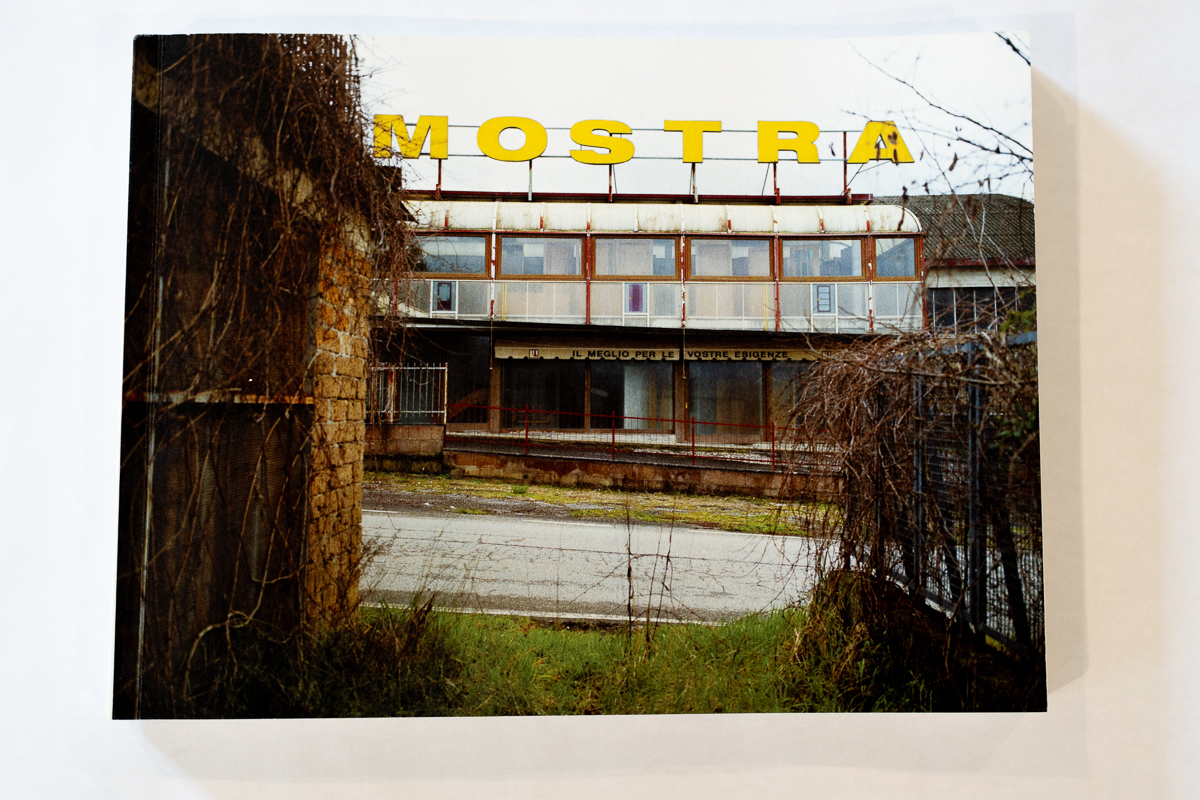
Review by Lee Halvorsen •
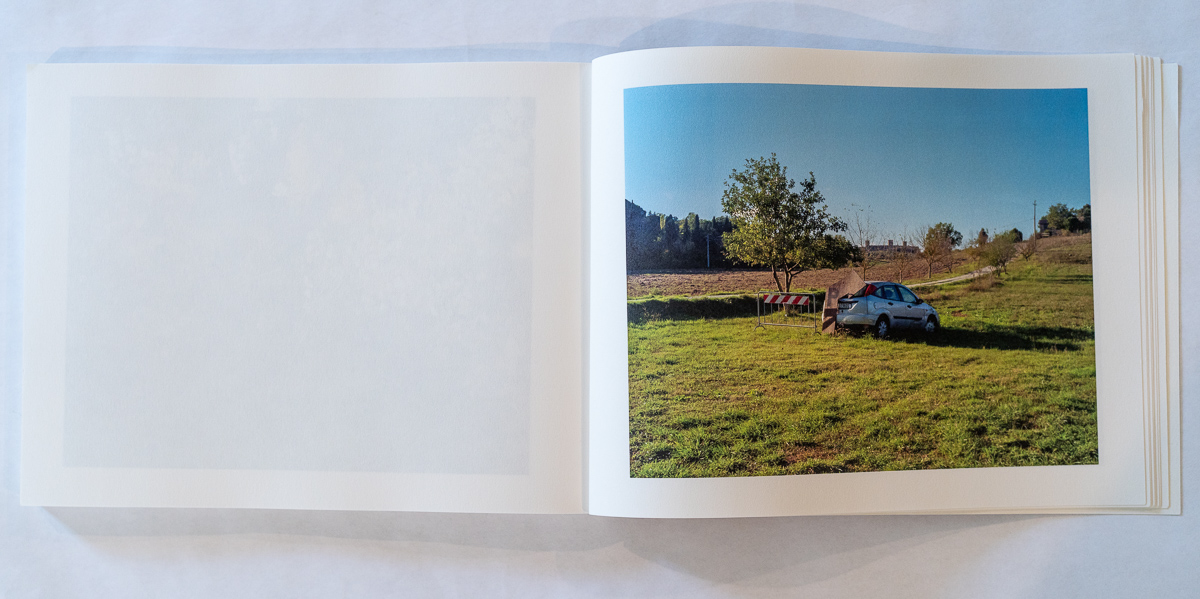
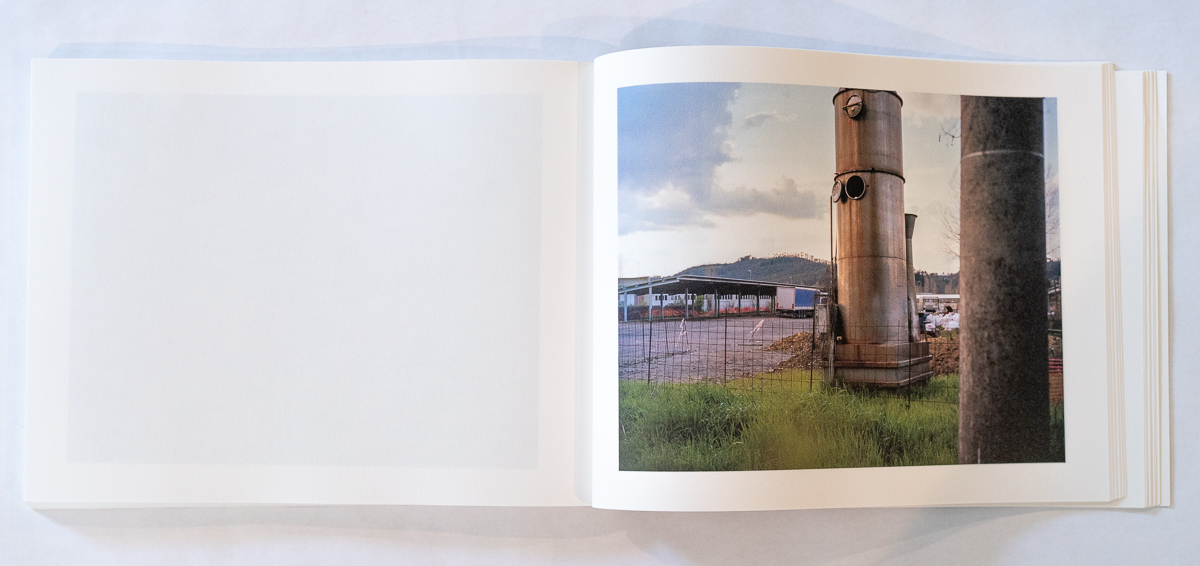
Mostra is a fascinating photographic journey, a challenge to notice and appreciate the subliminal, the almost invisible object that once seen, can’t be un-seen. In his introduction Pacini tells us about the word “Mostra” or “to show” in English…to show without gesture to bring the viewer closer to the edge of the “normal” scene and the almost missed object or slash in the landscape. He writes the word mostra also shares the root “mostro” which translates to MONSTER and indeed, some of the image anomalies he’s captured can be viewed as monsters in the quiet scene around.
The intensity and challenge and even fun of the book is finding that anomaly and thing that wants to show itself, but might be hard to see. In a Shakespearean sonnet, that thing would be called a “volta” or turn. In a haiku poem, the turn is called a “kireji” or cutting word. Sometimes the turns in Pacini’s images are very obvious, oftentimes, they are very subtle. For instance, a quiet street scene, with golden hour light, trees, curb, pavement, quiet and peaceful…but right out front, an upside down, rusted metal bucket propped on a traffic cone next to weed overgrowth. The turn is not subtle, so the reader is offered the challenge to appreciate the intrusion of the bucket into an otherwise bucolic street scene. But wait, perhaps the turn is not the bucket but the peaceful scene behind it.
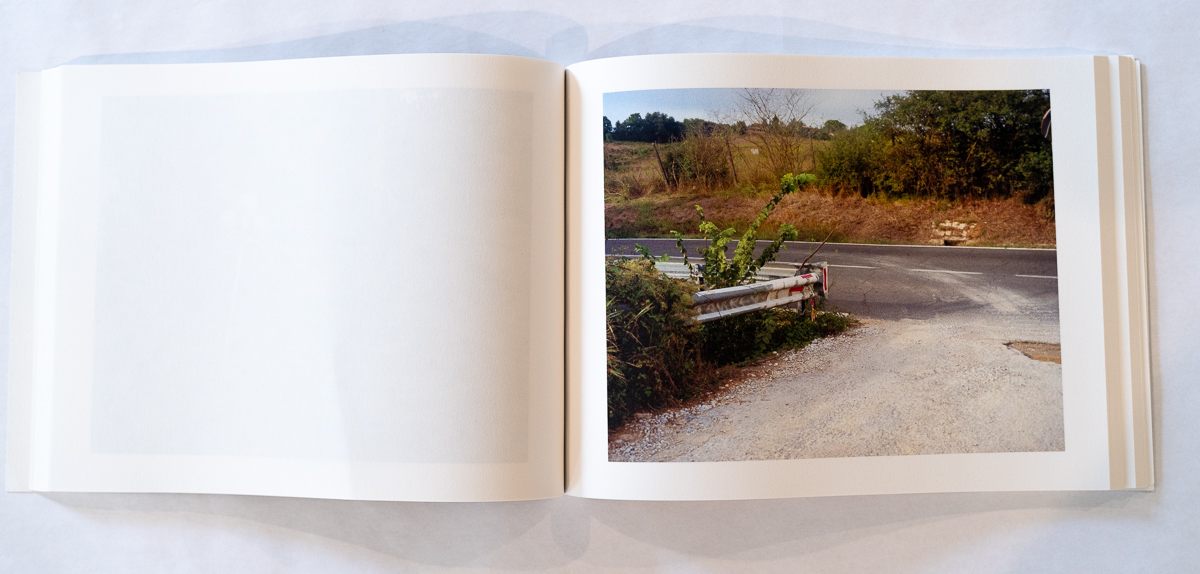
Contrast that with trees and greenery sitting at the base of and atop a concrete bulkhead…a wall probably holding nature away from a road. The golden hour light, the green and red hues of the trees and plants is comforting but the slash of the shadowed wall spoils the emotive landscape and the worn-down graffiti begs to be seen as it hides in the shadows. If you turn the page quickly, I guarantee you won’t appreciate the wall or the writing. That’s Pacini’s desire in this book, to get us to actually look and discover things that might otherwise go unnoticed and appreciate the edges between the objects and how they live within each other’s space.
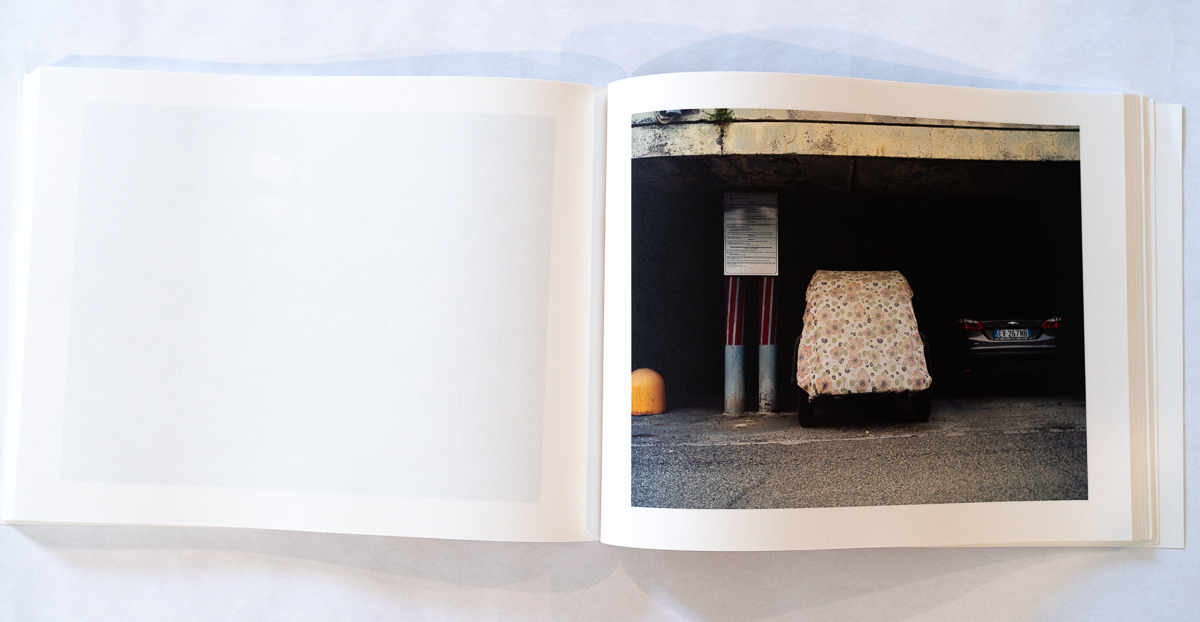
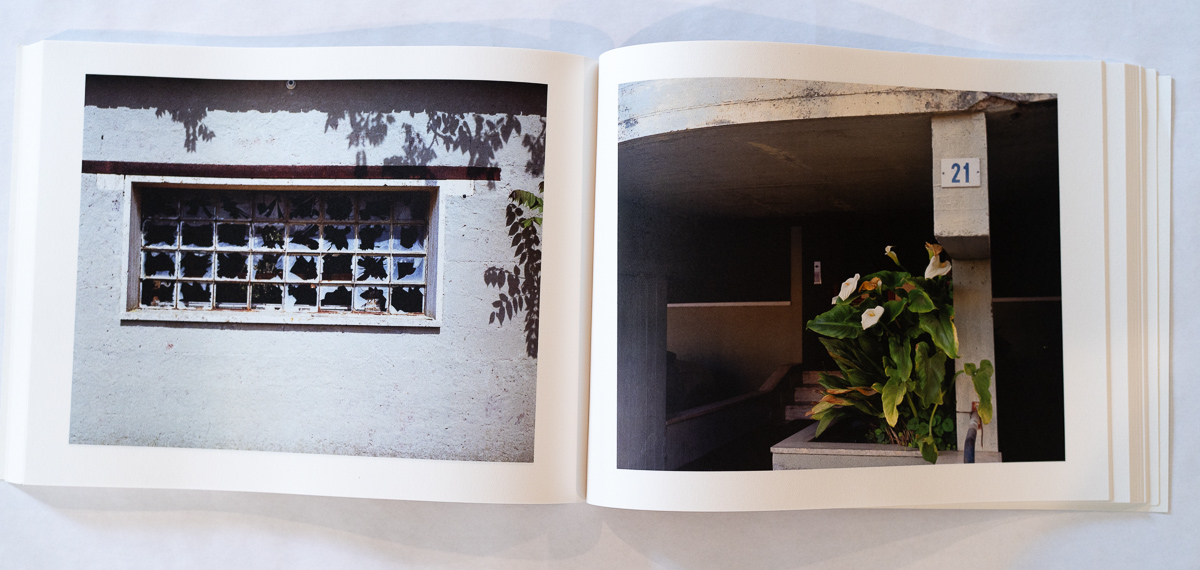
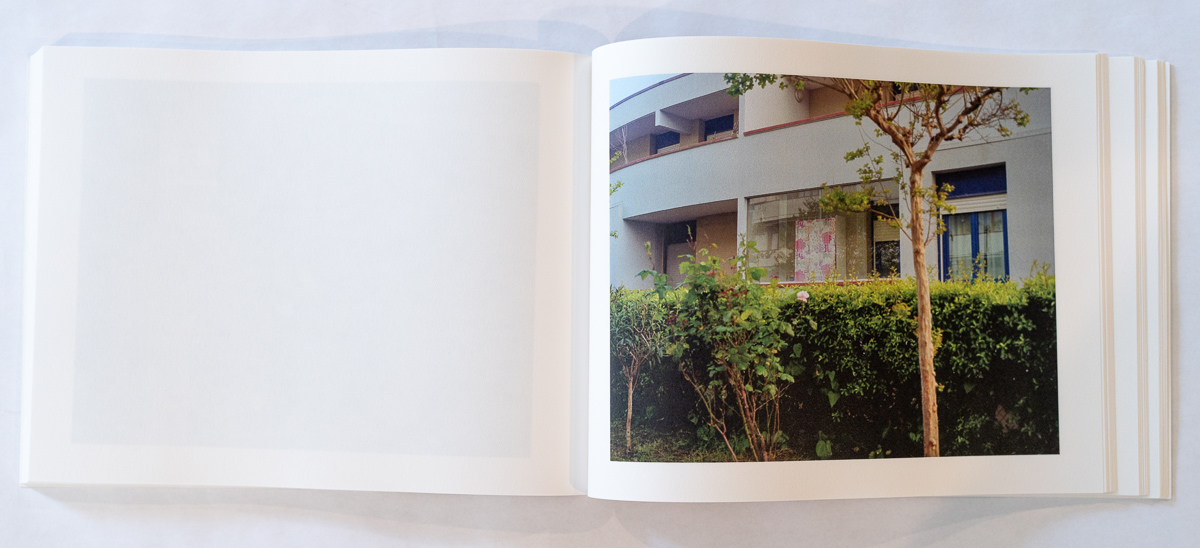
For instance, a wonderful scene from a country pasture, but are the very obvious objects three crosses or three power poles? And then a street scene of an old stone building…did you notice the huge doorway doesn’t have a door, just a curtain. Or the obvious, in a car park, a car covered in a flower decorated tarp. Or the subtle turn of a pink flowered shelf covering that’s barely visible on an apartment deck.
Each image is a story; a story that doesn’t really end with a quick glance. Pacini wants us to revel in the edges of the obvious and the almost invisible and to determine how the story elements exist with each other, acknowledging that our initial conclusion might be wrong. It’s only after giving the image time to percolate in my brain did I find the relationships and where the edges of visible and not so obvious appeared.
Pacini writes the sequencing is not present in the book and the order of the images is neither linear nor conclusive, rather time is suspended, dilated and distributed among details, spaces, and objects. And he’s so right, that’s what makes this a fun book to hold, to absorb and to “see.”
__________
Lee Halvorsen is assistant editor, writer and visual artist living in Virginia.
__________
Mostra. by Federico Pacini
Artist: Federico Pacini lives in Siena, Italy
Foreword: Federico Pacini
Copyright images and text Federico Pacini ©2025, the book for this edition ©2025 89books
Publisher: 89books
Website for purchase and overview at 89bo oks
Printed by: Fotograph, Palermo, Italy
Book design: 89books
Language: English, translated by Marta Basagni
Softcover, 204 pages, unpaginated, perfect binding, 107 color images, 28 x 21 cm, ISBN 979-12-80423-78-8
__________
Articles and photographs published in the PhotoBook Journal may not be reproduced without the permission of the PhotoBook Journal staff and the photographer(s). All images, texts, and designs are under copyright by the authors and publishers.
 PhotoBook Journal
Leave a comment