Review by Gerhard Clausing •
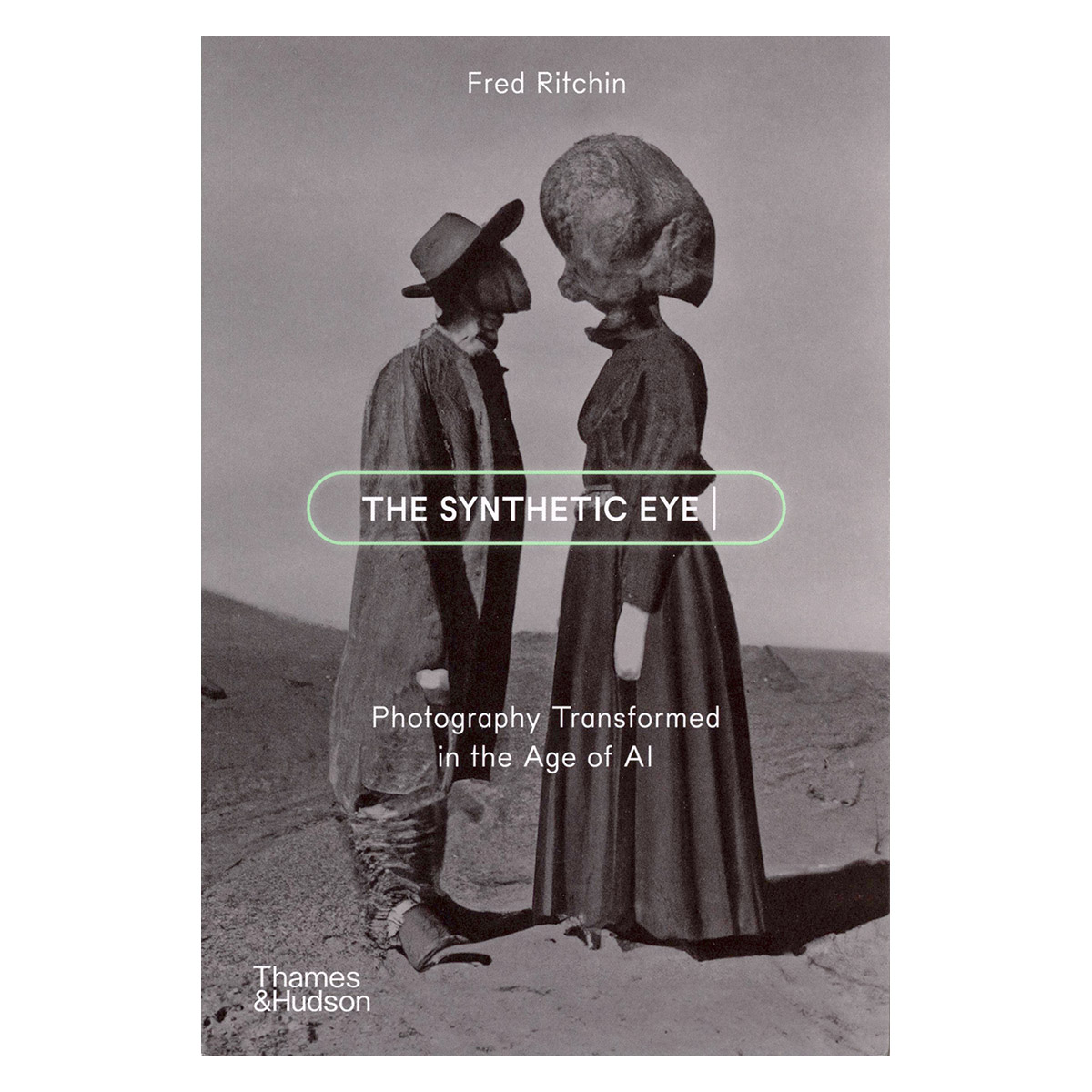
Fred Ritchin is one of the most respected critics when it comes to photography. Naturally, his views on artificial intelligence (AI) are of great interest. This latest book of his is primarily meant to stimulate discussion in this subject and to provoke creative thought and sane analyses. Of particular interest are the questions: “How can we believe or trust the images we are being shown?” Can AI be used as an enhancement of our world or will it be used to our detriment?
This book is not primarily a photobook; instead, it presents extensive explorations by the author, presented in seven sections, along with many visual examples:
- Exiting the photographic universe
- Playing with AI
- Histories transformed
- The unbearable relevance of photography
- Expanding the frame
- Synthetic challenges
- Shifting paradigms
The author starts out with a realistic assessment of the current situation. Virtually everyone has a cell phone, with which the vast majority of photographs are taken. He distinguishes actual photographs from “synthetic images,” i.e., those created exclusively with AI programs. Of course, this is a distinction that is problematic if so decisively stated, since many photographs are now edited with the help of AI, and therefore are a mixture of authentic and synthetic. Furthermore, as the author points out, many cameras are now enhanced with AI algorithm presets, based on preferences of style, lighting, and more, often even without much direct input from or awareness of the photographer. These innovations, also contained in programs such as Photoshop, make the question of authentication and the determination of authenticity very difficult indeed!
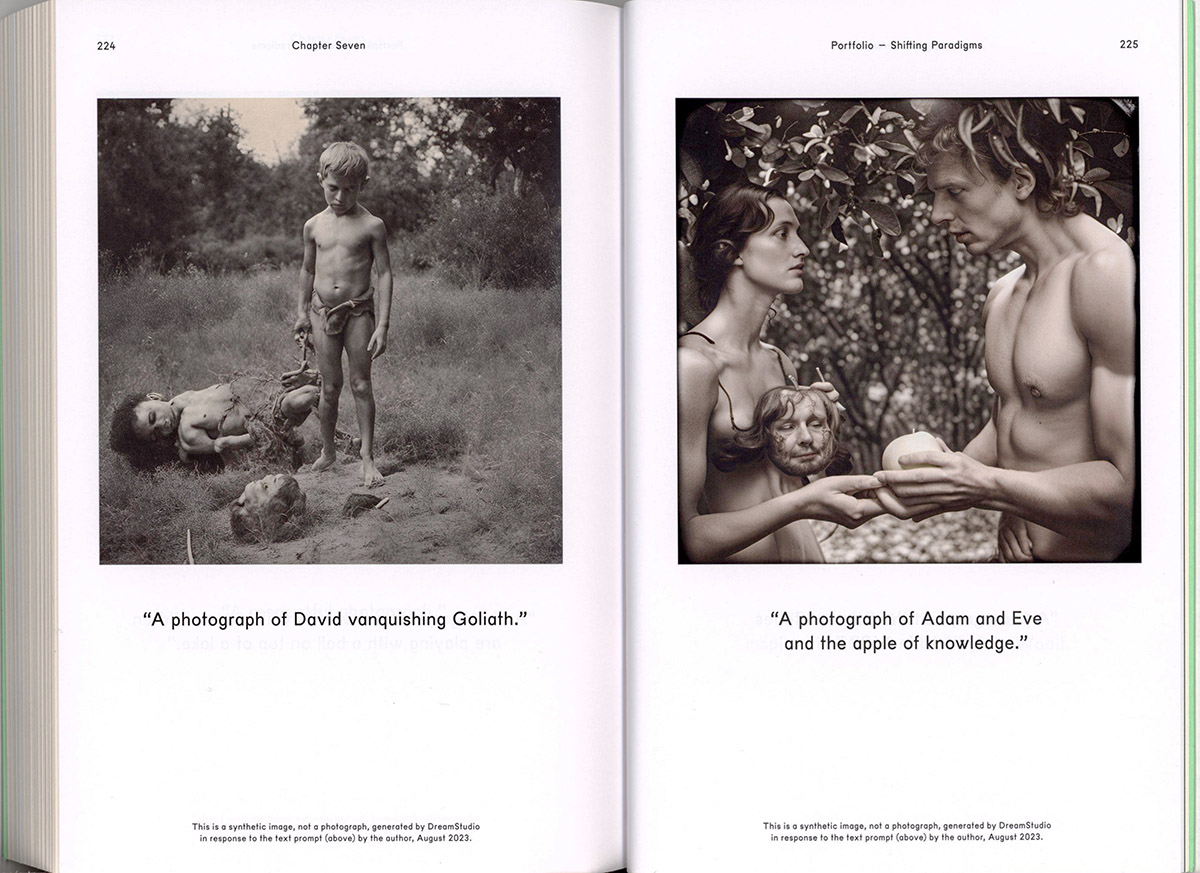
Ritchin makes a special effort to show the history and progress of creating synthetic images, as well as the reception of authentic and synthetic visuals and the relationship between the two. As you can see in one of the page reproductions below, the website “This person does not exist” was popular a few years ago, and I reviewed a book by Matz containing such non-entity portraits at that time. It was based on a process involving multimorphed generating of new synthetic people images. As I also discussed, strange secondary faces at times invaded the images unpredictably. The problem of anomalous hands and feet with too few, too many, or contorted fingers, and even contorted legs, has not been totally solved even to this day. Ritchin also discusses the generating of such aberrant visual elements, sometimes resulting in a bit of humor, as can be seen in some of the examples shown below.
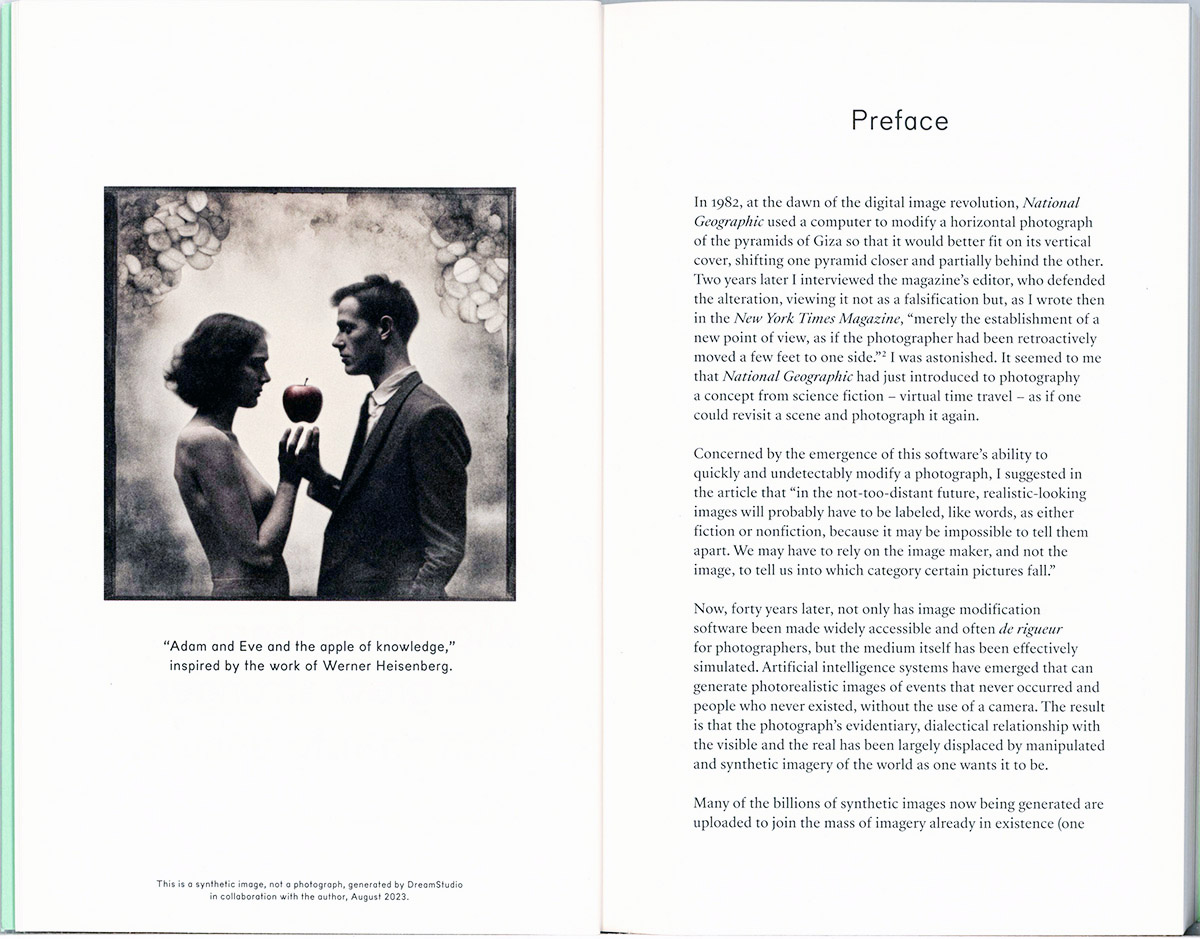
The real problem occurs when people try to create false narratives with images, for dramatic and or political purposes, that have an exclusive AI origin, or are altered in such a way as to misrepresent reality. If such images are not labeled as being artificial or “synthetic images,” the viewer is likely to take them at face value, assume they are a true representation of reality, and reach the wrong conclusions. Ritchin is very consistent in labeling all such synthetic images as to what they are. In the way of an explanation of some of the captions also shown below, it is important to realize that in order to achieve photorealistic images, some programs expect a phrase like “a photograph of …” as part of the prompt, even if the result is a photorealistic synthetic image and not an authentic photograph. It can also be said that nowadays few images are expected to be totally unedited, with photojournalism being the prime exception.
Chapter 4 is of great interest as well. There he discusses photographs that were taken at special moments, of social or political relevance. They often are examples of what raised the ire or reached special levels of attention because of their content or controversy. Ritchin provides an interesting discussion of people’s objections and challenges, whether they were depictions of prisoners or other sensitive subjects. People have always objected to some photographs, whether actual or synthetic, so that honesty is of prime importance in the presentation of images of all sorts.
Looking at some of the synthetic images presented by the author, we note the following: The images of Adam and Eve with the fruit of temptation demonstrate some of these difficulties. Of course, more detailed prompts might generate more refined details, especially as the sophistication of AI image generation is making further progress. Some of the others, imitating certain styles, can be shown to be full of humor and eccentricities. Choosing subject matter that predates the era of cameras, as exemplified by the image of the witches of Salem, is much safer. There it is very clear that that is an illustration of photo-like quality which was not really created in the time period depicted. One could consider such images photo-like illustrations.
There is much more in this very useful volume of 240 pages. I recommend that anyone interested in AI get a hold of it and think hard about the examples, the analyses, the implications, and especially about what all this might mean for the future of photography and for artistic illustration in general.
____________
Gerhard Clausing, Editor of the PhotoBook Journal, is an author and artist from Southern California.
____________
Fred Ritchin – The Synthetic Eye: Photography Transformed in the Age of AI
Author: Fred Ritchin (lives in New York and Paris)
Publisher: Thames & Hudson, New York and London; © 2025
Language: English
Paperback with cover images; 240 numbered pages with 88 images; 6 x 9 inches (15.5 x 22.8 cm); printed and bound in Malaysia by Papercraft; ISBN 978-0-500-29739-1
____________



Articles and photographs published in the PhotoBook Journal may not be reproduced without the permission of the PhotoBook Journal staff and the photographer(s). All images, texts, and designs are under copyright by the authors and publishers.
 PhotoBook Journal
Leave a comment