
Editorial by Hans Hickerson ·
Have you ever noticed how many photobooks there are? Most you can’t find in bookstores, even some that specialize in photography. But go to any book fair and you can see hundreds of photobooks, many of which you haven’t heard of. One reason you might not have heard of them is because there are few places that review photobooks. The audience is small, and there is no money to be made. Often all you can learn about a book is from the publisher’s PR blurb plus selected images – all of which tells you very little. The photobook deserves to be taken seriously as a medium, however, and there is no substitute for writing by thoughtful reviewers with experienced eyes. One photographer I met recently said that my review of his book had “made him feel seen.” Given that there is no journal of reference for the medium, no New York Times Review of Photobooks, contributions made by publications such as PhotoBook Journal are significant.
PhotoBook Journal has been a photobook review site for more than a decade. You might think the opposite, but our magazine is a simple operation. No one is paid. There are no sales and no ads. There is no boss or sponsor to please. There are no deadlines. Reviewers can choose what they want to review and say mostly what they want. We choose books to review like we choose our friends. Who do we find interesting and want to hang out with? Some of our reviewers have academic backgrounds while others work in non-profit photography organizations or in nonrelated fields. Virtually everyone is a practicing photographer, and many reviewers have published their own books.
Why would anyone want to review photobooks? Why would someone choose to spend three or four or more unpaid hours digging into a book, looking closely and figuring out what to say? Plus choosing page spreads that represent the book to photograph in order to tell the book’s story visually in a short photographic essay?
Mostly, the motivation is curiosity and the satisfaction that comes from solving a puzzle. You may have noticed that PhotoBook Journal reviews do not regurgitate phrases from press releases. The reader does not gag on artspeak. You will not read about a book that centers post-intersectionality while platforming modes of heterogeneously coded visual mediation. Instead you will get a guided tour of the book. You will hear the book’s story told through the filter of the reviewer’s interests and sensibilities. Reviewers choose books they like and want to talk about. They spend time getting to know books before writing about them. They are cheerleaders sharing their enthusiasm and insights.
The reward for a reviewer’s labor is appreciation and gratitude, and publishers and authors who can’t be bothered to say thank you may not see a future review – at least that is my point of view. If reviewers can choose who they want to work with, why would they choose a book from someone who considers it their due? Kiss up, kick down gets old fast.
Sometimes I have asked a publisher for a review copy, and have been told that they can’t give me one, that their margins are too low to allow it. I sometimes pay for books if the publisher is clearly struggling, or if I am curious about the book and want to look at it before deciding to review it. But generally I figure that if I am going to spend a minimum of several hours writing about and photographing a book, I should not have to pay for the privilege. After all, I am doing them a favor by giving their book free publicity, shining a spotlight on it for hundreds if not potentially thousands of readers.
I do understand the publisher’s point of view, that they cannot afford to hand out free copies of a book to everyone who says they are going to review it. I was turned down by Nazareli Press recently when I asked for a copy of Mark Steinmetz’ Chicago, even though Steinmetz himself had expressed interest and had put me in touch with the publisher. In the case of Steinmetz’ Chicago, I can see that there could be hundreds of people interested in a free copy for their bookshelf. Several months after its publication, Chicago had already sold some 80% of its printing, so Nazareli didn’t need my review to attract attention and sell books.
Another publisher I met at a recent book fair explained that he had given away too many copies to reviewers who had never written reviews. I told him that I had never asked for a review copy and then not reviewed it, but that did not change his mind. In the end, a sympathetic onlooker bought the book for me, and I gave her and the publisher a copy of one of my own books. A couple of weeks later I published my review to show that I had kept my word.
Where did PhotoBook Journal come from? Originally the site was started in 2009 in Los Angeles by Douglas Stockdale. Gerry Clausing joined as a contributor several years later and it morphed into its current magazine format around 2018. A number of contributors are from Southern California, while others are in Arizona, New York, Virginia, North Carolina, Illinois, and Oregon. If you are interested in reviewing, you do not have to pass a test. You just need interest and enthusiasm plus time.
For my part I have been enriched by the reviews I have written. I would not spend that much time thinking about a photobook if I didn’t have to write about it. Looking at a variety of books to see what makes them tick has deepened my understanding of the potential of the book as form. And working with photographers and publishers has led to rewarding personal relationships and the satisfaction of contributing to the photobook community.
Thank you for reading and for your support of PhotoBook Journal!
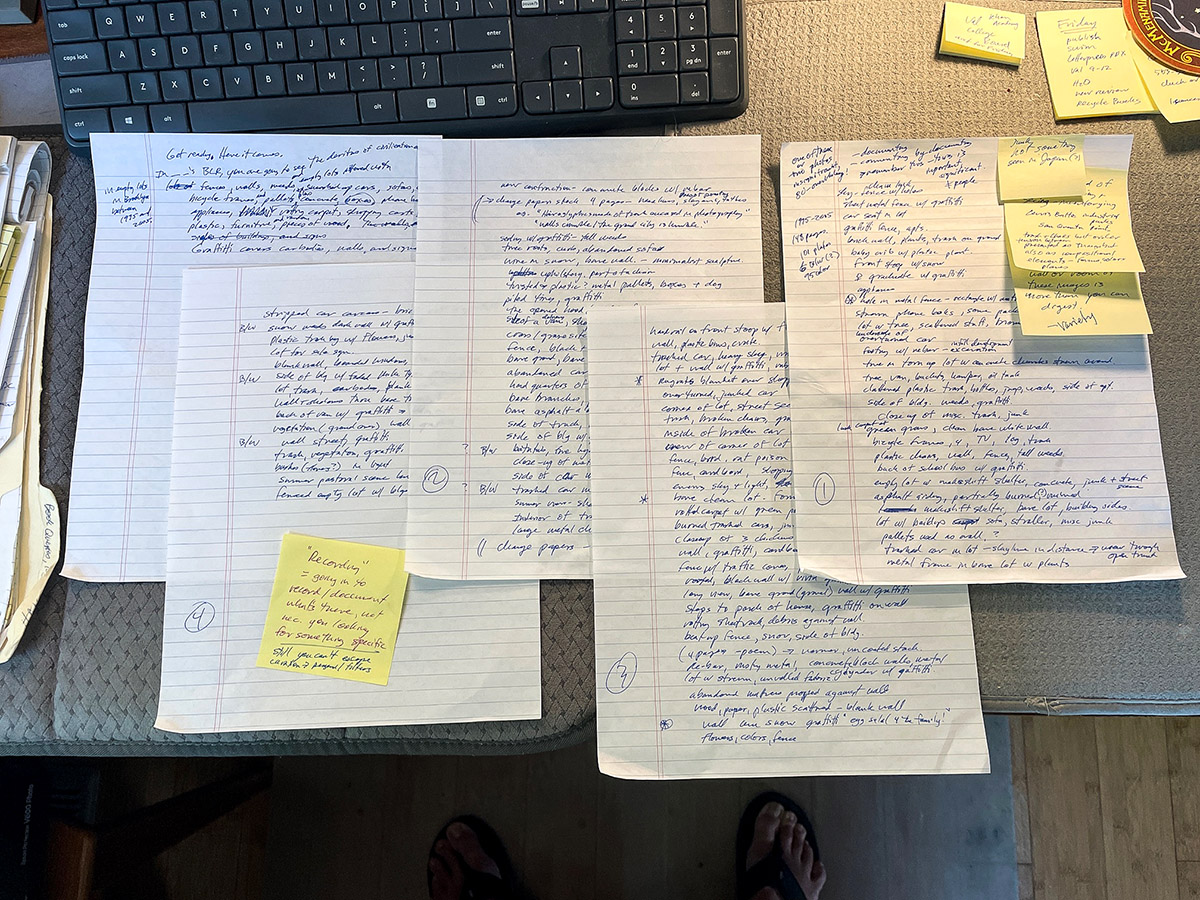
My notes for writing about Yasuyuki Takagi’s Brooklyn Lot Recordings.
Hans Hickerson, Editor of the PhotoBook Journal, is a photographer and photobook artist from Portland, Oregon.
Articles and photographs published in the PhotoBook Journal may not be reproduced without the permission of the PhotoBook Journal staff and the photographer(s). All images, texts, and designs are under copyright by the authors and publishers.
 PhotoBook Journal
Leave a comment