
Review by Lee Halvorsen ·
Cutino’s opening poem provides a deep philosophical foundation for experiencing her book and images. She looks at her images as artifacts of her life, describing the making, collecting, viewing. and presenting them as existential taxidermy, preserving each memory as an object, a moment preserved beyond its “expiration date.” She invites the reader to let the images reach out and become things or objects, objects that tell stories of impermanence, imperfection. A life lived with preservable moments.
Cutino’s introduction labels the book as an obituary for elastic skin and green grass which I took as a metaphor for looking at her youth in the rear-view mirror. Her closing and ending poems provide an ethereal, mostly gentle context for viewing her images and summarizing the experience. I directly met her images on the two-dimensional page, but using the rubric in Cutino’s intro, they weren’t just two-dimensional images, they have depth, scope, and scale that I could rotate, enlarge, and connect with the next image in the series. The next thing in her life.
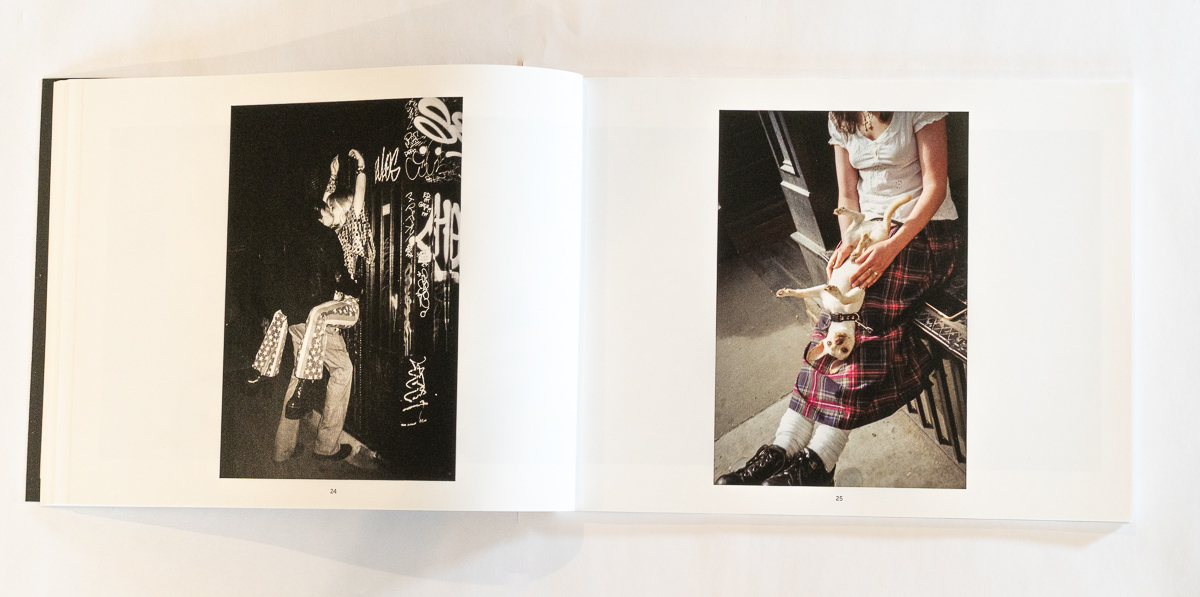
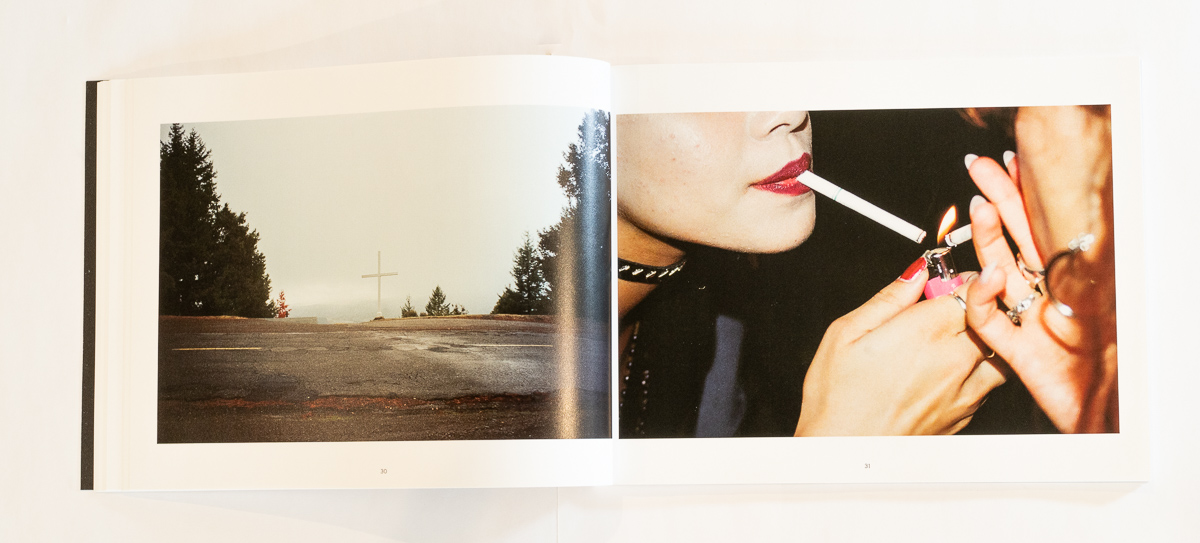
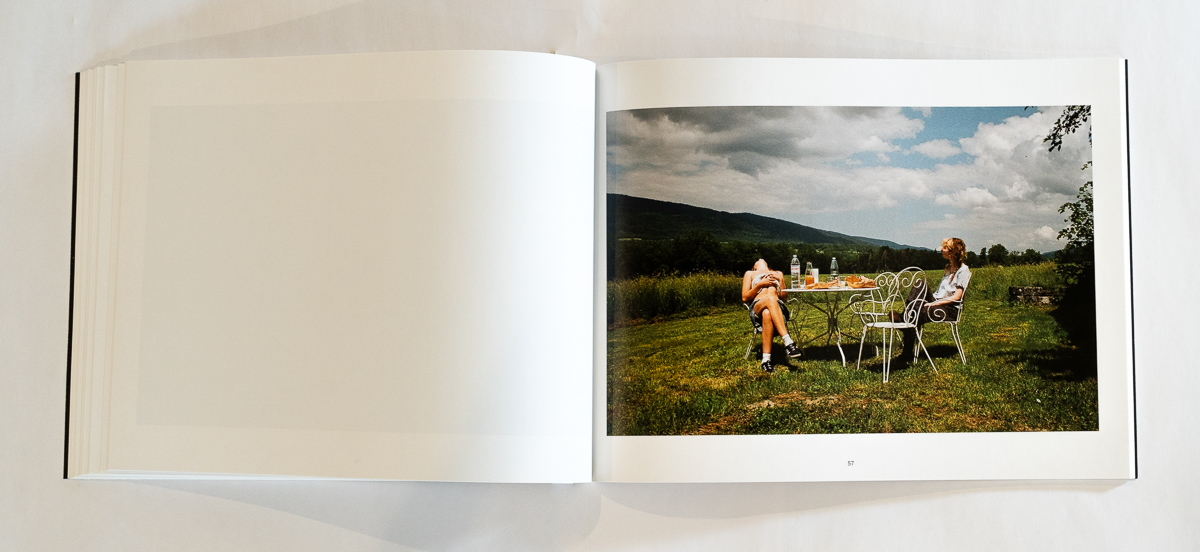
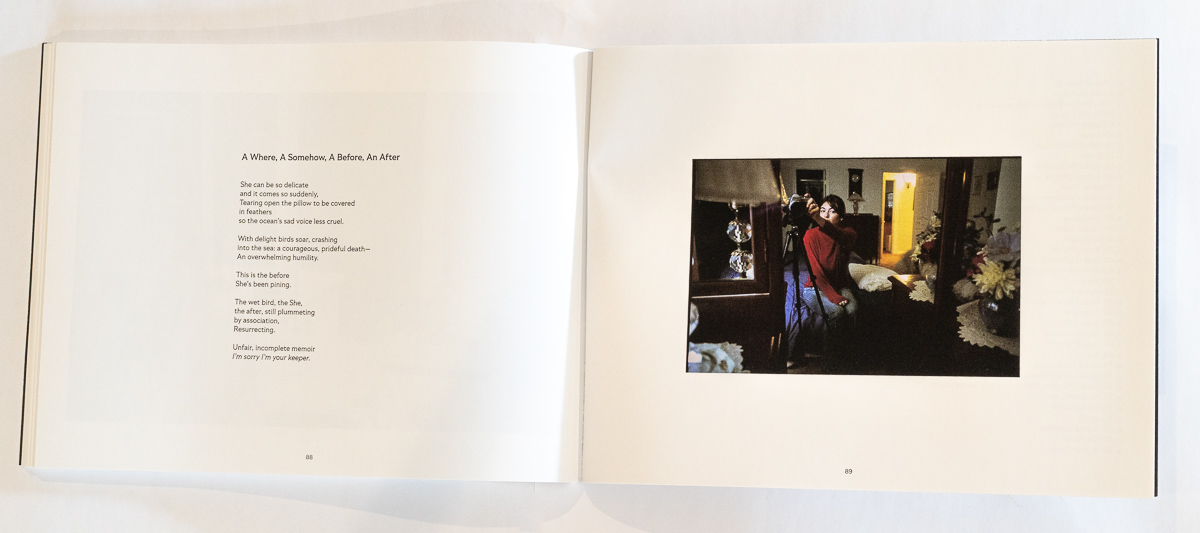
The images have a real life feel, an emotion of being on the inside. Friends, intimacy, fun, adventure, edginess are all tangible, but not like a documentary or a family album, more as the inside view from Cutino’s psyche. The mix of color and black and white combined with the mix of closeups and wide shots, tack sharp vs blurred, documentary vs in camera motion, all enhance the mood of the reader’s journey. We meet many of Cutino’s friends, acquaintances, party goers; their joy, somberness, and exuberance complete the multi-dimensional quality of the images. The relationships. Cutino.
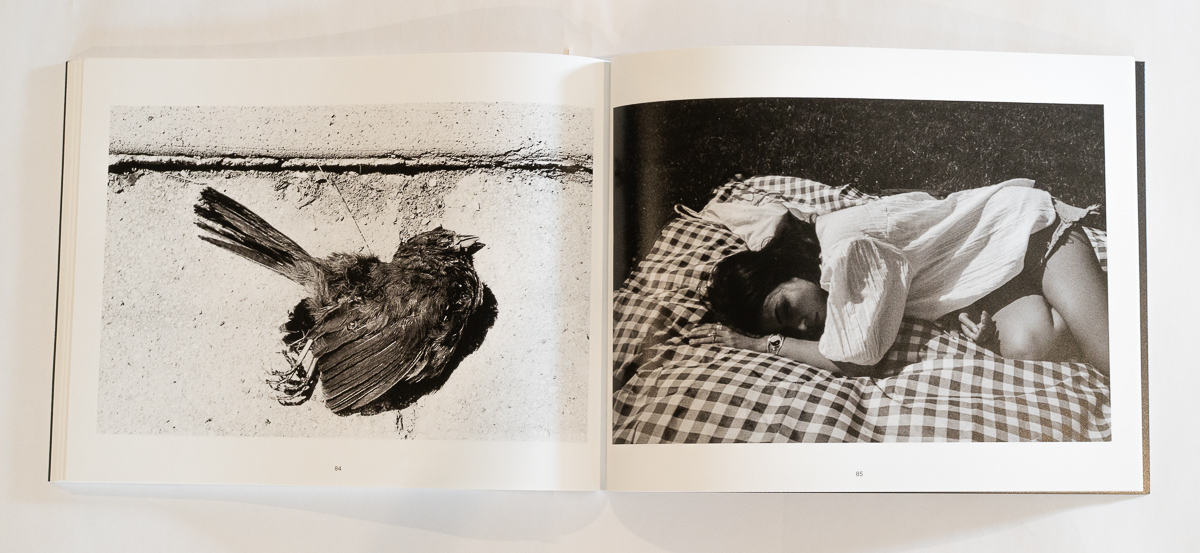
But all was apparently not rosy in Cutino’s youth…her image memories interrupted by sudden, shocking events. Cutino’s inclusion of dead, rotting animals jolts the reader. The wonder of growing up stops as the page turns and emotionally slams our mood to the pavement. The graphically decomposing animals disrupt the stroll down the museum of memory lane and remind us that life is impermanent, imperfect. Wabi-sabi.
An undercurrent of religion pops up and using the same museum tour technique on Cutino’s life, I assume she had some experience with religion that didn’t stick or didn’t stick the way the church might have hoped. Her memories of religious moments/images are almost iconic of a disappearing religious upbringing.
This is a fascinating book made more so by the combination of the images and the strong introduction, and opening and closing poems. The context suggests we mentally hold each image, view it from all its sides, and then place it back on the shelf in Cutino’s youth. It’s a compelling way to look at someone’s life; I enjoyed my tour of Cutino’s Memory Museum.
____________
Lee Halvorsen is assistant editor, writer and visual artist.
____________
Diaries of a Wet Bird – Sophia Cutino
Artist: Sophia Cutino, born in West Hills, CA, currently working and living in Berkeley, CA
Publisher: Sunstroke Press ©2025, with Images/text Sophia Cutino ©2025
Language: English
Softcover with satin finish, 94 pages perfect bound, 7.25 x 9.5 inches, ISBN 979-8-218-56109-3
Designer: Jing Tong Teo
Managing Director: Birdy Francis
Creative Director: Alex Ramos
Photo Editor: Mariel Wiley
Editor & Publicity Director: Turi Sioson
Marketing & Events Director: Angelica Crisostomo
Editor: Marie Figuereo
Art Director: Anoushka Narayanan
Photo Director: Kristen Williams
____________




Articles and photographs published in the PhotoBook Journal may not be reproduced without the permission of the PhotoBook Journal staff and the photographer(s). All images, texts, and designs are copyright of the authors and publishers.
 PhotoBook Journal
Leave a comment