By Hans Hickerson •
[Editor’s Note: These interviews are an interesting look at the history and wherewithal of this event, and accompany the report and visual essay we published a few days ago.]
Paris, November 10, 2024
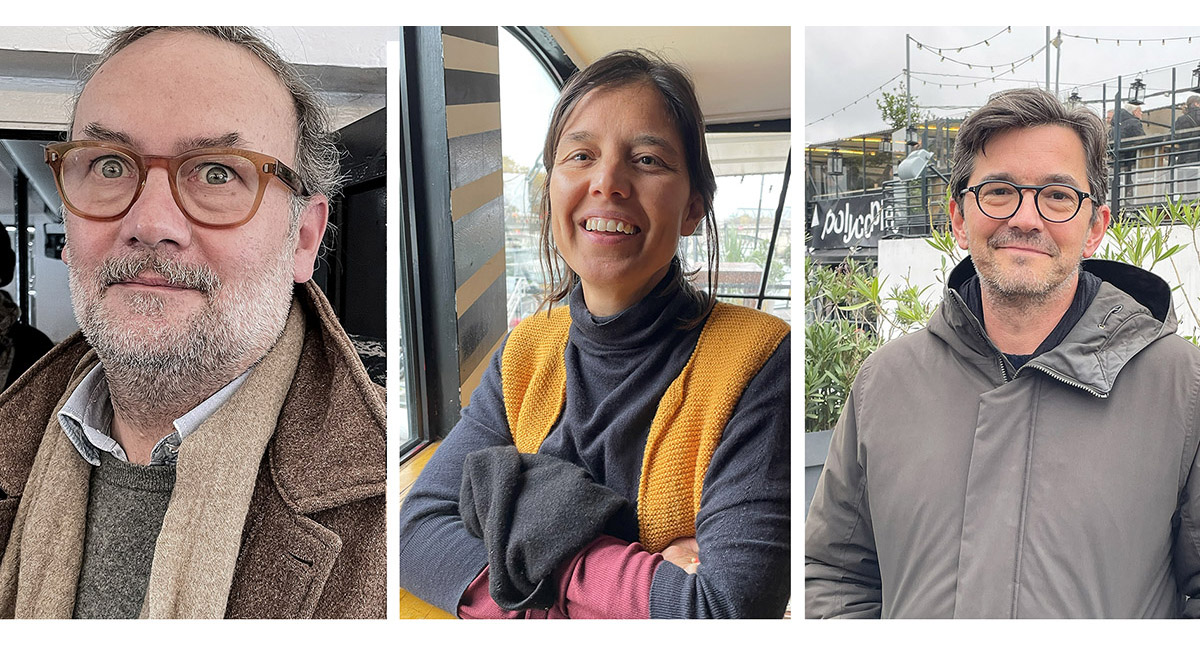
Sebastian Hau
Hans Hickerson: So, can you tell a little bit about the history of Polycopies and how it began?
Sebastian Hau: OK, there are many complex preconditions for that history to start, but it starts in a small coffee shop next to the Paris Opera with six participants in 2012. There was a Japanese publisher, a Swedish publisher, some independent publishers from France, and a bookshop, basically after the first wave of Offprint, when Offprint was sort of the big starting point in 2010 for independent bookmaking. I had been somewhat involved in the second Offprint, but Offprint from its start until today has always been ignoring photobook publishers, not replying, not handling them well.
So several of them approached me, important, good people that didn’t get replies, and so I organized two sessions in a coffeeshop in Paris. And because I was working at Le Bal (exhibition space), I had very good access to the press. At least in spite of being very small independent places they happened to be very successful. And at that point Laurent Chardon, with whom I created Polycopies – he was running a publishing house in France – and he approached me and he said, well, wouldn’t it be nice to do something bigger?
So there are several ways that we combined energies. But for example finding this boat, and organizing the boat, which is at the heart of Polycopies, as the place, as the photobook place at Paris Photo, everything is Laurent. On the other hand, I am better connected to international publishers in a certain way so in that way we combine energies.
So we had this boat in 2014. I was still working at Le Bal. At the beginning also we were still quite successful on social media, but in the beginning social media was very important and so I think the success of the 2014 Polycopies edition was really social media based. So no, no advertising. There’s no cost. There’s a lot of cost for the setup, but there’s no cost for (advertising) – we didn’t have any posters, we’re bad with posters I can say.
In the first year already two of the participants were the winners of the Aperture prize. I mean that year I had also happened to be on the jury of the Aperture prize. So you could say there’s a bit of luck involved. You could also say that it points to our understanding and taste in photobooks. And you can also say it points to the connection between Paris Photo and Polycopies.
So that’s why we make jokes about Offprint, because Offprint is a fantastic name, but what the hell does Offprint mean? It doesn’t mean anything. Offprint, like you’re off, no, you’re not. So Polycopies is not an off festival. I’ve worked at Paris Photo, I’ve worked for Paris Photo. Paris Photo is the driving motor. We do consider we have a nice selection of books. We know we could never exist without Paris Photo. We think we’re slightly better choosing some things, but Paris Photo is the main thing. So we’re not an off festival. And we don’t consider ourselves to be rebels.
HH: You’re very complementary.
SH: Complementary, exactly. So, we have publishers that would be invited to Paris Photo one year, we have publishers – I mean now, this has been cancelled, so that’s a bit of a tear in my eye, Paul Graham, but Paul Graham comes here every year. I’ve had long contact with Paul Graham, but obviously a conference with Paul Graham that was supposed to happen yesterday we can only do because he comes to Paris Photo. So you can talk about Paris Photo, there are many things to be said, but we depend on them. And so, yes, we built it up over the years. I think we’ve been successful from the start. Many things have had to get better, but it is a community, it is an interest in photography, and in books. It’s a community thing, that Laurent and I both share – we like books being sold. The commodity.
HH: They’re connecting with the public, finding their audience.
SH: Through the photobook. I think you’ll find festivals, that what they’re selling is a part of it, I mean the New York Art Book Fair would be something comparable to us, because at the base, the New York Art Book Fair, Printed Matter, there’s a bookshop and a publisher, so you need to sell those books. I think some festivals are weaker because they’re festivals and the organizers don’t care about the sales aspect so much.
But we really look the most closely at how publishers are selling. That is the basis of things. And when they’re selling it allows us – I mean we’re happy and what works is that you can just hang out on the terrace and have a very nice coffee or a very nice beer, but you can also not have a coffee or beer and just hang out with friends. So because these things work, on the basis of photography and books, and then finding a public who buys it, we can host a lot of people that just come here and chat. And that’s great. So that still works for us.
HH: I would say that my impression – because I went to Paris Photo as well – is that this is a human scale. I felt like an ant there.
SH: Everybody does.
HH: And this was wonderful. I’ve been connecting with publishers and getting books and talking to artists and it’s human. Although I came by last night, I wanted to talk to you, and I looked at the boat and I said, there’s no way, because it was about 7 o’clock, it was bondé (crowded), standing room only.
How do you choose participants, the publishers that you invite?
SH: So one thing that this is based on is the tradition of photobook making, which in the last historical period for me is from the 70s onwards, the 1970s onwards. So the 70s is people like Robert Adams and Daido Moriyama but many other people. But let’s take these two, they were making books considering them to be their main medium. Of course photobook history in the past 15 years has been explored more extensively. There were many things.
Now we have one guy who has some photobooks from East Germany that were really unknown, that are supposedly also unknown in East Germany. Like a love story from East Germany, and a travel story from East Germany. They’re fantastic, so there are many things to be discovered, and the photobook has been a medium of its own obviously since, I’d say since the 1920s. But the 70s is to me where a visual language, what I call “the visual language” is established, where people communicate social, political, poetical, artistic ideas in a sequence of images. And we are upholding that tradition because we’re self-publishing and with a bigger and more diverse world.
To me there’s a bit of a danger of things being flooded away. I think there’s really a peak in 2005, 2010, 2015, of really new languages, of grappling with issues. And they have been established and then the impression you can have and many people give us, there’s always more of the same. There’s a truth to that. There are many people who do many things. There are many new publishers who have to discover new ways of expressing themselves.
So that’s the other thing that we do. We try to get as many young people who we find interesting as possible, whilst trying to get those publishers, photographers, and books where there are languages about issues we care about. We do care about political and social issues, but also things we do with the conferences, as one basis of photography. One the other hand there’s landscape and like I say more expressionistic poetic forms, subjective forms. So we look, we try to help those publishers who are like a backbone of the last 20 years, like Journal from Sweden.
We are very open-minded. I suppose we get like 200 people that want to participate and we are open to people who write from other countries. They send you a website. They don’t really know very well what’s happening, so we have to ask them, listen we look at pdfs, right? I don’t want to be on your website. And we say we’re not like Unseen, where just everybody can come. We’re inviting people, we’re choosing people. They don’t really understand that so well. I mean I think most publishers you ask here wouldn’t even know they’ve been chosen. But we do choose them.
The thing is obviously we look at books. The main thing is looking at books. And when you have a young publisher from Greece, or from Bulgaria, or from the U.S., we also look at energy. What do people bring to the fair? There are some big publishers who want to participate, there are some publishers where we don’t think their ethical choices as entities are what we care for. There are people who do things that we don’t consider to be interesting. I’m always a bit open-minded for magazines, but actually, well, magazines…
HH: Zines?
SH: No, I mean magazines. In Europe you have twenty photo magazines. You can’t really see them but they all want to be here. So magazines. I mean we could have thousands of photographers that want to have a table here, so we have to say no to them, but we guide them towards the bookshops, or we organize special formats. So we are choosing, we’re doing variations, we’re telling people, OK, we’re not inviting you this year but we really want to be in contact for next year. So yes, we try to…
HH: Do people contact you and send you books? Is that how they do it?
SH: Well, they send us mainly digital information. But then we do our research. And there are some people we’re connected with, where there’s some more close contact, but now we have a publisher from Peru that we’ve known for some years. There’s also a matter of trust and communication. They don’t send us all their (books) – it would be nice if they would – well we’re not going to ask somebody to send us their books.
HH: One last question and thanks for doing this. What are your plans for the future? Are you thinking of like getting another pavilion, going bigger, or just keeping the same format for now?
SH: Well, if you looked closely, you’d see that there are many things happening. Maybe you’d have to look it up a bit. We’re organizing an exchange with French publishers and the Moholy-Nagy University in Budapest next year. That’s a commission by the mayor of Paris, for cultural exchange. Two years ago we did the Polycopies & Co., so actually funding some photobooks.
HH: In addition to this regular one?
SH: Yes, Polycopies and Co. is a committee of people that brings together a bit of money and then we give money to independent bookmakers, like a small help. So in fact we’re not growing, and I don’t think the marketplace should be bigger. There’s really a maximum with 105 publishers so as not to…
HH: …get too big?
SH: Get too big for the public, but again now I have a guy today from Berlin who sells vintage photography. That’s something we’re slowly building, because in 2016 we had photographers selling prints and also last year I had a photographer selling prints, so that’s still something where I feel, these are things I’d like to explore.
Sara Giuliattini
Sara Giuliattini: Sebastian and Laurent created Polycopies 11 years ago. As you see the Grand Palais is right over there. The idea was to find a place… (interruption) … I met Sebastian at the Le Bal bookstore, Sebastian and I were together in a place called Le Bal in Paris.
Hans Hickerson: Is it a photography gallery?
SG: It’s a space dedicated to documentary photography. It’s in the eighteenth arrondissement in Paris. It’s a space where with Sebastian we worked in the bookstore for a long time. And so Sebastian and Laurent decided in 2013 to create this place to be near the Grand Palais, so next to Paris Photo to host independent publishers who wouldn’t necessarily be able to buy a space there.
In the beginning there were 30 publishers and I began with them 11 years ago. With the years it has grown a lot and opened up and the canopy tent has been there for only three years, because the space in the boat was too full. And it’s good because it allows us to use this part of the boat as a meeting / event space. We’ve been doing that for two years. It’s something that has a small audience but a good audience. That is to say that we talk about photobooks, but also more generally about photography.
This year there is a focus on children’s books that was well received. Bernard Plossu, a French photographer that you know, who has made 300 books in his career, did a presentation on the subject. Also, photographers who shared their passion for the book. Paul Graham was set to do a master class that, alas, was canceled unfortunately. We hope next year to host him. Now we’re having a panel on young Hungarian photographers who are beginning. So it’s quite varied. But it’s important to create a more festival-like dimension and not just be a photobook fair.
HH: Sebastian told me you are in charge of a project – or several collaborative / partnership projects – is that it, to have Polycopies in other places?
SG: Yes, in fact, the city of Paris asked us to work with the French Institute, and they asked us to create not a Polycopies somewhere else, but to coordinate a series of publishing workshops and master classes in different countries around the world. So we’re starting in Hungary. We’re going to go to Budapest, with three French publishers, and we’re going to do workshops and master classes with photography students from a university in Budapest.
HH: And that’s happening outside of the regular time for Polycopies? In the winter or spring?
SG: Exactly. In fact, Polycopies has a (non-profit) organization, and the idea of the group is to promote and support independent photo publishing. The most important moment is this one, during Paris Photo. It wouldn’t exist if Paris Photo wasn’t there.
HH: You are a great complement, here it’s on a different scale, a human scale. Plus there is a lot of creativity here. There are interesting things there (at Paris Photo) as well, but to find the current creative trends…
SG: The effervescence, exactly. And since last year we have hosted three photography schools, an Italian one, an English school, and a Hungarian school. If you want to go see, there’s the Hungarian school down below, the Italian school over there, I’ll show you on the map.
HH: You mean..
SG: A table, exactly. The students’ work.
HH: I haven’t seen it yet. There’s so much here.
SG: I’ll show you on the map. So you can go see, because for us the main thing is seeing the work.
And there’s another thing that I’m following closely and that I like a lot. Thursdays and Fridays for three years, this room is a portfolio reviewing room. We invite five publishers here and they come to look at photographers’ portfolios. Photographers that are pre-selected by us send us a PDF and we match them with the different publishers. It’s free for the photographers, which is very rare, and we pay the publishers. And we are very proud to say that thanks to that there are books made. So encounters and it’s something that for us is very important. And here I’ll show you on our website.
HH: Yes, I saw the submission link.
Laurent Chardon
Hans Hickerson: You were the main organizer (of Polycopies), it was your idea along with other people, correct?
Laurent Chardon: Well, no, (I was) with Sebastian and with Sara, who at the time was working with Sebastian. In fact, I was a publisher too then. I was working at Editions Poursuite, and there was a year when we weren’t able to participate in other events. And we found ourselves needing to be able present our books during Paris Photo. And it turned out that the space, well, I am from Paris, and I started looking for a space and that’s how we landed on the banks of the Seine, on the boat.
But otherwise, that was the technical aspect, there was the willpower to promote the book and what we liked in photography, with Sebastian and with Sara.
HH: I am jealous because we don’t have anything similar in the U.S. There’s no public institutional support for this kind of project. We don’t have a Ministry of Culture. Everything is private.
LC: Yes, but I’ll stop you there straight away, because we don’t have any government support, if only from the city of Paris this last year. It’s a totally private initiative. In the beginning we created this small non-profit. Sebastian had a friend that lent him a cellar, maybe Sebastian mentioned it, a cellar in a Parisian café. Before doing Polycopies on the riverboat, with a dozen publishers for two years we occupied the cellar in a café in Paris during Paris Photo. And that convinced us to do something bigger and to gather even more publishers. But we created the non-profit. The exhibitors pay for their space, (and now) we have some grants from writers groups.
HH: But are you able to make a full-time job out of it?
LC: Full-time, no. It takes up a lot of time. Polycopies is something that has grown little by little. On the boat at the start we were 30 publishers. We added regularly every year, and have arrived at 100, 115 participants at a time. Before, that kept us busy two months a year, now there are proposals to write that takes more and more time. It could be almost full-time.
HH: So you work regular jobs as well?
LC: In different fields. I would love it (to work full time), why not? It’s not enough, and there are three of us. We can’t live on it. Or we would have to do it 3 or 4 times a year, and it wouldn’t be the same.
HH: How do you see the market for photobooks evolving? Is it progressing, stagnating?
LC: I am a little lost on the evolution because from one year to the next… we had after COVID, we had a sort of euphoric period, it seems to me, an energy where a lot of books were sold. There are always more books. I admit that now I don’t know what to think, personally, I don’t know what direction it’s going to take.
Beyond the photobook market there is the book market in general. In France there are more and more places closing. I don’t want to say anything foolish.
HH: Sara spoke to me about your future projects, the workshops in Hungary, working with schools…
LC: Yes, we’re going to try to develop – I don’t know if they spoke to you about Polycopies and Co. that we have developed, a second non-profit? Well, in the beginning it was a book market, publishers came and sold books. And so three years ago we decided, talking with several photobook collectors, to create a second non-profit called Polycopies & Co., “Co.” for collectors. And so it allowed us to find funding sources to help photographers create their books, to complete projects meant to be books.
HH: You set up meetings between publishers and photographers.
LC: Yes, but not exactly. We offer money, grants for book production, and when I say production, the photographer finishes their project by going to take pictures and so on. In general there are more prizes that exist for once your book is finished, and for us it was important to work farther upstream. So sometimes we’ve helped with a project based on only a few photos, for a project that captivated us. We also know photographers, but it was really to offer substantial financial aid in order to create books. At this point we have been able to help a dozen photographers, French photographers, an Uzbek photographer, really from the whole world, and there are a dozen books, almost all of which exist now.
HH: They are published by book publishers?
LC: Either they presented their project with a publisher, or they intended to self-publish, and when we have decided to choose a photographer without a publisher we have always succeeded in finding them one. It’s a helping hand shining the spotlight on the photographer’s work. I think out of the twelve there are still two books to come out, if I’m not mistaken.
HH: For the future do you intend to follow in the same direction? Is it sustainable?
LC: Yes, I don’t know. It’s the eternal question now in fact. After the event every year we wonder if we’re going to be able to continue, if we need another space. They are questions we are always asking.
HH: I didn’t know that it was a bit fragile…
LC: It depends on the organizers’ enthusiasm, on their personal and financial possibilities, on their availability, their time, on one hand, and then it depends on, well, we’re in a private space on the boat and we have to get along. The tent is in a public space and is done with the city of Paris. It’s a whole complex organization to put it together. Today it’s working…
HH: You should be proud…
LC: I’m not saying I’m not proud, it’s just that, but every year we wonder if it’s still the right formula for the next year and if we’re going to be able to do it again.
Articles and photographs published in the PhotoBook Journal may not be reproduced without the permission of the PhotoBook Journal staff and the photographer(s). All images, texts, and designs are under copyright by the authors and publishers.
 PhotoBook Journal
Leave a comment