Review by Steve Harp ·
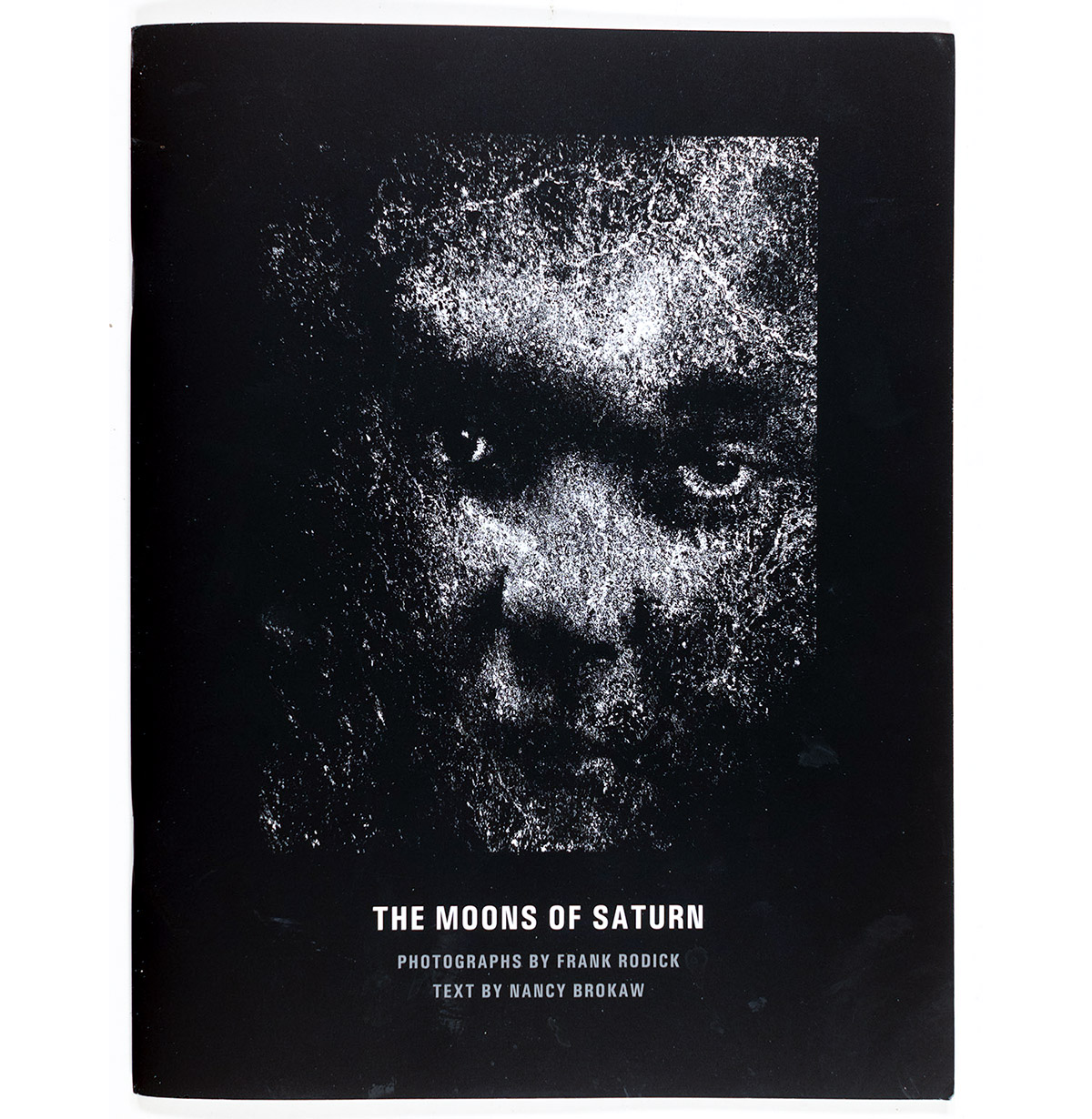
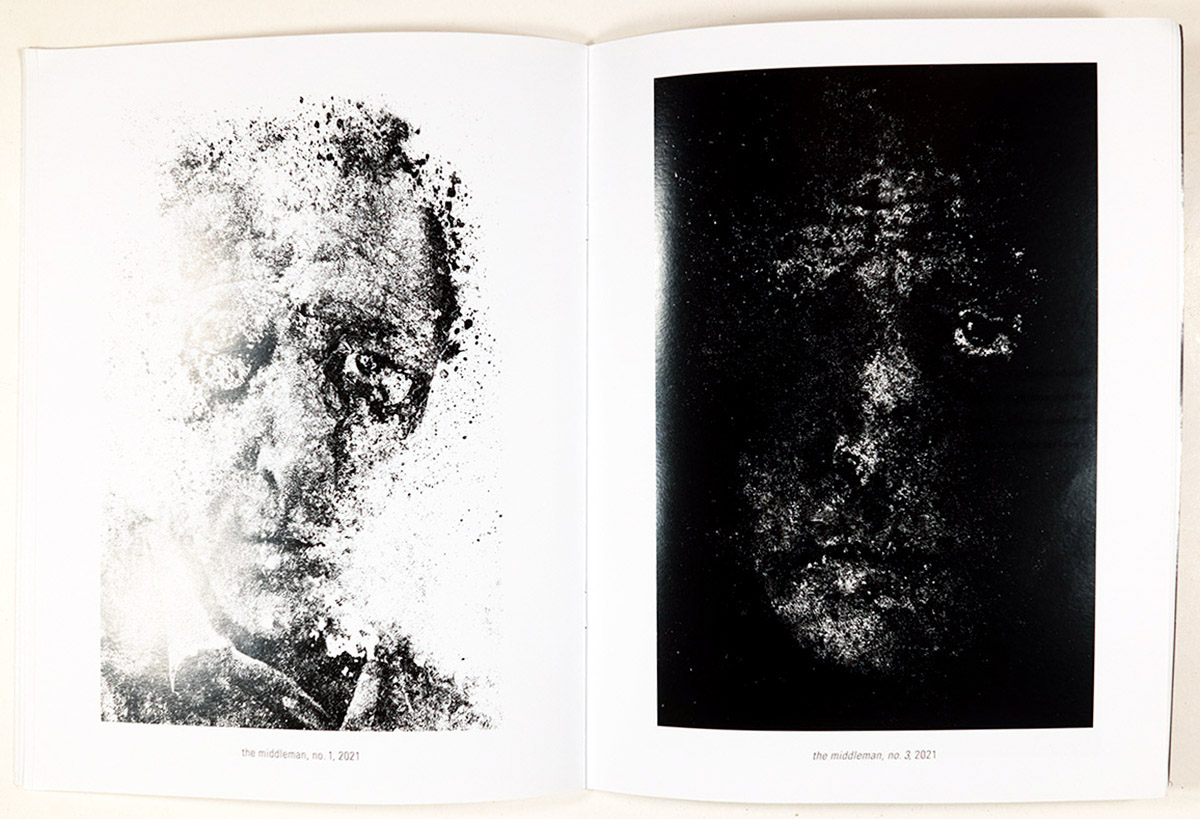
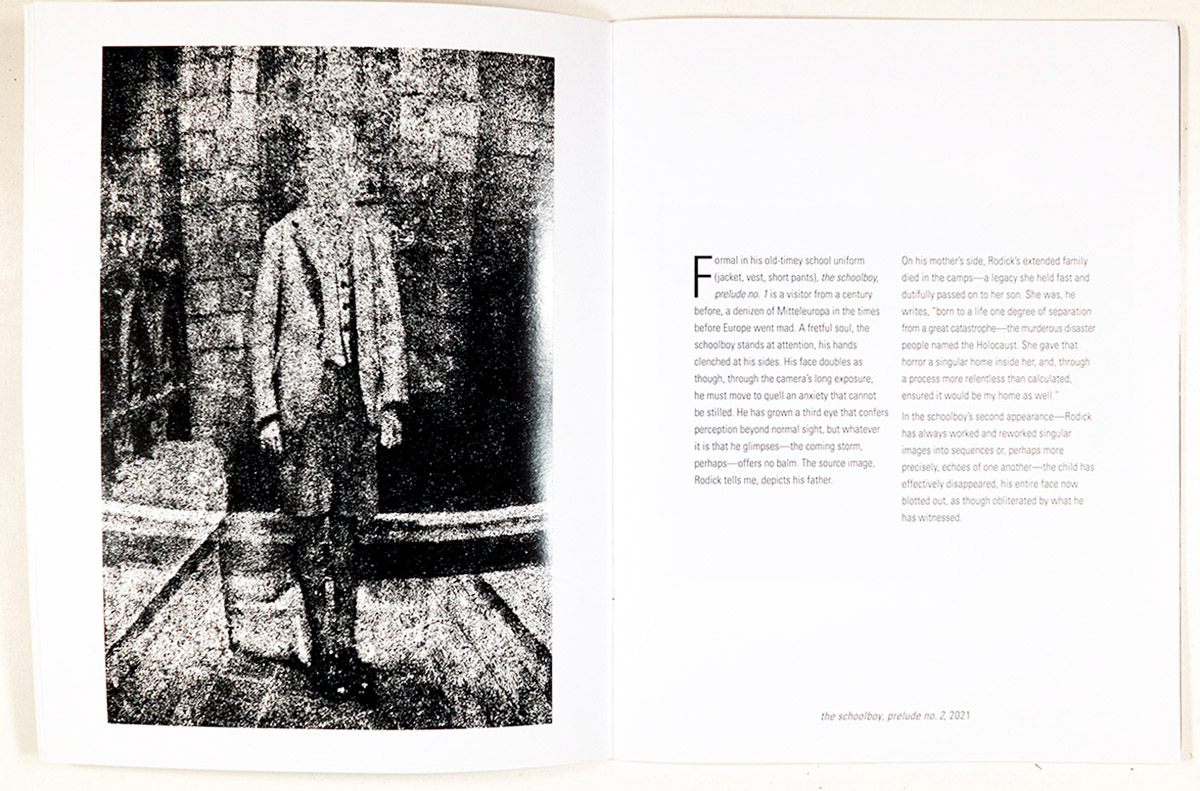
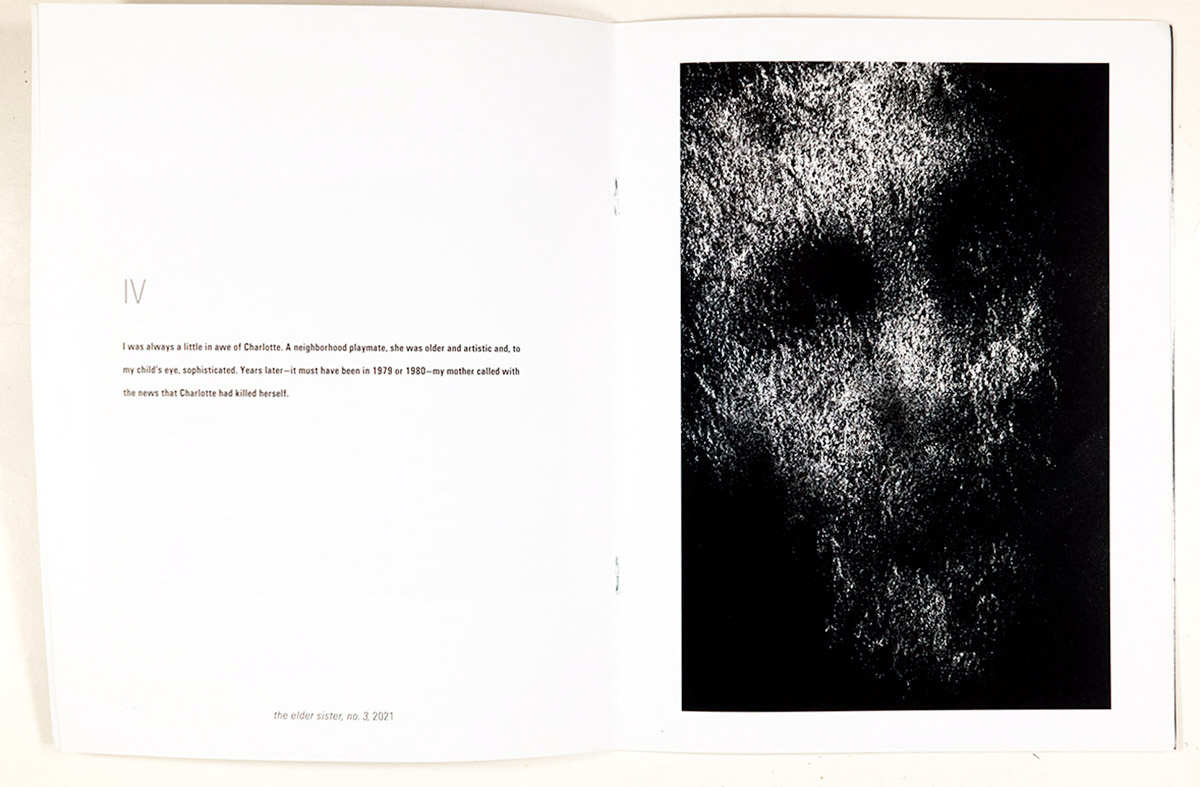
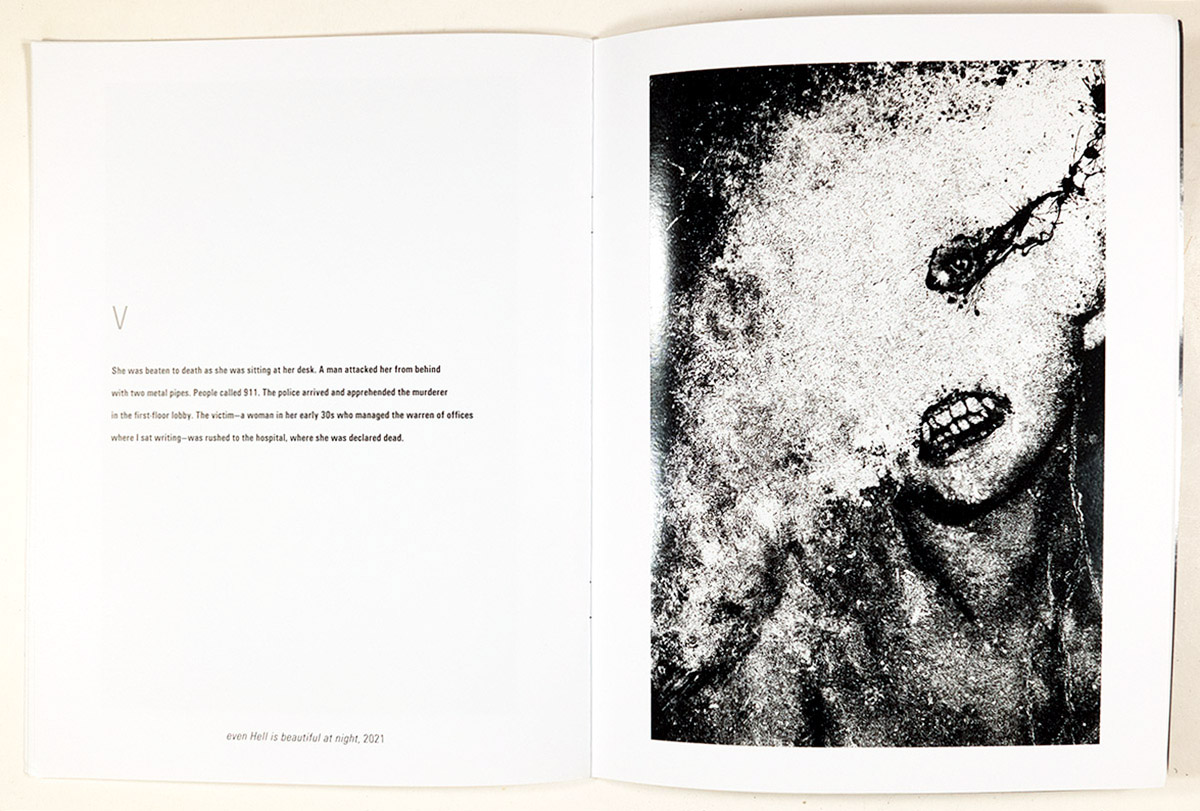
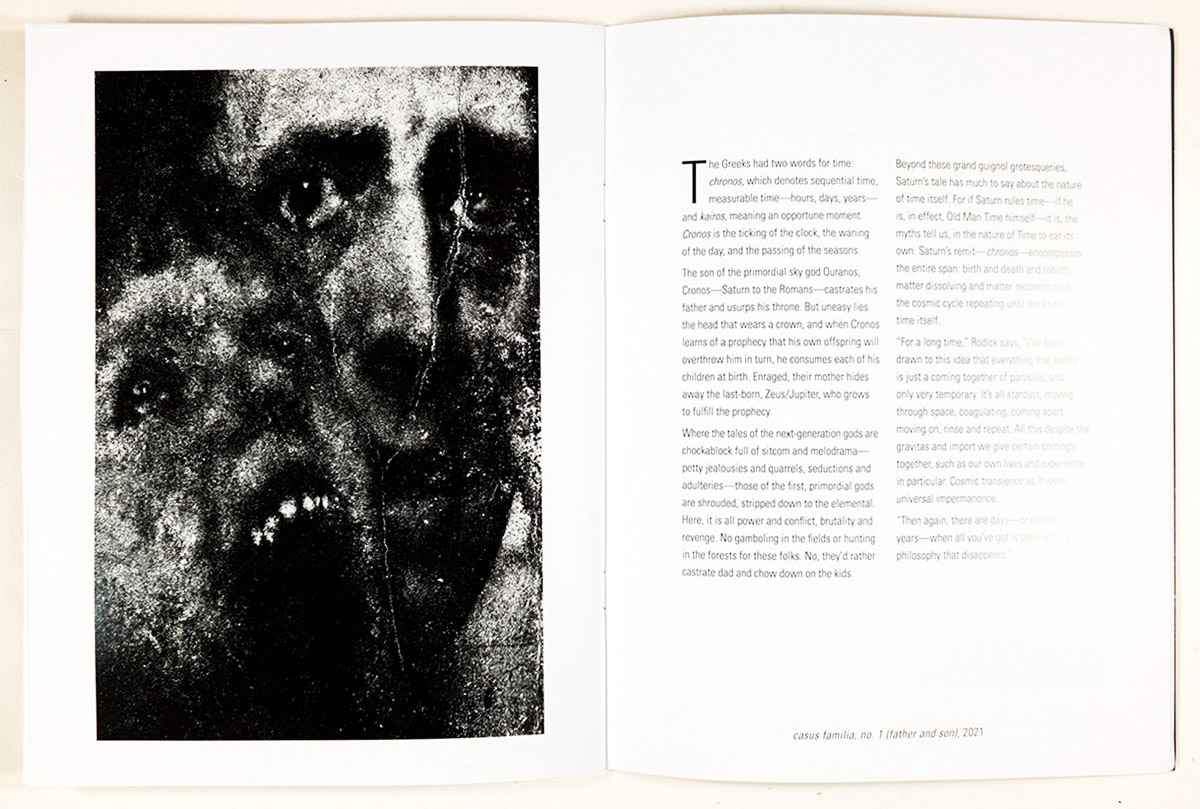
Frank Rodick’s monograph, The Moons of Saturn, has been sitting before me on my desk for quite some time (I will not embarrass myself by revealing just how long) – a testament to its unsettling yet spellbinding mystery. In looking through it, I am reminded of W.G. Sebald’s novel, The Emigrants, the sense of disintegration in these images recalling the working process of the painter Max Ferber. Sebald describes Ferber’s process using such words as annihilation, excavation, exhaustion and continual destruction. His description of Ferbers portraits could, as well be applied to these photographs Rodick has “rescued” from oblivion, portraits
. . . evolved from a long lineage of grey, ancestral faces, rendered unto ash but still there, as ghostly presences, on the harried paper.
I find the images Rodick presents here beyond compelling. A better word might be haunting, or disquieting. We are told in Nancy Brokaw’s commentary that these images are:
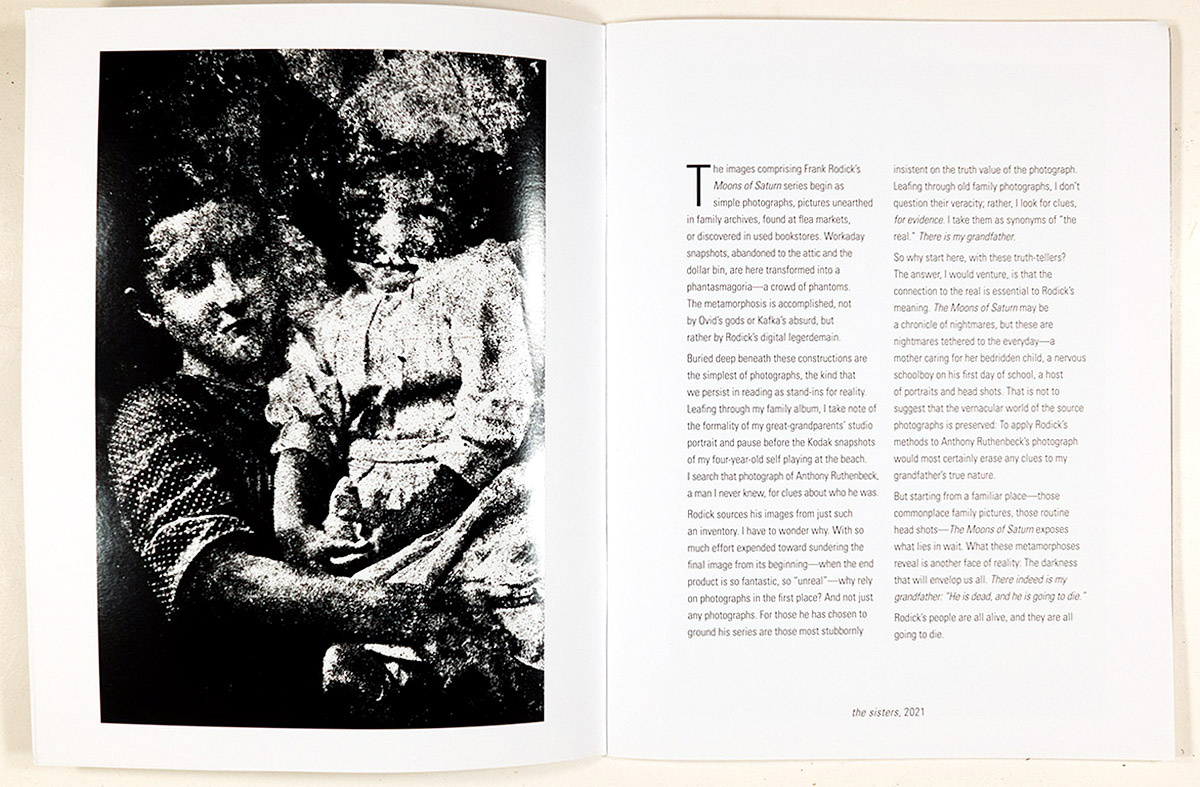
“simple photographs, pictures unearthed in family archives, found at flea markets or discovered in used bookstores . . . snapshots abandoned to the attic and the dollar bin,
which Rodick, through his “digital legerdemain” transforms into a “phantasmagoria – a crowd of phantoms.”
Brokaw’s commentary (writes Rodick in a separate statement sent to me about the work) “evolved from [their] correspondence.” Brokaw’s essays (presented in seven separate fragments distributed through the book) is trenchant and engaging and, I feel, best approached as a correspondence, part of a three-way conversation along with the images themselves and the short, orienting descriptions of the photographic subjects written by Rodick. But there is an enigma central to The Moons of Saturn that the texts and images revolve around: what is at the elusive core, what sets this enigma in motion?
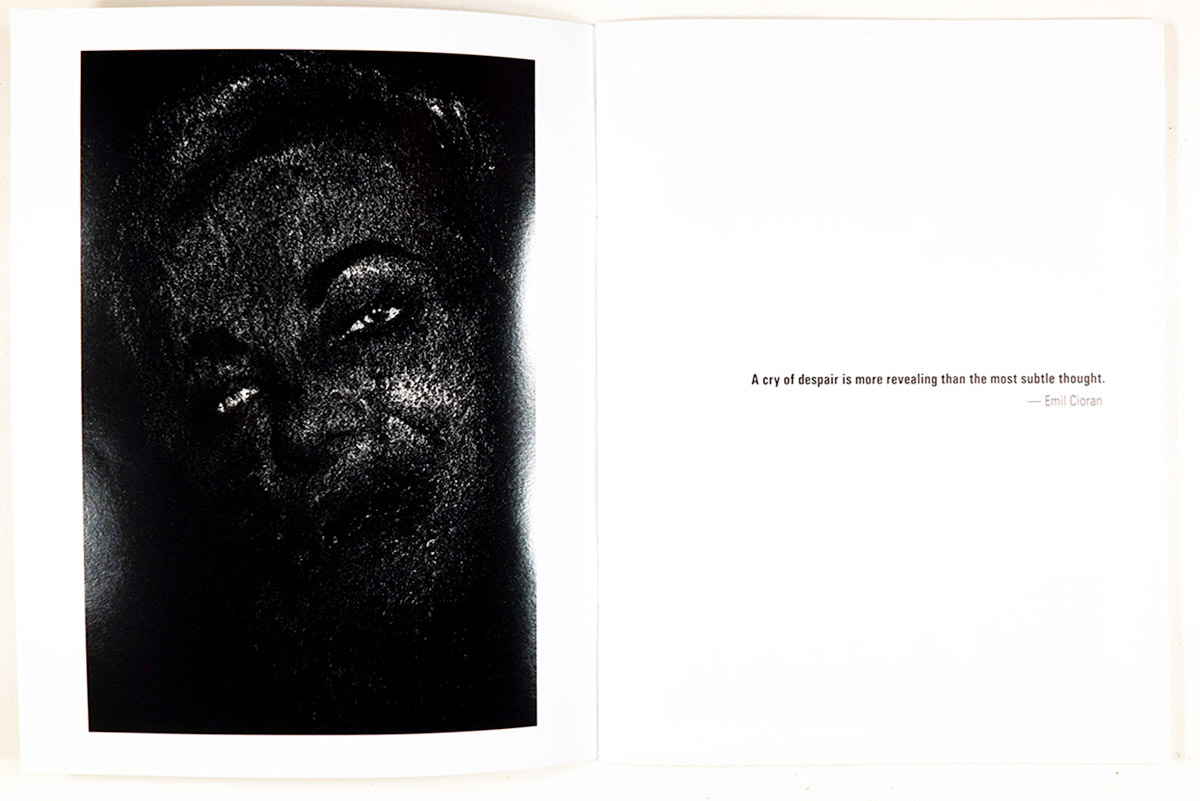
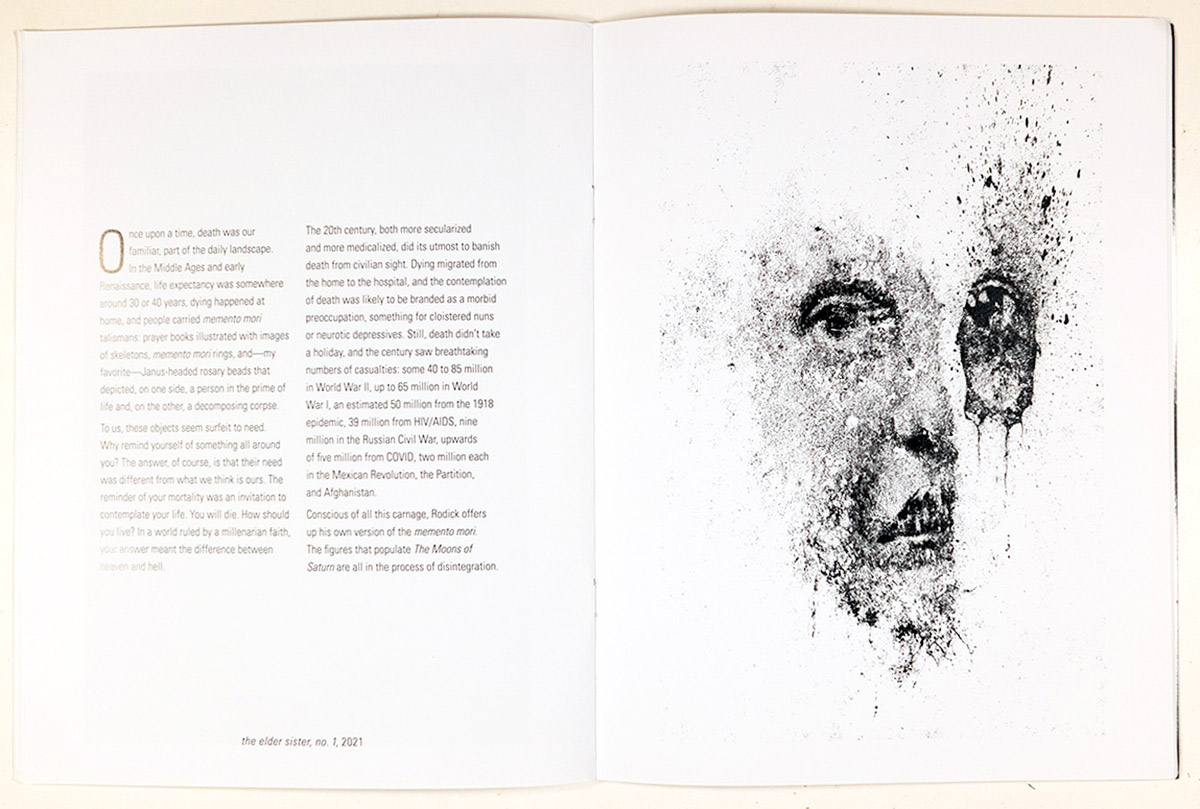
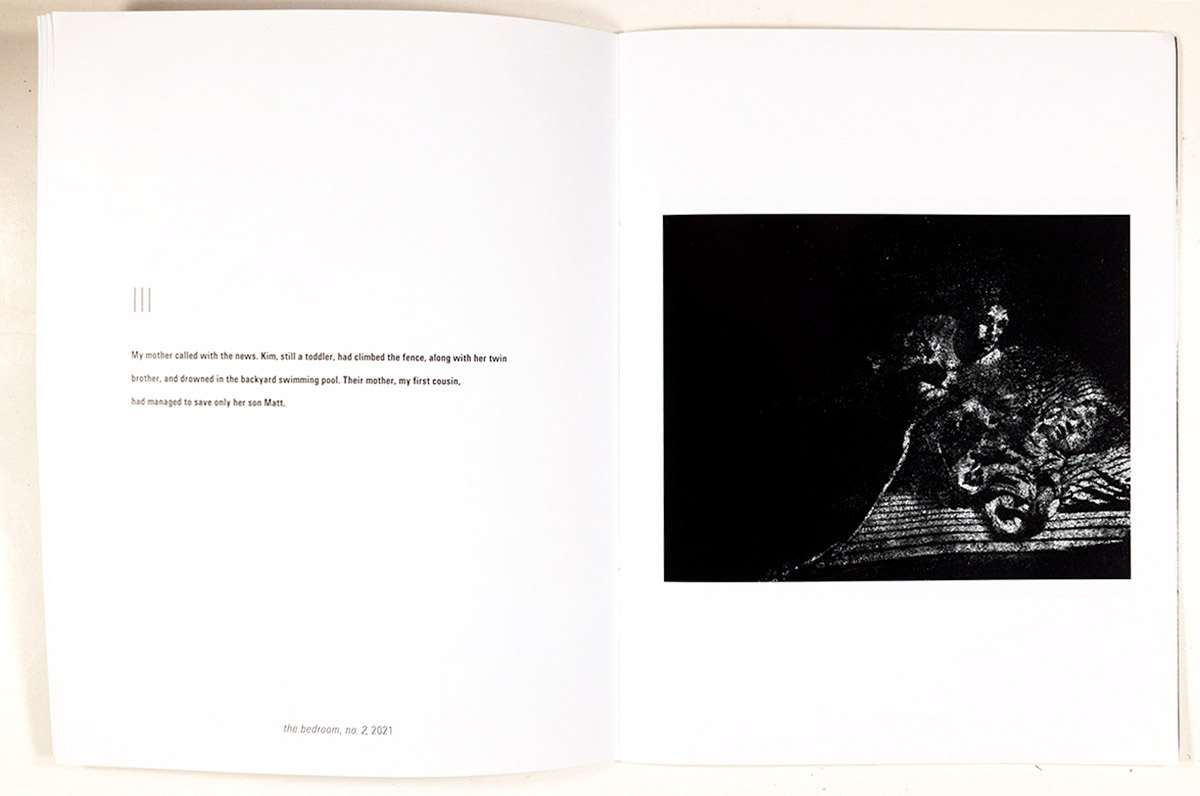
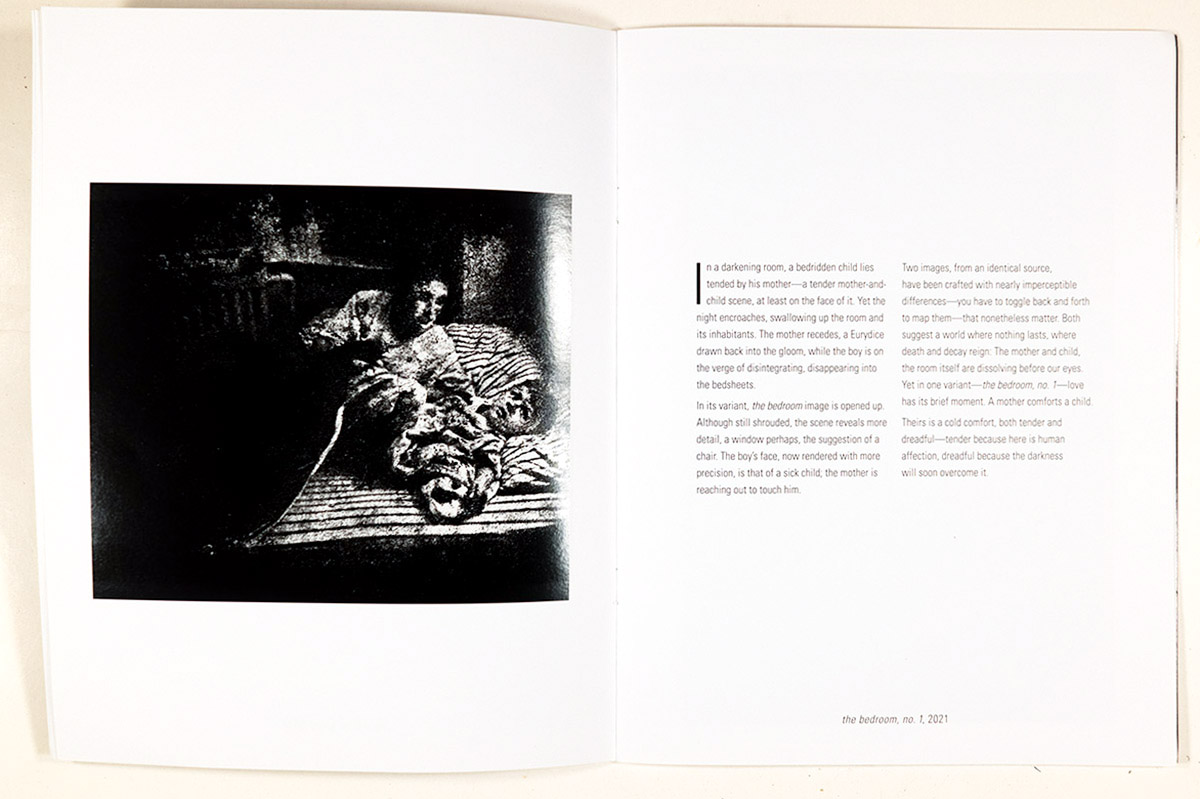
What I’m trying to get at here, is the complexity of how this short book weaves together three separate voices – the images, the biographical fragments and Brokaw’s commentary – which not only intertwine and modify each other, but also revolve, moon-like, around an unknown center. What do these images offer (other than their striking visual beauty) of the subjects photographed? In one respect, precious little, I would suggest, except the silence that imbues any photograph. While Brokaw tells us these images are digitally crafted, they strongly suggest the materiality of film-based photographs enlarged to the point of granular unrecognizability.
Think of Michelangelo Antonioni’s brilliant Blow Up (1966) in which a photographer, believing he has inadvertently photographed a murder, proceeds to enlarge the negative to get at the “truth” within. Rather than finding “the truth value of the photograph” (in Brokaw’s phrase) what he reaches, instead, is a visual indecipherability, a place of frustration and incomprehension. This frustration manifests as attempts to understand what has actually been photographed, what these images and texts orbit around. What is the “truth” at the center?
Visually, the images suggest a form of ruins. Rodick’s brief texts introducing or “describing” the subjects of the images are filled with references to death, decay and loss. Both Rodick and Brokaw tangentially reference the Holocaust in their texts.
The writing of W.G. Sebald is also interspersed with similarly cryptic (but visually quite different) photographic images. In Sebald’s work the Holocaust remains just out of frame, a blind field, which the work – in some ways – revolves around but touches only obliquely. The title The Moons of Saturn recalls Sebald’s The Rings of Saturn (Rodick, in a private correspondence, has acknowledged this connection to Sebald). One of the epigraphs Sebald gives to The Rings of Saturn is from the Brockhaus Encyclopedia and reads:
The rings of Saturn consist of ice crystals and probably meteorite particles describing circular orbits around the planet’s equator. In all likelihood, these are fragments of a former moon that was too close to the planet and was destroyed by its tidal effects . . .
The moons of Saturn, then, risk destruction and fragmentation, a shattering into particles that nonetheless continue to “describe[e] circular orbits . . . “
Physically, the book (published in partnership with The Photo Review [2023]) presents magazine-like, softcover with a saddle stitch binding, 8 ½ x 11 inches. Its 32 pages contain 16 plates as well as the text by Nancy Brokaw. The book’s fragility, in a sense, echoes the fragility of the fragments and bodies circling Saturn.
The planet Saturn is often described as a “gas giant” with a solid, rocky core (though without definite surface) enveloped by hydrogen and helium. Around Saturn rotates its rings of shattered debris as well as (at least) 146 moons, each describing its own unique path around this giant, ephemeral sphere. The planet remains an unsolvable mystery as distant, unreachable & unfathomable as Titan, Rhea, Iapetus or any of its moons.
And like the moons of Saturn, as viewers of the disintegrating, impenetrable images Rodick presents us, we are endlessly drawn in to a place of seeing but not knowing, hovering on the surface of the impenetrable. Who are these people rescued from oblivion, preserved only to yet remain inaccessible in the photographic void? Rodick gives us a kind of aposiopesis, an inability (or unwillingness) to proceed further, leaving out what is most important and quite likely unknowable. At the center then we are confronted with what is not there, absent yet somehow still remaining. The mystery at the center of photography.
____
Steve Harp is a Contributing Editor and Associate Professor The Art School, DePaul University.
____
The Moons of Saturn, Frank Rodick
Photographer: Frank Rodick; born in Montreal, Quebec and currently resides in Toronto, Ontario
Publisher: The Photo Review, Langhorne, PA; copyright 2023
Essays: Nancy Brokaw
Text: English
Softcover with saddle-stitch binding. Printed by Brilliant Graphics, Exton, PA.
Book design: Jodee Winger
____

Articles & photographs published on PhotoBook Journal may not be reproduced without the permission of the PhotoBook Journal staff sand the photographer(s).
 PhotoBook Journal
Leave a comment