Review by Brian F. O’Neill •
There are some books that just grab you. They demand your attention. There are others that seem to scream for attention, but their images and production might let you down. Often, we call the pictures in such books cliché. We don’t need to name the books. Just quietly think to yourself the most recent one you have seen. You know, to be respectful.
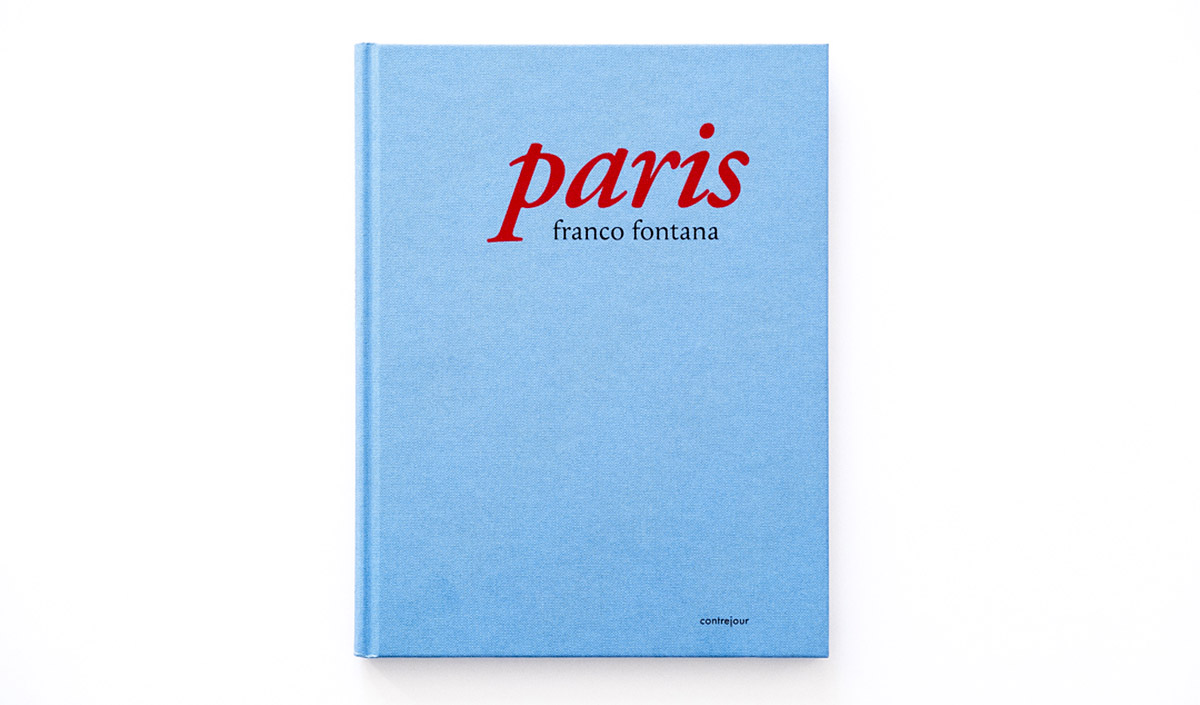
Recently, at the excellent Artazart along the Canal St. Martin in Paris, I was overwhelmed with the stock of art, design, and photography books. Some I had seen before – the better-known catalogue type coffee table books of the graphic colorists Saul Leiter and Harry Gruyaert. Virtually every bookstore I visited in Paris, and I visited a few, had copies of numerous titles like Morocco, Unseen Saul Leiter. Artazart has many lesser known artist books of all sorts though, from black and white to color, to books of cyanotypes and more. I visited once. Then I visited again. Not the next day, but a few days later. I needed time to process things. Furthermore, and perhaps most importantly, they had a great deal of stock here that did not seem to yet exist, if ever it will, in the American or British markets. It’s difficult enough to find a book in my hometown of Phoenix, Arizona, let alone such a diverse selection. Upon my return I weighed my options, and then, I did a very cliché thing, a bought a book titled Paris. I hemmed and hawed in the store about this. I thought to myself: The proprietor will already detect my accent, then they will see me with this book. Oh, how they will whisper in hushed tones about the cultureless American who bought a book about Paris in Paris. As I went to the register, they asked me if it was a gift. I responded that it was not. They then proceeded to wrap in cellophane. All the better for protection. As it turned out, this was just the little gift, even if to myself, that has so far been my new favorite of this still young year: Franco Fontana’s Paris.
An Italian, photographing Paris? I was intrigued from the first pages, and even more so by the sequence of wonderful, color images the book contained, and composed in a style that seem strangely out of sync with much contemporary color photography.
Paris was published by Contrejour in 2023, a Paris (originally in Montparnasse) based photography book publisher. The book contains 88 pages and goes for 35 euros and is worth the money as it is a nicely printed offset edition. The title of the book is embossed on blue board making up the covers. The design of the book overall might be described as understated, once again separating itself from the enormous amount of linen wrapped fine art photography books. Only Artazart wraps it in cellophane on demand.
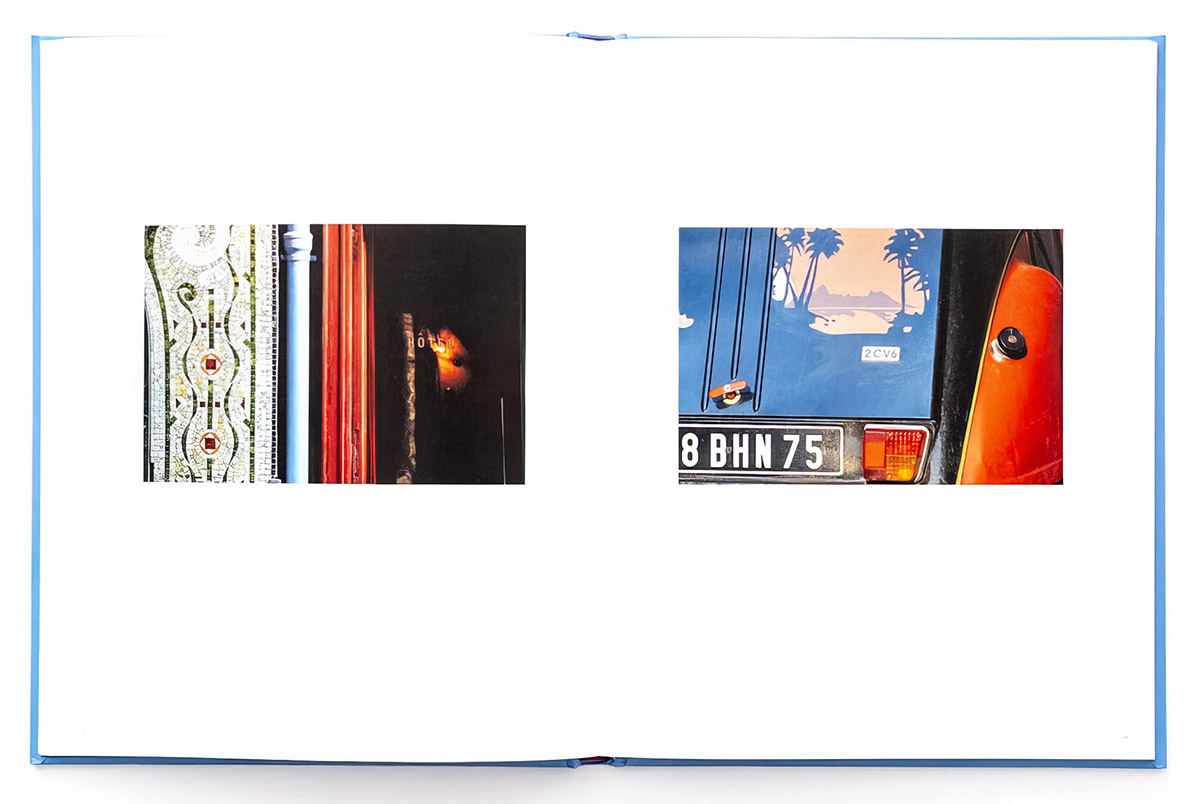
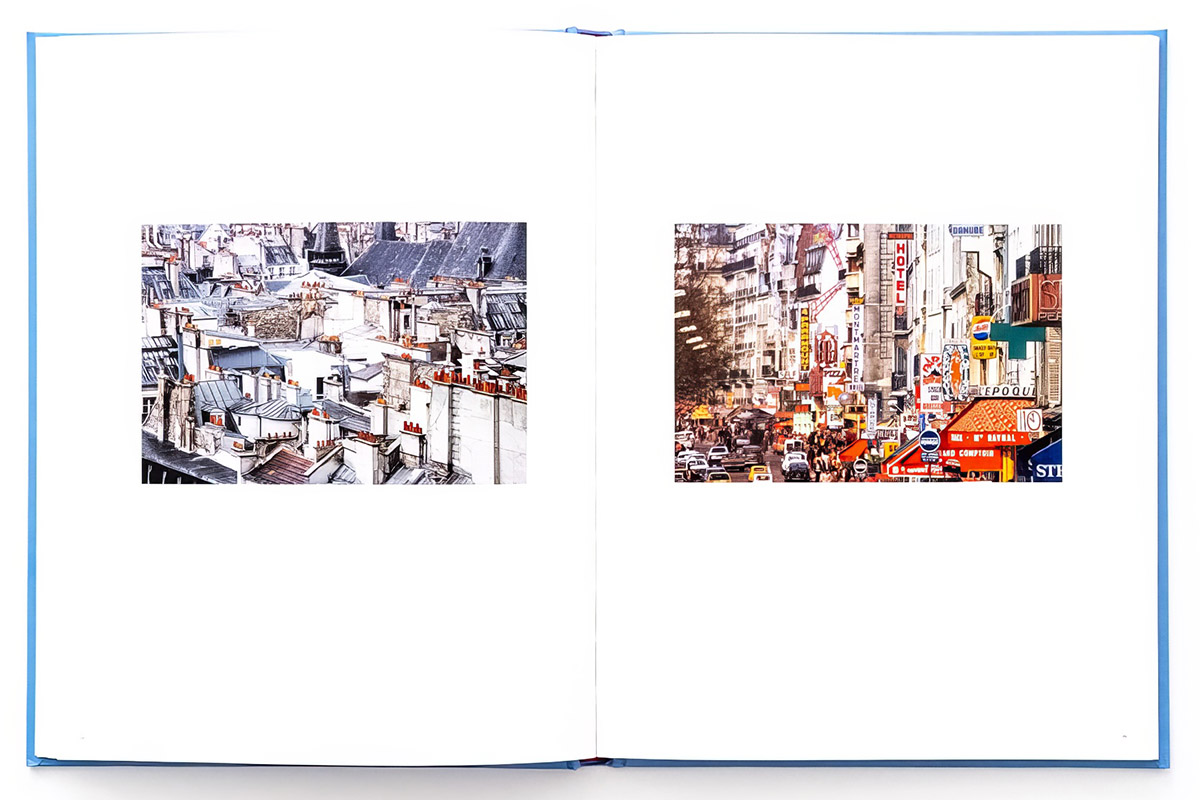
Reading the book is a visual pleasure, but it is not cliché. You might see bridges, boulevards, and beaux batîments, but only through the singular vision of Fontana. The sequencing of the book is largely organized by color and form. This does not occur in so much of an obvious thematic order, but Fontana prioritizes the interaction of facing pages. The decaying red and white façade of the Rue Piat plays off the vertical red piece of building material amidst a façade of blue, white, and gray. In a later sequence, telephoto shots of the visible density, even business of Paris are juxtaposed together – on the left the blue-gray rooftops accented with the terracotta pipes and shingles, and on the right we see an older image of Montmartre’s Pigalle district with a distant Moulin Rouge. Even here though, while nearly every tourist, including myself, takes an image of the famous red windmill, here Fontana subverts expectations and constructs a striking image of Paris.
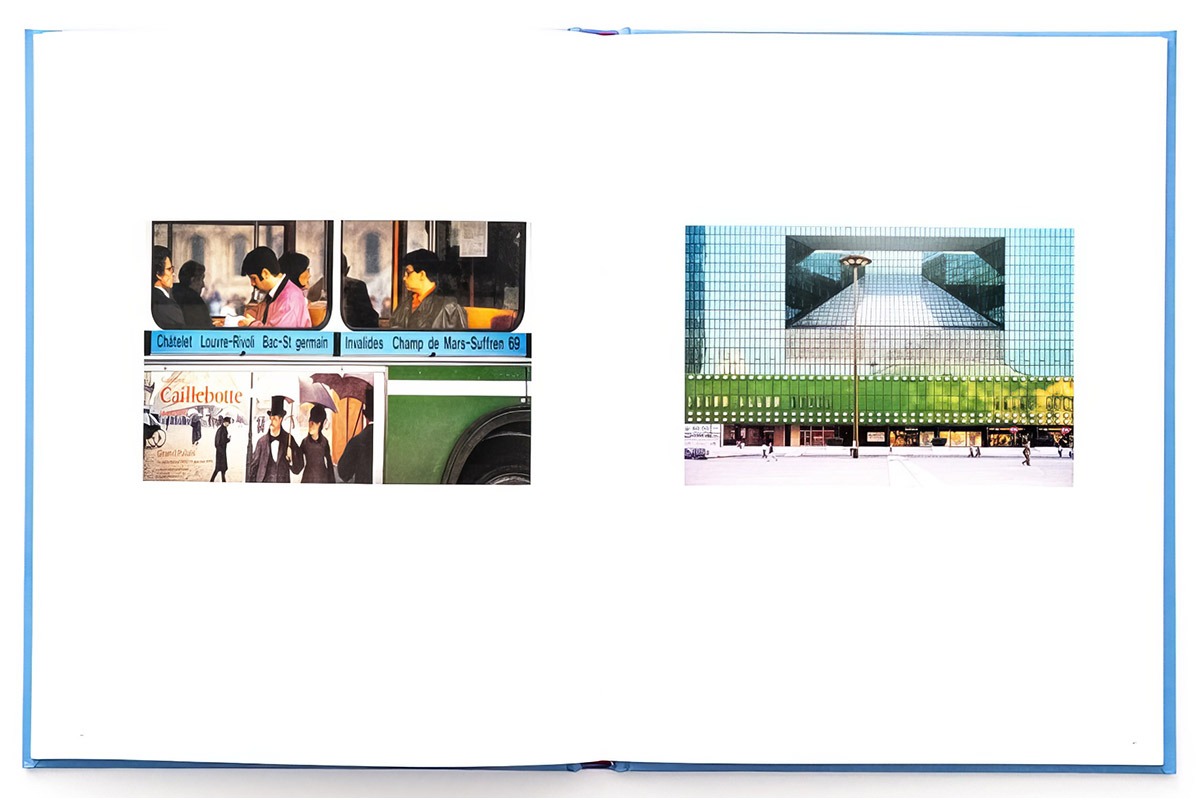
The use of color is, perhaps evidently, central, in this unique “street photography.” Quite literally, we are getting things on the street, as the details of the back end of a colorful blue and red Citroen car play off a blue and red paint job on a hotel. Color meets form in a number of striking image-pairings as well, where Fontana uses the telephoto lens in surprising ways. However, and quite importantly, as clearly Fontana’s concern is color and form in the Parisian landscape, Fontana’s method of using the telephoto lens is not at all like other contemporaries such as Beat Strueli (known for his 200mm street portraits). Instead, Fontana, in a way, takes a step back, and uses the telephoto lens to abstract the conjunction of the built environment with human activity, emphasizing the busy conviviality of the city, whether with abstractions of Parisian buses or gatherings outside shopping malls or other buildings. At the same time, another incredible virtue of this book is that the viewer/reader can never pin down Fontana. With each spread, one doesn’t know what to expect. He uses the telephoto lens in one sequence, then a wide, perhaps 28mm lens in the next. Similarly though, his concern with visual juxtaposition and a combination of complex line structure, color, and even texture provide a unique visual take on Paris, and one that is certainly quote beyond the typical books you may know of Paris (couples kissing, bridges, etc.).
And so, the sequence never grows tired. The organizing devices aforementioned may seem simple, but the sheer variety of technique, colors, and locations in the book keep you guessing. What you experience is the pleasures of the visual plane as composed so carefully by Fontana.
Furthermore, while Fontana is obviously concerned with color, I find that his images are especially concerned with the relationships of line and shape within the frame, a feature sometimes lost in much color photography, let alone contemporary color photography. In this regard, the clearest parallel that I am able to draw is with that of fellow Modena photographer Luigi Ghirri. Like Ghirri, there a fascinating combination of the joy of seeing and a real rigorous mode of working with photography that is evident. The images always make you stop and look again, whether from the expression of color, the interplay of lines on nearly gray building facades, or the human form, close up, or at a great distance in aspective view.
In reading the text that opens the book (French and Italian), the reader will find that the narrative speaks of “a day in Paris,” but again, its emphasis the joy of seeing, of walking, of being in the world, just as the images themselves so suitably suggest. And furthermore, we discover that this book represents roughly 50 years of work! This is truly one of the great achievements of Fontana’s Paris. While a few of the images were a bit out of focus where clearly Fontana was drawn to some pop of color on a moody Parisian day (of which there are many) or in the depths of the subway and therefore struggling to achieve a suitable shutter speed, it was very difficult to detect any technical imperfection across the pictures. In a few others we can see the effects of a 1970s or 80s telephoto lens, but the continuity in color, tonality and overall presentation of the images is remarkable. No doubt there are even some digital images here. Paris is a life’s work, and not only does the viewer receive the import of Fontana’s vision with this book, but furthermore is inspired by the commitment to photography required, as Paris expresses Fontana’s intrepid nature spanning time, space, and technologies.
____________
Brian F. O’Neill is a photographer and sociologist.
____________
Franco Fontana – Paris
Photographer: Franco Fontana (from Modena, Italy)
Publisher: Contrejour, Biarritz, France; © 2023
Texts: Franco Fontana
Languages: French and Italian
Hardcover, 88 pages, color; 20.5 × 26.5 cm; ISBN 979-10-90294-59-2
Designer: Gauvin Jean-Baptiste
____________




Articles and photographs published in the PhotoBook Journal may not be reproduced without the permission of the PhotoBook Journal staff and the photographer(s). All images, texts, and designs are under copyright by the authors and publishers.
 PhotoBook Journal
Leave a comment